Bakhrushin, Aleksey Aleksandrovich ( January 31 [ February 12 ] 1865 [1] - June 7, 1929 ) - a Russian merchant, a hereditary honorary citizen , manufactory adviser , philanthropist, collector of theatrical antiquity, creator of a private literary and theater museum.
| Alexey Alexandrovich Bakhrushin | |
|---|---|
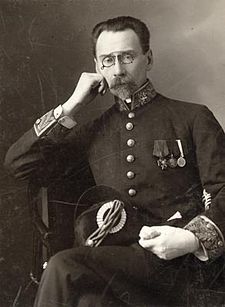 Alexey Alexandrovich Bakhrushin | |
| Date of Birth | January 31 ( February 12 ) 1865 |
| Place of Birth | |
| Date of death | June 7, 1929 ( 64) |
| A place of death | |
| Citizenship |  Russian Empire → Russian Empire →  the USSR the USSR |
| Occupation | merchant, philanthropist, creator of the museum |
| Father | |
| Children | |
Content
- 1 Biography
- 1.1 Youth
- 1.2 Family
- 1.3 Collecting
- 1.4 Museum
- 1.5 Death
- 2 Literature
- 3 notes
- 4 References
Biography
Youth
Born in Moscow in the family of a merchant Alexander Alekseevich Bakhrushin ; had two older brothers - Vladimir and Sergey , and three sisters - Claudius, Vera and Mary. From an early age, his parents instilled in him a love of art and theater. His grandfather Alexei Fedorovich wrote poetry, his father was fluent in foreign languages. Many relatives were fond of collecting. Bakhrushins were famous benefactors in old Moscow. From the age of six, the future connoisseur of theatrical antiquity became a regular at the Bolshoi Theater, then became an admirer of the Maly Theater troupe, and later he tried to play on the stage of the Perlovsky Theater Circle.
It is known that in 1876-1879, Alexey Bakhrushin studied at a private gymnasium of F. Kreiman (III — IV grades). In 1888 he joined the family business - “The Association of Leather and Cloth Manufactory Aleksey Bakhrushin and Sons” and until 1890 he was actively engaged in commercial and industrial activities. Carried away by collecting, Bakhrushin devoted more and more time to him and gradually retired. However, after the death of his older brother, he was forced to lead, until 1917, a family business. For his industrial achievements, he was awarded several gold medals and the Order of St. Anne of the 3rd degree.
An important aspect of his activity was also public: a member of the Moscow Exchange Society, a member of the Council of the Russian Theater Society, an honorary member of the Council of the Yakiman City Guardianship of the Poor, a member of the Board of the Bakhrushin Brothers Hospital and Maternity Hospital.
He was also the vowel of the Moscow City Duma (1900-1916), in which he headed the commission for public entertainment. The commission decided to open 12 national houses in Moscow, which A. A. Bakhrushin was authorized to manage in 1915. The first people's house, which opened in December 1904 - Vvedensky - Bahrushin was in charge since 1906; through his efforts, a permanent theater group was created in it, in which Ivan Mozhuzhin worked.
In 1904-1913, the Bakhrushin family rented a cottage of N. D. Teleshov in Malakhovka , where a gymnasium was created on the initiative and with the financial participation of A. A. Bakhrushin. In May 1913, Bakhrushin became the owner of his own estate near Moscow: a well-equipped manor house Afineevo was bought in Vereisk district . Reconstruction of the manor house in it was carried out by I. E. Bondarenko . In 1916, the house burned down and the Bakhrushins rented a summer house nearby - in the village of Maly Gorki .
Family
Wife: Vera Vasilievna Nosova (1875-1942), daughter of the merchant V. D. Nosov . The wedding took place on April 19, 1895 in the temple of the Life-Giving Trinity in Tanners .
Children:
- Yuri (1896-1973), ballet historian
- Alexander (1902-1905)
- Kira (1906-1968), in the marriage of Semin.
Collecting
He began to collect under the influence of a cousin, a passionate collector Alexei Petrovich Bakhrushin . “The collecting interests of the people who were with Alexei Petrovich were transferred to him - he wanted to collect what, why, how - it makes no difference, but to collect - to study and create a serious interest in life,” wrote his son Yuri Bakhrushin later.
Initially, Aleksei Aleksandrovich collected "eastern rarities" and relics of the Napoleon era. Once in the company of youth, a cousin of Aleksei Aleksandrovich S.V. Kupriyanov boasted of all kinds of theatrical relics he had collected - posters, photographs, souvenirs bought from antique dealers. This incident led Alexei Bakhrushin to the main business of his collecting activities:
“Soon theatrical gathering,” his son recalled, “became his passion. The people around looked at it as a whim of a rich tyrant, made fun of him, offered to buy a button from Mochalov’s trousers or Shchepkin’s boots. ”
On May 30, 1894, the owner first showed his theatrical collection to his closest friends, and on October 29 of the same year presented it for viewing to the Moscow theater community. From this day the biography of the first Moscow literary and theater museum began.
Museum
Among the numerous collectors of his time, Aleksei Aleksandrovich Bakhrushin was distinguished by independence in his search. He was not content with what merchants or other rarity collectors were offering. “To collect only through antique dealers,” he said, “without searching for himself, without being deeply interested,“ the occupation is empty, uninteresting, and if you collect antiquity, it is only subject to a deep personal interest in it. ” Bakhrushin possessed such a personal deep interest in the relics of theatrical life to the highest degree. He purposefully conducted searches to present in his collection the whole history of the domestic theater, from its origin to the present.
The collector once a week was sure to visit Sukharevka , often visited the antique shops of N. G. Afrikanov and V. I. Lekatto, regularly corresponded with St. Petersburg antiquaries M. M. Savostin. Thanks to Savostin, he acquired many relics of St. Petersburg theaters, in particular, received the archive of the actor and theatrical collector I.F. Gorbunov .
In search of exhibits, Aleksei Aleksandrovich Bakhrushin more than once made long trips around Russia, from which he brought not only theatrical rarities, but also works of folk art, furniture, old Russian costumes.
When traveling abroad, Aleksei Aleksandrovich certainly went around antique shops. At the beginning of the XX century. three times he made special trips to supplement sections on the history of Western European theater. From abroad, he brought the personal belongings of the French actress Mars , a collection of masks of the Italian comedy theater, many rare musical instruments.
One of the main sources of replenishment of the collection was gifts. According to the antiquarian M. M. Savostin, the “Leading Brotherhood” liked Bakhrushin’s idea of creating a theater museum so much that many people “sent him without a fee and duty free” rare photographs, autographs, memorial items. The influx of gifts was also facilitated by the Bakhrushinsky Saturdays, which gained considerable popularity in theatrical circles of Moscow. Famous actors and directors gathered for Bakhrushin’s “light”: A. I. Yuzhin , A. L. Lensky , M. N. Ermolova , G. N. Fedotova , F. I. Chaliapin , L. V. Sobinov , K.S. Stanislavsky , V.I. Nemirovich-Danchenko . By tradition, they didn’t come here empty-handed. So, the famous actress of the Maly Theater Glykeria Nikolaevna Fedotova transferred to Bakhrushin all her relics and memorable gifts received over the years of stage life.
Alexei Bakhrushin called his museum literary and theatrical. In his vast and diverse collection, three sections were distinguished - literary, dramatic, and musical.
In the literary section, rare editions of the plays of Y. B. Knyazhnin , A. P. Sumarokov , A. S. Pushkin , A. S. Griboedov , N. V. Gogol , and A. N. Ostrovsky were collected. Of great interest were works on the history of the theater, theater almanacs, magazines, and collections. Here were letters, notebooks, diaries of famous figures of national culture: A. S. Griboedov , I. I. Lazhechnikov , M. M. Kheraskov , N. V. Gogol , A. N. Verstovsky , A. F. Pisemsky , P A. Karatygin , N. G. Pomyalovsky . The collection of manuscripts included over a thousand titles.
In the drama section, scenery, posters and programs, portraits and sculptural images of actors and playwrights, objects of theatrical life were collected. Among the works of decorators, the works of two major theater artists of the late XIX - early XX century were stored. - K. A. Korovin and A. Ya. Golovin . There were also folk pictures with images of "demonic fun."
Of particular value were the personal belongings of many illustrious actors, in particular V.N. Asenkova , A.P. Lensky , M.S. Shchepkin , the famous entrepreneur and actor P.M. Medvedev . Bakhrushin had the full furnishings of the cabinet of V.F. Komissarzhevskaya , the dressing room of K.A. Varlamov . The highlight of the collection is a collection of ballet shoes from the time of Taglioni to Pavlova . And also offerings to the actors: anniversary wreaths, greeting ribbons, addresses, benefit gifts. In the dramatic section, there was also a portrait gallery, amazingly rich: here there are drawings, prints, lithographs, paintings and sculptures, a large collection of photographs, not only individual portraits of actors, but also a large number of scenes from performances captured by photographers.
Theater life is represented by objects accompanying inveterate theater-goers, including a unique collection of spectator tubes and theater binoculars. The music department consisted of instruments from different times and peoples: the Slavic harp , the Romanian kobza , the European mandolin , the Chinese flute and even African pipes .
The Bakhrushin assembly has become widely known. He was approached by scientists, theater historians, publishers, directors. And everyone got the necessary materials and advice here. Alexey Alexandrovich presented his collection at exhibitions more than once on the anniversary of P. S. Mochalov (Moscow, 1896), the World Exhibition in Paris (1900), the First Russian Theater Exhibition in St. Petersburg (1908), and the Second Russian Theater Exhibition in Moscow (1909) . When the 150th anniversary of the Russian theater was celebrated in Yaroslavl in 1899, the exhibition prepared for this anniversary comprised almost a third of the exhibits of the Bakhrushin collection.
The museum was housed in the owner’s mansion on Luzhnetskaya Street , built in 1896 by the architect K.K. Gippius . Even when laying the house, the owner provided three semi-basement large rooms for placing collections. However, when the construction was completed and the museum rooms were filled with exhibits, then soon all the other rooms of the basement were overwhelmed with theatrical antiquity. “Then it came to the residential top, which was gradually turning into a museum,” the collector’s son recalled, “then service and utility rooms began to curl up, followed by children's apartments, a corridor, a pantry, and, finally, even a stable and a horse-drawn barn were occupied. At the same time, one should not forget that since 1913, my grandfather put at the disposal of his father a neighboring house, where I was once born, and he was also full of things, books and other materials. ”
The faithful assistant in collecting activity of Alexey Alexandrovich Bakhrushin was his wife Vera Vasilievna. She put in order newspaper clippings, posters, programs, helped to select things for exhibitions, to arrange expositions.
Bakhrushin's collection became so extensive that the owner began to think about his future fate. Alexey Alexandrovich wanted to make it the property of Moscow. “As a vowel of the Duma, he proposed transferring his museum to the ownership of Moscow City Government. But the venerable fathers of the city, only having heard about it, began to dismiss this misfortune in every possible way. "What do you?! The Tretyakov and Soldier’s congregations sipped enough grief. And here you are still with yours! Fire me, for Christ’s sake! .. “Father was desperate - a huge meeting, already then worth hundreds of thousands, offered free of charge to state institutions, turned out to be useless to anyone. It turned out to be impossible to break the official inertness, ”recalled Yu. A. Bakhrushin .
Fortunately, in 1909, the Academy of Sciences became interested in the Bakhrushin collection. On November 25, 1913, a solemn act of transferring the meeting of the Academy of Sciences took place. The Museum Board was created, headed by a donor, who was recognized as a lifetime honorary trustee of the museum. In 1915, the donor was awarded the Order of St. Vladimir of the 4th degree.
The museum, created by Alexei Alexandrovich Bakhrushin, still exists (Bakhrushin St., 31/12). It, as before, is located in an old building. This is one of the few collections of old Moscow that has survived to this day.
Death
Alexey Alexandrovich Bakhrushin remained at the head of the museum after 1917 , until his death. Bakhrushin died in the Malyi Gorki estate near Moscow near Aprelevka station in the Kiev direction of the Moscow railway on June 7, 1929. He was buried at the Vagankovsky cemetery .
Literature
- Bakhrushin Yu. A. Memoirs. - M., 1994
Notes
- ↑ Bakhrushin // Discover Moscow - Mos.ru
Links
- Encyclopedia of the Russian Merchants , okipr.ru (Retrieved August 15, 2016)
- Bahrushin
- “Alexey Alexandrovich Bakhrushin” , cultcalend.ru (Retrieved March 16, 2009)