In modern physics, the electromagnetic potential usually means the four-dimensional potential of the electromagnetic field , which is a 4-vector ( 1-form ). It is in connection with the vector (4-vector) nature of the electromagnetic potential that the electromagnetic field belongs to the class of vector fields in the sense that is used in modern physics with respect to fundamental bosonic fields (for example, the gravitational field is in this sense not a vector, but a tensor field )
- The electromagnetic potential is most often indicated. or , which implies a quantity with an index having four components or , and the index 0 usually denotes the temporary component, and the indices 1, 2, 3 - three spatial. In this article we will adhere to the first notation.
- In modern literature, more abstract notation can be used.




In any particular inertial reference frame, the electromagnetic potential breaks up [1] into a scalar (in three-dimensional space) potential and three-dimensional vector potential ; these potentials and - and there are those scalar and vector potentials that are used in the traditional three-dimensional formulation of electrodynamics. In the case when the electromagnetic field does not depend on time (or the speed of its change in a specific problem can be neglected), that is, in the case (approximation) of electrostatics and magnetostatics , the electric field intensity is expressed in terms of , called in this case the electrostatic potential , and the magnetic field strength ( magnetic induction ) [2] - only through the vector potential . However, in the general case (when the fields change over time), the vector potential also enters the expression for the electric field, while the magnetic potential is always expressed only through the vector potential (the zero component of the electromagnetic potential does not enter this expression).





The relationship of stresses with electromagnetic potential in the general case is as follows in traditional three-dimensional vector notation [3] :
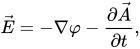

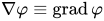
Where - electric field strength, - magnetic induction (or - that in the case of vacuum, essentially the same thing - magnetic field strength), - the operator is nabla , and Is the gradient of the scalar potential, and - rotor of vector potential.



In a somewhat more modern four-dimensional formulation, these same relations can be written as an expression of the electromagnetic field tensor in terms of the 4-vector of the electromagnetic potential:

Where - electromagnetic field tensor whose components are components .


The above expression is a generalization of the expression of the rotor for the case of a four-dimensional vector field.
When moving from one inertial reference frame to another, the components are transformed, as is characteristic of the components of a 4-vector, by means of Lorentz transformations .
Physical meaning
The physical meaning of the four-dimensional electromagnetic potential can be clarified by noting that when a charged particle [4] (with electric charge q ) interacts with an electromagnetic field, this potential gives an additive to the phase particle wave function :
- ,
or, in other words, the contribution to the action (the formula differs from the one written above only by the absence of a factor , but in the system of units, where - just coincides with her). A change in the phase of the wave function of a particle is manifested in a shift of the bands when observing the interference of charged particles (see, for example, the Aaronov-Bohm effect ).
The physical meaning of electric and magnetic potentials in the simpler special case of electrostatics and magnetostatics, as well as the units of measurement of these potentials are discussed in the articles Electrostatic potential and Vector potential of the electromagnetic field .
See also
- Electrostatic potential
- Vector potential
Notes
- ↑ This entry uses the covariant representation of the electromagnetic potential in the signature of the Lorentz metric (+ −−−), which is used in other formulas of the article. Contravariant representation differs from the covariant in the Lorentz metric (such a signature) only in the sign of three spatial components. In a representation with an imaginary time component (in the formal Euclidean metric), the electromagnetic potential is always written in the same form: .
- ↑ The article considers only fields in a vacuum , therefore the magnetic field and magnetic induction are essentially the same (though in some systems of units, for example, in SI , they have different dimensions, but even in such units in vacuum they differ from each other only by a constant factor).
- ↑ Depending on the system of physical units used, these formulas, as well as the formulas that connect the four-dimensional electromagnetic potential with three-dimensional vector potential and scalar potential, can include various dimensional constant coefficients; for simplicity, we give formulas in a system of units where the speed of light is equal to unity, and all speeds are dimensionless.
- ↑ This refers to a point particle without a magnetic moment.