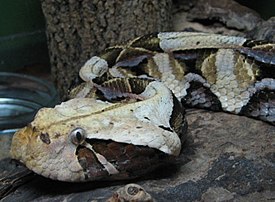
The Gabon Viper [1] , or the cassava [1] ( Latin Bitis gabonica ) is a venomous snake from the genus of African vipers . It is distributed in tropical rain forests and subtropical forests, in secondary forests, in savannah light forests in Western, Central, Southern, and also East Africa. Prefers wet habitat. This is one of the largest and thickest vipers, it reaches 1.8 m in length, and according to some data, more than 2 m. The body circumference is up to 47 cm [2] . The head is very large and wide, triangular in shape, delimited from the body by a narrow neck. Characteristic detail of the head: raised scutes between the nostrils in the form of horns, especially well marked in individuals from the western part of the range. Coloring the whole body mimics the forest floor of faded leaves.
| Gabon Viper |
 |
| Scientific classification |
|---|
| No rank : | Bilateral symmetric |
| Infraclass : | Lepidozavromorfy |
| Infrastructure : | Caenophidia |
|
| International Scientific Name |
|---|
Bitis gabonica Duméril , Bibron & Duméril , 1854 |
| Area |
|---|

|
|
It stands out calm character, rarely reacting to external stimuli - for this reason, cases of attacks on humans are rare. Despite this, a snake bite is a serious danger. Without immediate medical attention, toxins in cassava poison cause a number of systemic abnormalities in the body that can be fatal. For treatment, use standard serum against the poison of this particular species. The diet consists mainly of rodents ( mice , rats ), and to a lesser extent other mammals, birds, lizards and frogs. Metabolism is slow, like most snakes. The viviparous snake breeds once every two or three years. In broods usually up to 24, in rare cases up to 60 cubs.
Content
The snake is disproportionately thick for its length, with a broad, flat, triangular head, small eyes and a short tail. The length of an adult snake, as a rule, varies from 80 to 120 cm [3] , but there are also larger specimens. For example, in 1973, an individual 180 cm long and weighing 11.3 kg was caught, while her stomach was empty [4] . Famous American hunter and writer Peter Kapstik ) in the book “The Last Ivory Hunter” claims that in Sierra Leone , a viper 6 feet long and 8.5 inches long (about 210 cm) was killed, but this information was not documented [3] .
The head is distinguished by a peculiar decoration: a pair of protruding spinous scales in the form of horns that are located in front between the raised nostrils. In the vipers living in the western part of the range, these “horns” are large and curved back, whereas in the others they are barely noticeable [6] . As a result of this difference, two subspecies were identified: the former were named Bitis gabonica rhinoceros (rhinoceros - the English name for rhinoceros ), the second - Bitis gabonica gabonica [3] . The eyes are mobile, located in front of the head, surrounded by 15-21 shields [7] [3] . The rest of the head drawing is as follows: the interorbital flaps are 12–16, the upper lip 13–18, the lower lip 16–22 [7] . The length of poisonous teeth is longer than that of any other snake: up to 40 mm [8] [9] (according to some sources, up to 55 mm [2] ). The iris can be light gray, yellowish, or orange [3] .
The color imitates old fallen leaves and other rotting parts of plants against the background of red-brown soil, so that the snake almost merges with the environment. The head is light gray with a dark longitudinal mark on the crown, black spots in the posterior corners and radially diverging dark stripes from the eyes to the incision of the mouth. On the back you can see a clear geometric pattern consisting of rectangles, triangles and rhombuses, which are painted in bright and juicy shades of yellow, purple, pink and brown. The belly is off-white with unevenly scattered black or brown spots [3] [8] .
The Lope National Park in
Gabon - the traditional habitat of the Gabonean Viper
The main part of the range of the eastern subspecies is located in Central Africa from Benin to the east to South Sudan , to the south to northern Angola and Zambia . Middle and small foci of spread were recorded in eastern Tanzania , Malawi , Mozambique , Zimbabwe and the South African province of KwaZulu-Natal . The homeland of the western “horned” subspecies is considered to be the populations living in the west of the continent in Guinea , Sierra Leone , Cote d'Ivoire , Liberia, and Ghana [10] [11] .
In equatorial Africa, tropical tropical and other adjoining forests, cocoa plantations, and savanna woodlands inhabit the area. In Tanzania, it is found in the thickets of secondary forest, on cashew plantations and other woody crops. In Uganda and Zambia, it settles in evergreen forests and nearby wet meadows. In South Africa, it is found only in areas with high precipitation, mainly in the subtropical forest in the eastern part of the continent. In comparison with the closely related roaring viper, cassava prefers more humid and wooded biotopes . In the foothills it is found up to 1500 m above sea level [7] [8] [12] [13] .
The Gabon Viper has a reputation as a very slow snake, reluctant to respond to external stimuli. The fifth volume of the Animal Life encyclopedia, edited by the well-known Soviet biologist A. G. Bannikov, emphasizes that local snake catchers quietly grab cassava with their bare hands by the neck or tail, while in most cases it remains indifferent to what is happening, despite its protection capabilities. However, bites, which still occasionally occur, can lead to serious consequences up to death [8] . Being disturbed and frightened, the snake hisses loudly, slightly flattening his head on the exhale, but attacks only as a last resort [7] [3] [14] .
The reptile, as a rule, for a long time lies without signs of life, guarding prey from an ambush. She can also go on a long search for food, especially in the first half of the night: for example, in the vicinity of the city of Kumasi in Ghana, the viper often dies under horse hooves near the stables , which are up to 500 m from the nearest forest. The snake leaves typical biotopes and hunts rats in open areas [3] .
It moves slowly and, as a rule, straightforwardly - without the bends of the body, like most snakes. At short distances it can increase the speed due to zigzag movements [3] . American Herpetologist Raymond Ditmars described the so-called “side course” of cassava, more characteristic of the tailed viper ( Bitis caudalis ) and some desert species, such as sandy efa and horned rattles ( Crotalus cerastes ): with this method, the snake moves diagonally, adapting to unsteady sandy ground [14 ] .
Rodents - the main food of cassava
General view of the snake
It hunts in the dark, mainly rodents and other land mammals, and to a lesser extent birds , lizards and frogs [8] [15] . In one of the studies conducted in the south of Nigeria , 93.9% of the contents of the stomachs of adult snakes consisted of the remains of small mammals, of which 87.8% belonged to rodents and 6.1% belong to shrews . Juveniles more often hunted lizards and newborn mice [15] . Sources claim that, due to its size, cassava can choose larger prey in size up to an adult hare . There are also cases of attacks on tree monkeys , brush-tailed porcupines ( Atherurus ) and even a dwarf antelope . The snake attacks with lightning speed and from any angle relative to the position of the body, then holds the prey with the help of teeth (other vipers release and pursue the victim until it dies from the effects of the poison) [7] .
The peak of marital activity falls on the rainy season. Excited males often come into battle with each other: each snake tries to press the other's head to the ground, while raising its own to a height of 20-30 cm. Snakes hiss loudly and are so strongly intertwined that they can be taken from mating male and female, although this just a tournament of two males trying to get a female to be located. Under the conditions of a terrarium, such a struggle can flare up to 5 times a week, until it ends with the mating of one of the males with a female [7] [11] [9] .
The female gives birth to offspring every 2 or 3 years [9] . Like most other vipers, it bears eggs in its body (see egg-feeding ) [9] . Pregnancy lasts about seven months, while its onset may be delayed: the female is able to hold the male's sperm for several months before fertilization takes place. Most often, young snakes are born at the end of summer; their length varies from 25 to 32 cm, weight from 25 to 45 g [10] . In litter from 8 to 43 cubs, in the eastern subspecies it can reach 60. Nevertheless, the number of young rarely exceeds 24 individuals [7] .
The Gabonean Viper lives in little-visited human biotopes, is active at night and is not aggressive in nature - due to the combination of these factors its attack rarely happens [10] [16] . Most of the known cases are associated either with a random attack on the snake, or with conscious provocation and reckless behavior, including when kept in captivity [9] [17] [16] . Snake venom is highly toxic and deadly to humans; a snake bite requires immediate medical attention, even with minor initial symptoms [10] .
Open mouth with poisonous teeth
The venom of the viper has cytotoxic and cardiotoxic activity; it contains the following key toxins : arginine esterase , phospholipase A2 , thrombin , gabonase , antiplatelet component, gabonin and two hemorrhages (cause bleeding): HTa and HTb [16] . The clinical picture of a bite is similar to that when attacked by a noisy viper and other large closely related species [18] . At the site of the bite, a strong and painful puffiness develops with the formation of blisters, often in combination with extensive necrosis . Nausea and fever appear. Systemic effects may include sudden renal failure , hypotension , tachycardia , blood clots in the arteries and cardiac arrest . Impaired blood coagulation ( coagulopathy ) can lead to hematuria and bloody vomiting [3] [19] [20] .
After the attack, doctors recommend moving to a safe place, lying down and trying not to move, it is useful to impose a splint on the injured limb to fix it. You can gently remove any poison residues once with a damp cloth, but any other wound treatment, including cauterization, incision and suction of the poison, is contraindicated. A strong tumor usually develops at the site of the bite, and for this reason the watch and jewelry around it should be removed. The most serious consequences can appear after a few hours or even days, and therefore the victim should be delivered as soon as possible to the medical institution and given an antidote [20] .
- ↑ 1 2 Ananyeva N. B. , Borkin L. Ya. , Darevsky I. S. , Orlov N. L. A five-language dictionary of animal names. Amphibians and reptiles. Latin, Russian, English, German, French. / edited by Acad. V.E. Sokolova . - M .: Rus. lang., 1988. - p. 362. - 10 500 copies. - ISBN 5-200-00232-X .
- ↑ 1 2 Bitis gabonica (Neopr.) . WCH Clinical Toxinology Resources . The University of Adelaide. Circulation date November 22, 2015. Archived November 22, 2015.
- ↑ 1 2 3 4 5 6 7 8 9 10 Spawls et al., 2004 .
- ↑ Wood, 1983 .
- Stick Capstick, 1988 , p. 3
- ↑ Bannikov, 1985 , p. 338–339.
- ↑ 1 2 3 4 5 6 7 Mallow et al., 2003 .
- ↑ 1 2 3 4 5 Bannikov, 1985 , p. 339.
- ↑ 1 2 3 4 5 Warner, Jonathan Kirk. Conservation Biology of the Gaboon Adder (Bitis gabonica) in South Africa (Neopr.) . Dissertation (January 2009). The appeal date is November 21, 2015. Archived November 21, 2015.
- ↑ 1 2 3 4 Spawls & Branch, 1995 , p. 116-117.
- ↑ 1 2 Gaboon viper ( Unreferenced ) . Toronto Zoo. The appeal date is November 17, 2015. Archived November 18, 2015.
- Werger & van Bruggen, 2013 , p. 939.
- ↑ Mehrtens, 1987 , p. 312-313.
- ↑ 1 2 Ditmars, 1933 .
- ↑ 1 2 Luisellia & Akanib, 2003 , p. 103
- ↑ 1 2 3 Marsh et al., 1997 .
- ↑ Marais, 2005 .
- ↑ Mabey et al., 2013 , p. 856
- ↑ Immediate first aid for bites by Gaboon Viper (Bitis gabonica) (Neopr.) . Division of Toxicology, University of California, San Diego. Circulation date November 22, 2015. Archived November 22, 2015.
- ↑ 1 2 Snakebite Management Overview Document (Undefined) . State Toxinology Services . The University of Adelaide. Circulation date November 22, 2015. Archived November 22, 2015.
- Bannikov, A. G. (Ed.). The life of animals in the 7 m. .. - 2nd ed., Pererab .. .. - M .: Enlightenment, 1985. - T. 5. Amphibians and reptiles. - 399 s.
- Capstick, Peter Hathaway. The Last Ivory Hunter: The Saga Of Wally Johnson. - St. Martin's Press, 1988. - 240 p. - ISBN 978-0312000486 .
- Ditmars, Raymond Lee. Reptiles of the world ;: The crocodilians, lizards, snakes, turtles and tortoises. - The Macmillan company, 1933. - 321 p.
- Luisellia, Luca; Akanib, Godfrey C. Diet of sympatric Gaboon Vipers (Bitis gabonica) and Nose horned Vipers (Bitis nasicornis) in the southern Nigeria // African Journal of Herpetology. - 2003. - Vol. 52 , No. 2 . - pp . 101-106 . - DOI : 10.1080 / 21564574.2003.9635485 .
- Mabey, David; Gill, Geoffrey; Weber, Martin W .; Whitty, Christopher JM Principles of Medicine in Africa. - Cambridge University Press, 2013. - 928 p. - ISBN 978-1107002517 .
- Mallow D., Ludwig D., Nilson G. True Vipers: Natural History and Old World Vipers. - Krieger Pub Co, 2003. - 410 p. - ISBN 978-0894648779 .
- Marais, Johan. A Complete Guide to Snakes of Southern Africa. - Penguin Random House South Africa, 2005. - 312 p. - ISBN 978-1-86872-932-6 .
- Marsh NA; Whaler BC The Gaboon viper (Bitis gabonica): its biology, venom components and toxinology // Toxicon. - 1984. - V. 22 , No. 5 . - p . 669-694 .
- Marsh, Neville; Gattullo, Donatella; Pagliaro, Pasquale; Losano, Gianni. The Gaboon Viper, Bitis gabonica : hemorrhagic, metabolic, cardiovascular and clinical life of the venom // Life Sciences. - 1997. - V. 61 , No. 8 . - p . 763-769 .
- Mehrtens, John M. Living Snakes of the World in Color. - Sterling Publishing, 1987. - 480 p. - ISBN 978-0806964607 .
- Spawls, Stephen; Branch, Bill. Dangerous Snakes of Africa: Natural History - Species Directory - Venoms and Snakebite. - Ralph Curtis Pub, 1995. - 192 p. - ISBN 978-0883590294 .
- Spawls, Stephen; Howell, Kim; Drewes, Robert; Ashe, James. A Guide to the Reptiles of East Africa: Kenya, Tanzania, Uganda, Rwanda and Burundi. - Christopher Helm Publishers Ltd, 2004. - 544 p. - ISBN 978-0713668179 .
- Werger, Marinus JA; van Bruggen, Adolf Cornelis (Editors). Biogeography and Ecology of Southern Africa. - Springer, 2013. - 1444 p. - ISBN 978-9400999534 .
- Wood, Gerald. The Guinness Book of Animal Facts and Feats. - Sterling Pub Co Inc, 1983. - 256 p. - ISBN 978-0851122359 .
