Entandrophragma ( lat.Entandrophragma ) - a genus of deciduous trees, representatives of which grow only in tropical Africa . Belongs to the family Meliaceae ( Meliaceae ). Consists of 10-12 speciessome of which have a vulnerable status .
| Entandrofragma | |||||||||||||||||||||
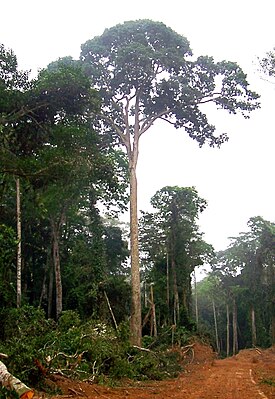 Entandrophragma cylindricum , Republic of the Congo | |||||||||||||||||||||
| Scientific classification | |||||||||||||||||||||
|---|---|---|---|---|---|---|---|---|---|---|---|---|---|---|---|---|---|---|---|---|---|
| |||||||||||||||||||||
| International scientific name | |||||||||||||||||||||
Entandrophragma C.DC. , 1894 | |||||||||||||||||||||
| Synonyms | |||||||||||||||||||||
| |||||||||||||||||||||
The range of the genus covers most of West , Central , East and South Africa . Here, representatives of the genus - along with some other Melian genera - often dominate in the upper tier of evergreen and deciduous forests . The genus includes dioecious plants with cirrus leaves and large complex inflorescences . Five-petalled flowers. Fruit - box . In the melian system, phylogenetically closest to the genus Entandrophragma are the genera Cedrela and .
Entandrofragm timber appears on the market as part of the mahogany group and is an important export item for a number of countries in tropical Africa. The bark of the entandrofragma is widely used in folk medicine , and the study of biologically active compounds produced by representatives of this genus has revealed their insecticidal activity along with antibacterial , antiviral , antifungal and possibly anti - cancer properties .
Title

The genus Entandrophragma was first isolated by the Swiss botanist Casimir Dekandol in 1894 [2] , when he transferred the species described in 1859 by Frederick Welwich as Swietenia angolensis , from the genus Swietenia into a separate genus [3] [4] . Dekandol chose the name of the genus, taking into account the fact that the stamens in the flower of the plant grow together in a stamen tube , the lower part of which is divided by partitions into small compartments; it is made from dr. ἐν 'in', ἀνήρ (genitive ἀνδρός ) is 'male' (in this case, the word indicates an androecium of a flower) and φράγμα is 'separation, separation, septum' [5] .
Distribution
Representatives of the genus Entandrofragma grow in the evergreen and deciduous moist and dry forests of tropical Africa [6] . In West Africa, the total range of the genus covers almost the entire tropical forest zone of the Guinean region - from Guinea in the west to Cameroon and Equatorial Guinea in the east. In Central Africa, it extends from the CARs in the north to Angola and Zambia in the south (capturing the extreme northwest of Namibia ). In East Africa, the range of the genus extends from southern Sudan and western Kenya in the north to Mozambique in the south (but practically does not go to the coast of the Indian Ocean ). Finally, in South Africa, the entandrofragma grows in the northeast of the region - in Zimbabwe and Swaziland , as well as in adjacent areas of Botswana and South Africa [7] .
Along with representatives of the and Lovoa genera , also belonging to the Melian family, species of the genus Entandrophragma dominate in the upper tier of mountain tropical African forests [8] .
Description
All representatives of the genus Entandrofragm are trees reaching a height of 40-50 m or more [6] . In October 2016, a team of German and Swiss botanists published a study according to which a high specimen of Entandrophragma excelsum , growing in the Kilimanjaro mountain range, is the tallest tree in Africa, reaching a height of 81.5 meters. The age of the tree is estimated at more than 470 years [9] [10] .
Dioecious plants. The leaves are usually paired (sometimes pinnate), their leaves are whole (smooth or with simple hairs) [11] [12] .
Inflorescences are large, combined heterogeneous ( thyres ). The calyx is leafy, its edge is solid or divided into 5 sharp lobes. Corolla consists of 5 yellowish petals about 2 mm long. The male flower’s nectar disk is pillow-shaped, the number of stamens is 10, and they grow together into a tube connected to the disk 10 or 20 by short ridges or partitions. The stamen tubes have a pitcher or goblet shape, their edge is solid or dissected (slightly or deep enough). In female flowers, the nectar disc is reduced to a faint swelling at the base of the ovary [11] [12] . The ovary is 5-membered; each nest contains from 4 to 12 ovules [13] .
The fruit is an elongated five-section septiphric box of cigar-shaped, spindle-shaped, cylindrical or club-shaped. The central column of the capsule is pentahedral and extends to the top of the latter [11] [12] . The size of the fetus varies: for example, in the fetus E. cylindricum they are 6–14 cm by 2.5–4 cm [14] , in E. utile - 14–28 cm by 4.5–7 cm [15] . One ovary nest contains from 3 to 9 seeds , each of which is attached to the central column, and at the end is equipped with a wing; the residual endosperm is represented by a thin layer [12] . Seeds vary markedly in length even in representatives of the same species; Thus, in E. candollei, it varies from 5 to 12 cm [16] . The embryo has two thin cotyledons , and the germinal root protrudes laterally [12] .
Chromosome set : 2n = 36 or 2n = 72 [11] .
Systematic position
The genus Entandrophragma belongs to the subfamily Cedreloideae of the family Meliaceae ( Meliaceae ) [13] . In this subfamily, it is the sister group for the clade formed by the genera Cedrela and and usually allocated to the tribe Cedreleae [17] [18] ), which separated from this clade about 30 million years ago [19] .
Views
(view under the microscope)
According to modern concepts, the genus Entandrofragma has 10 species (sometimes 11 [11] or 12 species [20] [21] are indicated). Below is a list of them according to the information from the database [22] :
- ( Welw. ) C.DC. typus [23] [24] - Angolan entandrofragma , or tiama [6] - a species widespread in tropical Africa (from Guinea and Angola in the west to South Sudan and western Kenya in the east) [25] . The leaves are large, each of them consists of 8 (14) —20 (22) oblong leaves from 7 to 28 cm long. Inflorescences up to 40 cm long, and individual flowers are 4-5 mm long, greenish-white. Fruits - cylindrical capsules 11-22 cm long and 3-5 cm in diameter, color - from brown to black; seeds - from 6 to 9.5 cm long [26] [27] . Deciduous tree, reaching a height of 50 m; differs in a slender straight trunk (with a diameter of up to 2.5 m), branching only from a height of 20-23 m. In some cases, highly developed board-like roots rise up to a height of 6 m along the trunk. The red wood of this tree, darkening in the light, is strong and well polished; it is used in furniture production , for interior decoration and the manufacture of accessories . The bark is used to obtain brown paint [6] [28] .
- Harms ex Engl. - grows in Tanzania and Burundi . A tree reaching 10–20 m in height [29] [30] . Wood is reddish brown, heavy; handles well, but holds nails poorly. It is used in construction, for interior decoration , turning , manufacturing accessories, boxes and plywood [31] .
- Harms - Candand's entandrofragm , or kosipo [6] - grows in tropical Africa (from Guinea in the west to the Democratic Republic of the Congo in the east) [32] . The leaves have a petiole 7–20 cm long, and each leaf consists of 10–20 oblong leaves from 5 to 18 cm long. Inflorescences are up to 30 cm long, and individual flowers have a peduncle up to 3 mm long and greenish-white petals 6-7 mm long. Fruits - cylindrical capsules 17-23 cm long and 3-5 cm in diameter, violet-brown or dark brown; seeds - from 5 to 12 cm long [16] [33] . A tree reaching a height of 65 m; slender, not branching up to a height of 30 m trunk with a diameter of up to 2 m. The wood is pink, sometimes it does not darken in the light in old trees, it is dense (it drowns in water in freshly prepared trees), it is well polished; in comparison with sapele, it is less decorative and is usually used for carpentry [6] [34] .
( , South Africa )
- ( Sprague ) Sprague - grows in southern Africa ( South Africa , Namibia , Botswana , Zimbabwe , Swaziland , Mozambique , Zambia , Malawi ) [35] . Leaves up to 25 cm long, with each leaf consisting of 5-8 pairs of oblong leaves up to 11 cm long. Inflorescences up to 20 cm long, flowers of a pale green color with petals 5-6 mm long. Stamen tubes 3-4 mm long. Fruits are cigar-shaped boxes 15–20 cm long and 5 cm in diameter. Seed sizes: 9–10 by 2 cm [36] . A tree, ranging in height from 3 to 30 m, and its trunk in diameter reaches 1.5 m [37] . Wood is reddish brown or dark brown in color, moderately heavy. It is used in some places for the manufacture of accessories and canoes , but its supply is limited [31] .
- E. cylindricum ( Sprague ) Sprague - The cylindrical entandrofragm , or sapele [6] , is widespread in tropical Africa (from Sierra Leone in the west to Uganda in the east) [38] . It can grow in drier areas than other species of the genus Entandrofragma, and in most of the range of the genus is its most common species. The leaves have a petiole with a length of 5 to 13 cm, and each of the leaves consists of 6-7 pairs of oblong leaves from 4 to 15 cm long. The inflorescence reaches a length of 25 cm; flowers are small, yellow-green. Stamen tubes approximately 2 mm long. The fruit is a cylindrical capsule 6-14 cm long and 2.5 to 4 cm in diameter, the color of which varies from brown to purple-black. The length of the seeds is from 6 to 11 cm [14] [39] . Deciduous tree, reaching a height of 65 m, and in diameter reaching up to 6 m. The wood is whitish, solid (like in oak oak ), but not heavy; the core is initially pink, but quickly darkens in the light to a red-brown color of a typical mahogany . A clear pattern of uniform stripes, most pronounced in radial sections, is characteristic. It is used for the construction of ships and boats, houses, for the manufacture of fittings , and is used for interior decoration, furniture production and carpentry [6] [40] .
- De Wild. - grows in Zambia , in the east of the Democratic Republic of the Congo and in the south-west of Tanzania [41] . The leaves have a petiole up to 25 cm long, and each leaf consists of 3-5 pairs of oblong leaves from 5 to 18 cm long. Inflorescences reach a length of 15 cm, and individual flowers have a peduncle up to 2 mm long and petals 5-7 mm long. Stamen tubes 5–7 mm long. The fruit is a cylindrical box 14–16 cm long and 3–3.5 cm in diameter. Seed sizes: 7–8.5 per 1.5 cm. A tree reaching a height of 35 m and its trunk in diameter reaches 1.5 m; the bark is gray-brown, smooth [42] . The wood is moderately heavy. It is used in some places for the construction of houses, the preparation of firewood and the production of charcoal [43] .
- ( Dawe & Sprague ) Sprague - Entandrofragma high [44] - grows in central Africa and neighboring areas (east of the Democratic Republic of the Congo , northeast of Zambia , northern Malawi , Tanzania , Burundi , Rwanda , Uganda ) [45 ] . The leaves have a petiole with a length of 9 to 23 cm, and each of the leaves consists of 8-16 oblong leaves from 8 to 18 (sometimes even up to 30) cm long. The inflorescence reaches a length of 25-45 cm; the flowers are small, white or pinkish-white. Stamen tubes 3-4 mm long. The fruit is a cylindrical box 12–20 cm long and 3-4 cm in diameter, the color of which varies from dark brown to purple-black [31] . A tree usually reaches a height of 45 m, and sometimes even more significant; its trunk reaches 2.5 m in diameter. Its wood has a pinkish-brown color (for freshly sawn trees), but after aging it becomes reddish-brown. The wood is hard, well processed (but it is difficult to cleanly drill, and it holds nails weakly); it is suitable for construction, carpentry and decoration, the manufacture of furniture and plywood , musical instruments and vehicle bodies [46] .
- Staner - grows in the north of the Democratic Republic of the Congo [47] . A tree reaching a height of 40 m. Moderately heavy reddish-brown wood is suitable for construction, carpentry and finishing works, furniture manufacturing [48] .
- ( C.DC. ) Sprague , spiky entandrofragma, is found in a small range on both banks of the lower reaches of the Kunene River (southwestern Angola and northwestern Namibia ) [49] [50] . Each of the leaves consists of 3–7 pairs of oblong leaves up to 11 cm long. Inflorescences are heavily encircled. A tree, reaching a height of 9-18 m, with a rough flaky bark. It grows mainly on sandy soils [51] .
- E. utile ( Dawe & Sprague ) Sprague - Useful or sipo [6] entandrofragma is widespread in tropical Africa (from Sierra Leone and Angola in the west to Uganda in the east) [52] . The leaves have a petiole with a length of 5 to 15 cm, and each of the leaves consists of 14–32 oblong leaves from 4 to 15 cm long. The inflorescence reaches a length of 25 cm; flowers are small, greenish-white. Stamen tubes 3-4 mm long. Fruit - club-shaped brown-black capsule 14–28 cm long and 4.5 to 7 cm in diameter; seed length - from 8 to 11 cm [15] . A tree, reaching a height of 70 m, and in diameter at the base reaching up to 2 m; straight cylindrical trunk without boardlike roots. The wood is reddish brown; texture due to the presence of large pores is more rare than sapele. It is well processed and polished (after filling). Somewhat inferior in value to sapele wood, it is used for the same purposes, and also goes to the manufacture of plywood [6] [53] .
Some sources also consider species E. congoense ( De Wild. ) A.Chev. and E. pierrei A. Chev. , isolating them from E. angolense [20] [21] .
Pests
The shoots, flowers, fruits and bark of trees of the genus Entandrofragma are often damaged by caterpillars of butterflies of the species from the family of fire-flames ( Pyralidae ). Other types of fires also pose a danger to these trees: caterpillars attack old trees; the butterflies lay their eggs in the fruit, and the caterpillars that are born feed on the seeds, crawling from fruit to fruit; seeds (as well as fruit walls) also feed on caterpillars of the species [26] [39] .
Guard Status
On the greater part of its range, the entandrofragm, due to its wide distribution in biotopes , is in a relatively favorable position. However, the significant extent of wood harvesting in a number of its species has led to significant in the latter in some countries. In this regard, the IUCN Red List of IUCN ( Red List of Threatened Species ) lists E. angolense [54] , E. candollei [55] , E. cylindricum [56] and E. utile [ 57] . Species of E. caudatum [58] and E. excelsum [59] are included in the category of species under the least threat of extinction .
Usage
( Toulouse Museum )
The wood of the genus trees appears on the market under various names and serves as an export item. Usually it is included in the mahogany group [6] [60] . The largest export volume is accounted for by wood ( logs , lumber ) of four species of the genus. In the 1970s, Côte d'Ivoire and Ghana were the leading exporters of wood of the endandrofragm, but later they lost the leading position to the states of Central Africa. According to data at the beginning of the 2000s, relating to individual countries in Africa, the following states were the largest exporters [61] :
- E. cylindricum (sapele): Republic of the Congo ( 211,000 m³ of logs), Cameroon ( 180,000 m³ of lumber), CAR ( 41,000 m³ of logs, 29,000 m³ of lumber);
- E. utile (sipo): Republic of the Congo ( 43,000 m³ of logs, 10,000 m³ of lumber), CAR ( 8,000 m³ of logs, 1,000 m³ of lumber);
- E. candollei (skip): Cameroon ( 4000 m³ logs, 19 250 m³ lumber), Gabon ( 2100 m³ lumber), CAR ( 1000 m³ lumber);
- E. angolense (тиама): Республика Конго ( 8000 м³ бревна, 2000 м³ пиломатериалов), Габон ( 7500 м³ пиломатериалов), Камерун ( 1000 м³ пиломатериалов).
Кору энтандрофрагмы используют в народной медицине : в качестве болеутоляющего средства её применяют наружно при болях в желудке , язвенной болезни , боли в ушах и области почек , при ревматизме или артрите , а отвар коры пьют для снятия жара (в частности, при малярии ) [26] .
Биохимическое изучение представителей рода показало, что они продуцируют разнообразные — биологически активные вещества, представляющие собой модифицированные тритерпеноиды и выступающие в качестве вторичных метаболитов . Лимоноиды содержатся в листьях и коре этих деревьев; они проявляют инсектицидную активность, а также обладают антибактериальными , противовирусными , противогрибковыми и, возможно, противораковыми свойствами [62] .
Notes
- ↑ For the conventionality of indicating the class of dicotyledons as a superior taxon for the plant group described in this article, see the APG Systems section of the Dicotyledonous article .
- ↑ De Candolle C. Entandrophragma C. DC. Genus novum // Bulletin de l'Herbier Boissier. Tome II, No. 9 / Sous la direction de Eugène Autran. — Genève: Imprimerie Romet, 1894. — 769 p. — P. 582—584.
- ↑ Pennington & Styles, 1975 , p. 518.
- ↑ African Plant Database. Entandrophragma angolense (Welw.) C.DC. . // Site web Conservatoire et Jardin botaniques de la Ville de Genève . Date of treatment December 27, 2016.
- ↑ Entandrophragma C. DC. Meliaceae // Quattrocchi U. CRC World Dictionary of Medicinal and Poisonous Plants: Common Names, Scientific Names, Eponyms, Synonyms, and Etymology. - Boca Raton: CRC Press , 2012 .-- 3960 p. - ISBN 978-1-4822-5064-0 . - P. 1573-1575.
- ↑ 1 2 3 4 5 6 7 8 9 10 11 Bazilevskaya N.A. Entandrofragma // Africa. Encyclopedic reference book. T. 2 / Ch. ed. A.A. Gromyko . - M .: Sov. Encyclopedia , 1987 .-- 671 p. - S. 577-578.
- ↑ African Plant Database. Entandrophragma C.DC. . // Site web Conservatoire et Jardin botaniques de la Ville de Genève . Date of treatment January 6, 2017.
- ↑ Plant life. Encyclopedia in 6 vols. T. 5, part 2: Flowering plants / Ch. ed. A. L. Takhtadzhyan . - M .: Enlightenment , 1981. - 511 p. - S. 253.
- ↑ Hemp A., Zimmermann R., Remmele S., Pommer U., Berauer B., Hemp C., Fischer M. Africa's highest mountain harbors Africa's tallest trees // Biodiversity and Conservation , 2016. - P. 1-11. - DOI : 10.1007 / s10531-016-1226-3 .
- ↑ Scientists have discovered the tallest tree in Africa . // Site "Telegraph" - News of Ukraine and the world. Date of treatment December 10, 2016.
- ↑ 1 2 3 4 5 Flowering Plants. Eudicots: Sapindales, Cucurbitales, Myrtaceae / Ed. by K. Kubitzki. - Berlin: Springer Science & Business Media , 2011 .-- x + 436 p. - (The Families and Genera of Vascular Plants. Vol. 10). - ISBN 978-3-642-14396-0 . - DOI : 10.1007 / 978-3-642-14397-7 . - P. 194.
- ↑ 1 2 3 4 5 Pennington & Styles, 1975 , p. 519.
- ↑ 1 2 Byng J. W. The Flowering Plants Handbook: A practical guide to families and genera of the world . - Hertford: Plant Gateway Ltd., 2014 .-- vi + 619 p. - ISBN 978-0-9929993-0-8 . - P. 291.
- ↑ 1 2 Timbers, vol. 1, 2008 , p. 241-243.
- ↑ 1 2 Timbers, vol. 1, 2008 , p. 247.
- ↑ 1 2 Timbers, vol. 1, 2008 , p. 237.
- ↑ Takhtadzhyan A.L. Magnoliophyte system. - L .: Nauka , 1987 .-- 439 p. - S. 179.
- ↑ Muellner A. N., Pennington T. D., Koecke A. V., Renner S. S. Biogeography of Cedrela (Meliaceae, Sapindales) in Central and South America // American Journal of Botany , 2010, 97 (3). - P. 511-518. - DOI : 10.3732 / ajb.0900229 . - PMID 21622412 .
- ↑ Koenen E. J. M., Clarkson J. J., Pennington T. D., Chatrou L. W. Recently evolved diversity and convergent radiations of rainforest mahoganies (Meliaceae) shed new light on the origins of rainforest hyperdiversity // New Phytologist , 2015, 207 (2). - P. 327—339. - DOI : 10.1111 / nph.13490 . - PMID 26053172 .
- ↑ 1 2 Genus Entandrophragma CEC Fisch. . // Website Biological Library (BioLib) . Date of treatment December 14, 2016.
- ↑ 1 2 Species in Entandrophragma . // The Plant List . Version 1.1. (2013). Date of treatment December 14, 2016.
- ↑ Entandrophragma : Search Results . // Website Catalog of Life . Date of treatment December 10, 2016.
- ↑ NCU-3e. Names in current use for extant plant genera. Electronic version 1.0. Entry for Entandrophragma C. DC. . // Names in Current Use for Extant Plant Genera (the NCU-3 database) by the International Association for Plant Taxonomy (IAPT). Date of treatment December 29, 2016.
- ↑ Entandrophragma C.DC. . // Website Tropicos ® by the Missouri Botanical Garden . Date of treatment December 11, 2016.
- ↑ Entandrophragma angolense (Welw.) C.DC. . // Website Catalog of Life . Date of treatment December 10, 2016.
- ↑ 1 2 3 Entandrophragma angolense (Welw.) C.DC. // The CABI Encyclopedia of Forest Trees. - Wallingford: CABI , 2013 .-- 536 p. - ISBN 978-1-78064-236-9 . - P. 165-167.
- ↑ Timbers, vol. 1, 2008 , p. 233.
- ↑ World Wood, vol. 1, 1982 , p. 43-44.
- ↑ Entandrophragma bussei Harms ex Engl. . // Website Catalog of Life . Date of treatment December 10, 2016.
- ↑ Entandrophragma bussei . // Website Useful Tropical Plants . Date of treatment December 14, 2016.
- ↑ 1 2 3 Timbers, vol. 1, 2008 , p. 244.
- ↑ Entandrophragma candollei Harms . // Website Catalog of Life . Date of treatment December 10, 2016.
- ↑ Entandrophragma candollei Harms // The CABI Encyclopedia of Forest Trees. - Wallingford: CABI , 2013 .-- 536 p. - ISBN 978-1-78064-236-9 . - P. 167-168.
- ↑ World Wood, vol. 1, 1982 , p. 79-80.
- ↑ Entandrophragma caudatum (Sprague) Sprague . // Website Catalog of Life . Date of treatment December 11, 2016.
- ↑ Entandrophragma caudatum . // Website Global Plants on JSTOR . Date of treatment December 29, 2016.
- ↑ Entandrophragma caudatum . // Website Useful Tropical Plants . Date of treatment December 14, 2016.
- ↑ Entandrophragma cylindricum (Sprague) Sprague . // Website Catalog of Life . Date of treatment December 11, 2016.
- ↑ 1 2 Entandrophragma cylindricum (Sprague) Sprague // The CABI Encyclopedia of Forest Trees. - Wallingford: CABI , 2013 .-- 536 p. - ISBN 978-1-78064-236-9 . - P. 168-169.
- ↑ World Wood, vol. 1, 1982 , p. 85-86.
- ↑ Entandrophragma delevoyi De Wild. . // Website Catalog of Life . Date of treatment December 11, 2016.
- ↑ Entandrophragma delevoyi . // Website Global Plants on JSTOR . Date of treatment December 29, 2016.
- ↑ Timbers, vol. 1, 2008 , p. 244-245.
- ↑ UDC 674.031.752.334. Entandrophragma. Entandrofragma . // Section "Reference on UDC" on the website www.vak-journal.ru . Date of treatment January 6, 2017.
- ↑ Entandrophragma excelsum (Dawe & Sprague) Sprague . // Website Catalog of Life . Date of treatment December 11, 2016.
- ↑ Entandrophragma excelsum . // Website Useful Tropical Plants . Date of treatment December 14, 2016.
- ↑ Entandrophragma palustre Staner . // Website Catalog of Life . Date of treatment December 11, 2016.
- ↑ Entandrophragma palustre . // Website Useful Tropical Plants . Date of treatment December 14, 2016.
- ↑ Entandrophragma spicatum (C.DC.) Sprague . // Website Catalog of Life . Date of treatment December 11, 2016.
- ↑ African Plant Database. Entandrophragma aspicatum (C.DC.) Sprague . // Site web Conservatoire et Jardin botaniques de la Ville de Genève . Date of treatment December 27, 2016.
- ↑ Entandrophragma spicatum . // Website Global Plants on JSTOR . Date of treatment December 29, 2016.
- ↑ Entandrophragma utile (Dawe & Sprague) Sprague . // Website Catalog of Life . Date of treatment December 11, 2016.
- ↑ World Wood, vol. 1, 1982 , p. 91-92.
- ↑ Entandrophragma angolense . // The IUCN Red List of Threatened Species . Date of treatment January 6, 2017.
- ↑ Entandrophragma candollei . // The IUCN Red List of Threatened Species . Date of treatment January 6, 2017.
- ↑ Entandrophragma cylindricum . // The IUCN Red List of Threatened Species . Date of treatment January 6, 2017.
- ↑ Entandrophragma utile . // The IUCN Red List of Threatened Species . Date of treatment January 6, 2017.
- ↑ Entandrophragma caudatum . // The IUCN Red List of Threatened Species . Date of treatment January 6, 2017.
- ↑ Entandrophragma excelsum . // The IUCN Red List of Threatened Species . Date of treatment January 6, 2017.
- ↑ Hall J. S. Seed and seedling survival of African mahogany ( Entandrophragma spp.) In the Central African Republic: Implications for forest management // Forest Ecology and Management , 2008, 255 (2). - P. 292-299. - DOI : 10.1016 / j.foreco.2007.09.09.050 .
- ↑ Timbers, vol. 1, 2008 , p. 232, 236, 239, 246.
- ↑ Paritala V., Chiruvella K. K., Thammineni C., Ghantad R. G., Mohammed A. Phytochemicals and antimicrobial potentials of mahogany family // Revista Brasileira de Farmacognosia , 2015, 25 (1). - P. 61-83. - DOI : 10.1016 / j.bjp.2014.11.11.009 .
Literature
- Wood species of the world. T. 1. Africa. South America. South Asia Southeast Asia / Ed. G.I. Vorobyov. - M .: Forest industry , 1982. - 326 p.
- Entandrophragma // Timbers. Vol. 1 / Ed. by D. Louppe, A. A. Oteng-Amoako, M. Brink. - Leiden: Barkhyus Publishers, 2008 .-- 704 p. - (PROTA Foundation, Wageningen, Netherlands. Plant Resources of Tropical Africa, vol. 7 (1)). - ISBN 978-0-9929993-0-8 . - P. 232-249.
- Pennington T. D., Styles B. T. A Generic Monograph of the Meliaceae // Blumea , 1975, 22 (1). - P. 419-540.
Links
- Richter HG, Dallwitz MJ Commercial Timbers. Entandrophragma angolense (Welw.) C. DC. (Tiama) . // Website delta-intkey.com (25th June 2009). Date of treatment January 8, 2017. (Tiama: wood anatomy)
- Richter HG, Dallwitz MJ Commercial Timbers. Entandrophragma candollei Harms (Kosipo) . // Website delta-intkey.com (25th June 2009). Date of treatment January 8, 2017. (Cosipo: wood anatomy)
- Richter HG, Dallwitz MJ Commercial Timbers. Entandrophragma cylindricum (Sprague) Sprague (Sapeli) . // Website delta-intkey.com (25th June 2009). Date of treatment January 8, 2017. (Sapele: wood anatomy)
- Richter HG, Dallwitz MJ Commercial Timbers. Entandrophragma utile (Dawe & Sprague) Sprague (Sipo, utile) . // Website delta-intkey.com (25th June 2009). Date of treatment January 8, 2017. (Sipo: wood anatomy)