The official language is English , while there are actively Scottish and two Celtic languages: Welsh and Gaelic . Scottish and Gaelic are the national languages of Scotland ( Gaelic is spoken in the highlands of Scotland . The national language of Wales is Welsh , according to the legislation adopted in 1967, Welsh has equal rights with English. In Wales, all inscriptions are given first in Welsh , and then duplicated in English.In North and West England, they speak many local dialects and dialects of the English language.
| UK Languages | |
|---|---|
| Official | English [1] [2] (de facto, not de jure) |
| Main languages | English (non-official) > 95% [3] |
| Minority languages | officially recognized |
| The main languages of immigrants | Arabic , Punjabi , Bengali , Syraki , Urdu , Sylhet , Yue , Greek , Italian , French , Southwestern Caribbean Creole , Gujarati , Kashmiri , Polish , Russian |
| Major foreign languages | French (23%) German (9%) Spanish (8%) [4] (The percentage of languages was revealed during the survey, where respondents indicated the ability of basic communication in the language) |
| Sign languages | British Sign Language, Irish Sign Language, Northern Irish Sign Language, English Sign Language |
| Keyboard layout | |
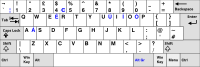 British QWERTY | |
Languages of the United Kingdom
Living Languages
The table below shows the living indigenous languages of the United Kingdom (England, Wales, Scotland and Northern Ireland). Languages from the Crown ( Channel Islands and Isle of Man ) are not included as they are not part of the United Kingdom of England.
| Tongue | Type of | They say in | Number of speakers (in the UK) |
|---|---|---|---|
| English | West Germanic languages | All over the UK | 55 million [5] including all dialects |
| Welsh | Celtic Languages ( British ) | Wales and parts of England near the Welsh-English border | 611,000 (according to a 2004 study by the Welsh Language Development Board ) [6] |
| Scottish (Germanic) | West Germanic languages | Scotland ( Lowlands , Caithness , Orkney , Shetland ) Northern Ireland ( Down County , Antrim , Londonderry ) | More than 1.5 million including all dialects [7] |
| Irish | Celtic languages ( Goidel languages ) | Northern Ireland | 95,000 (based on 2004 data) [7] |
| Anglo-gypsy | Mixed languages | England , Scotland , Wales | 90,000 [8] |
| Scottish (Celtic) | Celtic languages ( Goidel languages ) | Scotland ( Highlands with significant minorities in various cities) | 58,552 (based on the 2001 census in Scotland) [9] |
| Shelta ( Gammon ) | Mixed languages | England , Northern Ireland | Less than 86,000 worldwide, the UK is unknown. [ten] |
| Kornsky (revived) | Celtic Languages ( British ) | England ( Cornwall ) | approximately 2000 [11] |
Dead Languages
- Welsh-Gypsy
- Gypsy language
- Norn
- Pictish language
- Cumbrian language
- Yola
Languages and Dialects in the UK
Local languages
English Languages
The differences in the English language variants are of both geographical and class nature. The class stratification of British society has determined significant differences in the language of educated classes and lower classes of society [12] .
- English language ( British English )
- English English (as they say in England)
- Northern English
- Cumbrian dialect
- Geordie (in and around Newcastle upon Tyne )
- Lancashire dialect
- Makem (in and around Sunderland )
- Manchester dialect
- Yorkshire dialect
- Scouse (in and around Liverpool)
- East Midland English dialect
- West Midlands English
- Northern English
- English English (as they say in England)
Immigrant Languages
In recent decades, mass immigration has brought Britain many new languages. A study of immigrant languages, conducted in London in 1979 at the initiative of the Inner London Education Department, revealed more than 100 languages spoken in the families of schoolchildren in the central areas of the city.
South Asians , the largest diaspora in the UK, speak dozens of different languages, and it is difficult to determine how many people speak each of them along with English. The largest subgroup of British Asians is Bengalis , mostly of Bangladeshi origin, mainly from the Sylhet region (mainly Muslims ), as well as immigrants from the Indian state of West Bengal (mostly Hindus ). There are over 520,000 Bengali speakers, 300,000 of whom speak Silkheti , [13] which is sometimes regarded as a Bengali dialect. West Bengalis mainly speak standard Bengali . The Bengali-speaking community of Great Britain is most numerous in the Tower of Hamlets district of London . [14]
The second largest subgroup of British Asians is the Punjabi from India and Pakistan , making up the largest Punjabi community outside of South Asia. [15] . More than 220,000 people speak the East Punjabi language , another 50,000 use West Punjabi . [13] In addition to Bengali and Punjabi, other immigrant languages from Hindustan were also widely used in Great Britain.
Many Asian-born Britons use English as their first language. Their ancestors mainly came from the West Indies , in particular, Jamaica , and, as a rule, spoke Creole languages based on English , [16] therefore, there are a significant number of speakers of the Caribbean Creole languages . In addition, many black Britons, primarily immigrants of African descent, use French as their first or second language.
In recent years, the Slavic and Baltic languages , spoken by about a million immigrants, have spread in the UK due to active migration from Central and Eastern Europe . The most common of them is Polish (more than 600,000), as well as Lithuanian (85,500), Russian (67,400) and Slovak (50,500). [13]
The most common immigrant languages
Fifteen of the most common languages of British immigrants according to the Summer Institute of Linguistics : [13]
- Polish language (618,000)
- Sylhet (300,000)
- Urdu (269,000)
- Punjabi (224,000)
- Bengal (221,000)
- Gujarati (213,000)
- Arabic (159,000)
- French (147,000)
- Portuguese language (133,000)
- Spanish language (112,000)
- Tamil (101,000)
- Turkish language (99,400)
- Italian language (92,200)
- Somali language (85 900)
- Lithuanian language (85 500)
Notes
- ↑ Great Britain; Key Facts // Generalwealth Secretariat.
- ↑ English language: Directgov - Government, citizens and rights (inaccessible link) . Date of treatment February 29, 2012. Archived October 15, 2012.
- ↑ Languages - Languages . BBC Added on 2011-03-17.
- ↑ Europeans and their languages // European Commission. - 2006 .-- S. 13 .
- ↑ Speak English! website statistic. Retrieved: September 20, 2011
- ↑ 2004 Welsh Language Use Survey: the report - Welsh Language Board (link not available) . Date of treatment May 23, 2010. Archived May 24, 2011.
- ↑ 1 2 Ethnologue statistics
- ↑ Ethnologue information on Angloromani
- ↑ CnaG ¦ Census 2001 Scotland: Gaelic speakers by council area
- ↑ Ethnologue report for language code: sth
- ↑ 'South West: Teaching English: British Council: BBC , BBC / British Council website , BBC. Archived January 8, 2010. Date of treatment February 9, 2010.
- ↑ Bragg, 2017 , p. 7.
- ↑ 1 2 3 4 Country: United Kingdom . Ethnologue | Languages of the . SIL International (2015). Date of treatment February 3, 2017.
- ↑ Encyclopedia of the Languages of Europe / Price, Glanville. - Wiley-Blackwell, 2000. - P. 91–92. - ISBN 978-0631220398 . (eng.)
- ↑ Ballard, Roger. Desh Pardesh: The South Asian Presence in Britain . - C Hurst & Co Publishers Ltd, 1994 .-- ISBN 1850650918 . (eng.)
- ↑ Bagley, Christopher. A Comparative Perspective on the Education of Black Children in Britain // Comparative Education : journal. - 1979. - Vol. 15 , no. 1 . - P. 63-81 . - DOI : 10.1080 / 0305006790150107 . Archived January 19, 2012. (inaccessible link - history )
Literature
- Melvin Bragg . Adventures of English = Melvyn Bragg. The Adventure of English: The Biography of a Language. - M .: Alpina non-fiction, 2017 .-- 418 p. - ISBN 978-5-91671-685-6 . .