Pygmies ( Greek: Πυγμαῖοι - “people the size of a fist”) are a group of stunted Negroid peoples living in the equatorial forests of Africa . Another name for African pygmies is Negril.
| Pygmies | |
|---|---|
| Abundance and area | |
| Total: 280,000 [1] | |
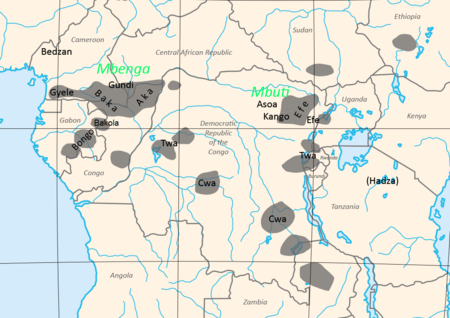
| Central Africa: Gabon , Cameroon , Central African Republic , Congo , Democratic Republic of the Congo , Rwanda . | |
| Tongue | Bantu languages , Ubangian languages , etc .; previously allegedly pygmy languages |
| Religion | Traditional beliefs |
| Racial type | Central African (Negril) race [2] |


Content
Testimonies
Mentioned already in ancient Egyptian inscriptions III millennium BC. e., at a later time - in ancient Greek sources (in the "Iliad" of Homer , Herodotus and Strabo ).
According to the tombstone of the Egyptian nobleman nomarch Ta-network (Elephantine nome) and the “chief of the South” Khufhor , he brought from the expedition to Equatorial Africa his master, Pharaoh of the VI dynasty of the Old Kingdom of Piopi II (2279-2219 BC), who has ascended the throne as a child, a “black dwarf”, having received a high reward from him for this. The same inscription says that this was not the first "black dwarf" brought to Egypt from the south, and another mentioned, delivered by a certain Baurjed to Iset , probably the pharaoh of the 5th dynasty of the Old Kingdom of Jedkar Isesi (XXIV century BC.) , the predecessor of Piopi II [3] .
Aristotle considered the pygmies to be a real people [4] .
In the XVI-XVII centuries, pygmies called "matimba" are mentioned in descriptions left by researchers in West Africa .
In the XIX century, their existence was confirmed by the German explorer Georg August Schweinfurt , the Russian explorer V.V. Juncker and others who discovered these tribes in the tropical forests of the Ituri and Uzle rivers (various tribes under the names: Akka , Tikitiki, Obongo, Bambuti, Batva ).
Study History
In the years 1929 - 1930 the expedition of P. Shebest described the Bambuti pygmies (Bambuti), in 1934 - 1935 the German explorer Martin Guzinde found the pygmies efé (Efé) and basua (Basua).
In the 1960s, Belgian ethnologist and naturalist Jean-Pierre Hallee made several expeditions to the efe pygmies living in rain forests near Lake Kivu in Rwanda . For several months he lived with one of the pygmy communities. The materials he collected formed the basis of two documentaries: The Pygmies (Pygmies, 1973) and The Pygmies of the Ituri Forest (1975). In 1975, Jean-Pierre Allé founded the charity Fund for Assistance to Pygmies, as a result of the successful activities of which the number of ephemes grew to 4,000 by 1980 . By 1994, the Fund had achieved the goal of providing land for farming for 46% of the pygmies in the Congo .
At the beginning of the XXI century, the pygmies live mainly in the forests of Gabon , Cameroon , the Central African Republic , Congo , Rwanda .
Pygmies in mythology
Physical Type
Height is from 124 to 150 cm for adult men, the skin is light brown, hair is curly, dark, lips are relatively thin, this physical type can be classified as a special race . The possible number of pygmies can be from 40 to 280 thousand people.
In appearance, the negritos of South and Southeast Asia are close to them, the inhabitants of some islands of Melanesia and northeast Australia, but genetically there are strong differences between Negril and Negritos.
Anthropology and Genetics
To identify mutations that explain the miniature pygmies, scientists compared the genomes of the pygmies from the Batwa tribe and their neighbors- bakig farmers, as well as for the pygmies of the bak and their neighboring neighbors nzebe and nzimi . It turned out that single nucleotide polymorphisms responsible for low growth are different in the Batwa and Tank Pygmies, which means that the dwarfism of African tribes is the result of convergent evolution [5] .
In the people living east of the tank of nations, efe and sua , small children are initially born - the growth restrictor is activated during intrauterine development. In a tank, children are born normal, but in the first two years of life, the children of the tank grow noticeably slower than Europeans [6] .
The frequency of the Y chromosome haplogroup B in aka and Mbuti pygmies ( en: Mbuti people ) reaches 35% [7] . In the genomes of Yoruba and Mbuti pygmies, from 0.2% to 0.7% of Neanderthal genes were found [8] . A study of biak DNA showed that approximately 2% of the genetic material was inserted into the human genome about 35,000 years ago. They received these sequences from the now extinct member of the genus Homo , which separated from the modern man about 700,000 years ago [9] [10] .
Occupation
Pygmies are the inhabitants of forests, the forest for them is the source of everything necessary for life. The main occupations are hunting and gathering . Pygmies do not make stone tools, previously did not know how to make fire (they brought the source of fire with them). The hunting instrument is a bow with arrows with metal tips, moreover, these tips are often poisoned. Iron is exchanged at the neighbors - Bantu.
Language
Pygmies usually speak the languages of the peoples around them - efe , asua , bambuti , etc. There are some phonetic differences in the dialects of the pygmies, but with the exception of the Bak people, the pygmies lost their native languages .
Notes
- ↑ Pygmy / Great Encyclopedic Dictionary. 2000.
- ↑ Pygmies / Popov V.A. // Peru - Semitrailer. - M .: Big Russian Encyclopedia, 2014. - P. 171. - ( Big Russian Encyclopedia : [in 35 vols.] / Ch. Ed. Yu. S. Osipov ; 2004—2017, vol. 26). - ISBN 978-5-85270-363-7 . {title} . Date of treatment November 4, 2018. Archived December 30, 2017. (Retrieved December 30, 2017)
- ↑ Biography of the nomarch Khufkhor, 6 royal house
- ↑ Aristotle. The history of animals. VIII, 76
- ↑ Geneticists have discovered that pygmies appeared in Africa recently
- ↑ Not all pygmies are the same
- ↑ A. Knight et al., 2003
- ↑ Back to Africa
- ↑ Michael F. Hammer et al. Genetic evidence for archaic admixture in Africa , 2011 Aug 30
- ↑ Human ancestors interbred with related species , 5 September 2011
Literature
- Alle Jean-Pierre. Campaign in the great forest "Ituri" // On land and at sea , 1989. - M.: Thought, 1989. - S. 253-268.
- Eliseev V.I. On the jungle of the Congo: Notes of a geologist . - 2nd ed., Revised. and add. - M .: Nauka , 1992. - 160, [8] p. - ( Man and the environment ). - 9000 copies. - ISBN 5-02-002222-5 .
- Putnam Ann. Eight years among the Pygmies / Ann Putnam; From the foreword and ed. B. I. Sharevskaya ; The artist. B.A. Diodorov . - M .: Publishing house of oriental literature , 1961. - 184 p. - (Traveling to Eastern countries). - 75,000 copies. (region)
- Horia Matei. Pygmies / Per. with the room. T. Berindey. - Bucharest: Publishing House of Youth, 1970. - 150 p. (region)
- Kulik S.F. Safari: Travels in East, Central and South Africa / Photo. the author; The artist. B.A. Diodorov . - M .: Thought , 1971. - 336, [8] p. - (Travel. Adventures. Search). - 100,000 copies.
Links
- African Pygmies Culture, Music and Photography
- Origin of the Central African (Pygmy) race .
- Schukarev A.N. Pygmies // Brockhaus and Efron Encyclopedic Dictionary : in 86 volumes (82 volumes and 4 additional). - SPb. , 1890-1907.