
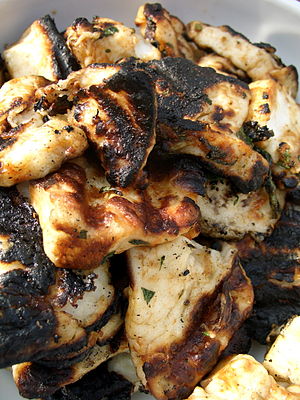
Halumi , halloumi ( English Halloumi or haloumi , Greek χαλούμι , Turkish . Hellim , حلوم ḥallūm ) - Levantine cheese , known in Europe for Cypriot cuisine . It is made from a mixture of goat's milk and sheep’s milk, although it sometimes contains cow’s milk. It has a high melting point, and therefore it can be fried or grilled.
Content
- 1 Basic Information
- 2 Nutritional Information
- 3 See also
- 4 notes
- 5 Links
Basic Information
White cheese with a distinctive layered texture similar to mozzarella has a slightly salted taste. It is stored in brine and can be stored for up to one year if frozen below −18 ° C (0 ° F) and thawed to +4 ° C (39 ° F) for sale in supermarkets. Mint is often added to cheese. Peppermint enhances the taste, in addition, it has a natural antibacterial effect, which increases the shelf life of the cheese. Industrial-made halumi cheeses contain more cow's milk than goat's and sheep's. This reduces production costs, but changes the taste and frying behavior.
The peculiarity of its preparation is that it can be fried to a beautiful golden brown color due to its higher melting point than other cheeses. This makes it suitable for frying or grilling (as, for example, in saganaki ). As such, it is used as a filler in salads or served with fried vegetables. Cypriots in the hot season eat halumi with watermelon. Another option is halumi and lountza - a combination with either a slice of smoked pork or lamb, or with a soft mutton sausage.
The property to resist melting arises due to the manufacturing features. Halumi is made from cottage cheese, which has been heated to form in brine. The traditional halumi has a semicircular shape, about the size of a large wallet, weighing 220-270 g. The fat content is about 25% by weight or 47% of dry weight; about 17% protein. Its hard texture leads to the fact that when it is eaten, it creaks on the teeth.
Despite the fact that halumi is of controversial origin and is also produced in other countries of the eastern Mediterranean, its name is registered in the USA as a trademark of Cyprus.
Nutritional Value
Typical content per 100 g of product: [1]
| Fats | 26 g |
|---|---|
| Carbohydrates | 1.8 g |
| Squirrels | 22 g |
| The energy value | 322 kcal |
See also
- Danable
- Bergkeze
- Anari
- Brynza
- Mozzarella
- Feta
Notes
- ↑ Nutritional information on halloumi cheese (Inaccessible link) . Alambra Dairy Products. Date of treatment May 7, 2008. Archived March 27, 2012. (eng.)
Links
- Halumi cheese . cypriot.ru. Date of treatment March 3, 2009. Archived March 27, 2012.
- Halloumi in Cypriot and no other way (inaccessible link - history ) . The newspaper "Herald of Cyprus". Issue No. 510 dated July 08, 2005. Date of treatment March 3, 2009.
- Hallumi cheese has become available to Russians