The Bug-Dniester culture is a Neolithic archaeological culture of the 6th -5th millennia BC. e. [1] [2] Known for a group of small settlements located near the city of Soroki and the adjacent regions of Moldova and Ukraine , along the Dniester and Southern Bug rivers .
| Bug-Dniester culture Neolithic | ||||
|---|---|---|---|---|
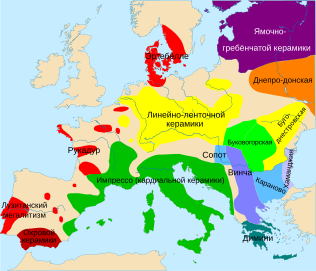 | ||||
| Localization | Ukraine [1] , Moldova | |||
| Dating | 6-5th millennium BC e. [one] | |||
| Carriers | Cro-Magnons | |||
| Type of farm | hunting | |||
| Continuity | ||||
| ||||
Evolved from the local Kukrek culture of the final Mesolithic . The dishes of the first period of the Bug-Dniester culture find analogies among the ceramics of the monochrome horizon in Bulgaria, the oldest layers of the settlements Grivats and Blagotin on the Danube. The oldest Bug-Dniester dishes are radically different from the younger ceramics of the Krish culture with the complete absence of barbotin, painted dishes, the small number of sticks and rollers, and the singularity of bowls. A common element of the early Bug-Dniester tableware with the most ancient kitchenware of North-East Bulgaria, Serbia and Croatia is the technology of making dishes using clay with a large admixture of organic matter up to the beginning of the VI millennium BC. e. Then this technology was replaced by the tradition of manufacturing kitchen utensils with a large admixture of sand and insignificant additions of vegetation, which corresponds to the transition from the first to the second period of the Bug-Dniester culture [3] .
In the early phase (the middle of the 7th millennium BC), the carriers of the culture were not familiar with ceramics and agriculture , lived by hunting for bison , deer , wild boars , and caught river fish: roach , pike , eel . V.I. Markevich in the early Neolithic of the extreme South-West of the USSR singled out groups of monuments of the first half of the 7th millennium BC. e. in the ancient ceramics-free phase, called the Soroca complex, in which there were signs of domestication of a pig and a bull. Around 5800 BC e. began to produce original ceramics with an admixture of crushed shells, mainly jugs with a flat or pointed bottom, decorated with an ornament of wavy lines. Subsequently, fell under the influence of Starchev-Krish culture , which resulted in a sharp change in the nature of ceramics, and instead of wild cereals began to give preference to cultivated wheat and spelled .
After 5500 BC e. ties with the Starchev-Krish culture were lost due to the invasion of culture carriers of linear tape ceramics [4] , which probably penetrated from the upper Dniester and devastated the entire region. Local stone houses disappeared, the population began to live in long houses , and linear-ribbon ceramics came into use. Subsequently, the local version of the culture of linear tape ceramics evolved into the Tripoli-Cucuteni culture . Remains of the population migrated to the area of the Dnieper-Donetsk culture , where they played a role in the creation of Srednestogovskaya culture .
Bug-Dniester culture was replaced by the Tripoli-Kukuten culture [1] .
Notes
- ↑ 1 2 3 4 5 Bug-Dniester culture / Balabina V.I. // Big Caucasus - The Great Channel [Electronic resource]. - 2006 .-- S. 288-289. - (The Big Russian Encyclopedia : [in 35 vols.] / Ch. Ed. Yu. S. Osipov ; 2004—2017, vol. 4). - ISBN 5-85270-333-8 .
- ↑ Archeology: A Textbook. Edited by Academician V.L. Ioannina . M .: Moscow Publishing House. University, 2006, p. 131.
- ↑ Kotova N.S. Ancient Ceramics of Ukraine // Kiev-Kharkov, 2015 The book discusses the oldest ceramics in Ukraine. The author offers its typology, explores the problem of origin, as well as the further development of pottery traditions during the 7th – 5th millennia BC. e.
- ↑ Linear pottery culture Archived July 28, 2013 to Wayback Machine
Literature
- Bug-Dniester culture / Balabina V.I. // Big Caucasus - The Great Channel [Electronic resource]. - 2006 .-- S. 288-289. - (The Big Russian Encyclopedia : [in 35 vols.] / Ch. Ed. Yu. S. Osipov ; 2004—2017, vol. 4). - ISBN 5-85270-333-8 .
- Danilenko V.N. Neolithic of Ukraine: Heads of the Ancient History of Southeast Europe, Kiev: Naukova Dumka, 1969.
- Markevich V.I. The Bug-Dniester culture on the territory of Moldova, Chisinau: Shtiintsa, 1974.
- Tovkaylo M. T. Neolit Stepovogo Pobuzhzha (Kam'yana doba Ukraine, VIP. 6), Kiev: Shlyakh, 2005.
Links
- Igor Rassokha. Ukrainian ancestral home of Indo-Europeans (inaccessible link)
- BOUG-DNIESTR (in French)