Northern Macedonia gained independence in September 1991. Its economy was the least developed compared to other former Yugoslav republics, especially compared to Slovenia and Croatia [7] . In 1990 - 1993, a privatization program was passed in the Republic of Macedonia [8] . In subsequent years, the Government of Macedonia carried out a number of reforms in the financial sector. Northern Macedonia maintains macroeconomic stability amid low inflation and low public debt , but lags behind in attracting foreign investment and creating jobs [7] .
| Economy of Northern Macedonia | |
|---|---|
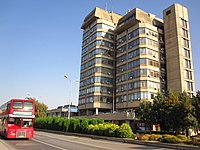 National Bank of Northern Macedonia | |
| Currency | Denar (= 100 days) |
| Fiscal year | Calendar |
| International the organization | WTO candidate for EU |
| Statistics | |
| GDP | ▲ $ 33.822 billion (PPP) [1] ▲ $ 12.783 billion (face value) [1] |
| Place by GDP | 125th place (faculty) / 136th place (nominal) |
| GDP growth | 2.3% (2018) [2] |
| GDP per capita | ▲ $ 16 253 (PPP, 2019) [3] ▲ $ 6,143 (face value, 2019) [3] |
| Inflation ( CPI ) | 2.3% |
| Population below the poverty line | 20.8% |
| Economically active population | 0.89 million (43% of the total population) |
| Pre-tax average salary | 36488 denars [4] / $ 680.74 per month (2019) |
| Post-tax average salary | 24,817 denars [5] / $ 463 per month (2019) |
| Unemployment rate | ▼ 21.9% (Q4,2017) [6] |
| International trade | |
| Export | 2.4 billion |
| Export partners |  Serbia Serbia Montenegro 19.4% Montenegro 19.4% Germany 14.7% Germany 14.7% Greece 10.5% Greece 10.5% Italy 10.2% Italy 10.2% Bulgaria 9.9% Bulgaria 9.9% Croatia 5.6% Croatia 5.6% Belgium 5.1% Belgium 5.1% Spain 5.1% (2006) Spain 5.1% (2006) |
| Import | 3.7 billion |
| Import partners | Germany 11.5% Greece 11.3% Russia 11.1% Bulgaria 8.4% Serbia Montenegro 6.7% Russia 11.1% Bulgaria 8.4% Serbia Montenegro 6.7% Turkey 5.7% Italy 5.5% Turkey 5.7% Italy 5.5% Slovenia 4.4% (2006) Slovenia 4.4% (2006) |
| Public finance | |
| State debt | 30.8% of GDP |
| External debt | 4 billion |
| Government revenue | 2.508 billion |
| Government spending | 2.487 billion |
According to the rating of the Doing Business Report for 2019 published on October 31, 2018, North Macedonia took 10th place, thereby obtaining the highest rating among the countries of the Europe and Central Asia region after Georgia (6th place) [9] .
Content
Economic Growth
A number of factors (the inability to conduct free trade with the former Yugoslav republics; the embargo imposed by Greece ; UN sanctions against Yugoslavia ; lack of infrastructure ) impeded the economic growth of the former Yugoslav Republic of Macedonia in the first half of the 1990s. Economic growth was outlined in the country only in 1996. GDP growth was observed up to 2000 [7] [8] .
In 2001, due to the inter - ethnic conflict that took place in the Republic of Macedonia, economic growth declined to 4.5%. The recession in the economy occurred as a result of periodic closure of borders , a decrease in trade with other countries, an increase in state budget spending on state security, and investors' refusal to invest in a country with an unstable political situation [7] [8] . In 2002, economic growth was observed at the level of 0.3%, and in 2003 - 2.8% [8] . For the period from 2003 to 2006, the average indicator of economic growth amounted to 4%, for 2007-2008 - 5% [7] .
In 2009, the country's GDP was estimated at $ 9.238 billion, economic growth fell to −1.8%. Gross domestic product by sectors amounted to: agriculture - 12.1% of GDP, industry - 21.5%, services - 58.4% [7] .
Public Finance
State budget revenues in 2009 amounted to $ 2.914 billion, expenditures - $ 3.161 billion. The public debt of the Republic of Macedonia grew in 2009 compared to 2008 by 3.7% and amounted to 32.4% of GDP. As of September 31, 2009, the country's external debt reached $ 5.458 billion, which is $ 0.8 billion more than last year [7] .
Agriculture
Good climatic conditions make it possible to grow grain crops ( wheat , corn , rice ), industrial crops ( tobacco , sunflower , cotton , poppy ), vegetables and fruits in the country. In northern Macedonia developed viticulture and winemaking [8] .
In mountainous areas, pastoralism is developed. The population breeds sheep , goats , cattle , pigs . The country also has poultry and beekeeping . Residents of lake regions are engaged in fishing [8] .
The leading sectors in agriculture in Northern Macedonia are: tobacco growing , vegetable growing , fruit growing , sheep farming [10] .
Industry
The growth of industrial production in the Republic of Macedonia in 2009 fell sharply to the level of −7.7% [7] . The following leading industries are distinguished in the country: tobacco , wine , textile [10] .
Mining industry
The country has insignificant reserves of ore and non-metallic minerals : iron , lead - zinc , nickel , copper and manganese ore , chromites , magnesite , antimony , arsenic , sulfur , gold , brown coal , feldspar , dolomite , gypsum [8] [11 ] [11 ] ] .
| Minerals | 2007 year | 2008 year | year 2009 |
|---|---|---|---|
| Brown coal | 6 569 220 | 7 669 103 | 7 395 915 |
| Copper ore | 4 109 464 | 4,239,500 | 3 766 500 |
| Copper concentrate | 33,467 | 38 337 | 35,430 |
| Lead concentrate | 48,702 | 67 401 | 63,227 |
| Zinc concentrate | 61 913 | 77 473 | 77,296 |
Chemical industry
The chemical industry of Northern Macedonia is mainly based on imported raw materials. A large chemical plant is located in Skopje . The development of the chemical industry is facilitated by foreign investment (the United States - in the pharmaceutical industry, Turkey - in the production of fuels and lubricants and plastics, Italy - in the production of technical glass). There is a pulp and paper industry .
Textile industry
The main centers of the textile industry are Tetovo (production of woolen fabrics), Shtip (cotton mill), Veles (silk weaving mill). They mainly produce finished, including knitted, clothes, bedspreads, bedding, faux fur, blankets, cotton threads, woolen yarn, fabrics, carpets. The leather and leather and footwear industry mainly works on imported raw materials and is largely developing thanks to the investments of Italian and Italian-American companies.
Foreign Trade
The export volume in 2016 was estimated at 5.46 billion US dollars. [12] The country exports chemical goods, machinery and equipment, metallurgical products and semi-finished products, tobacco, wine, fruits and vegetables, and textile products. Major export partners: Germany (2.27 billion US dollars), Serbia (0.393 billion US dollars), Bulgaria (0.266 billion US dollars), Czech Republic (0.261 billion US dollars) and Greece (0.221 billion US dollars).
In 2016, the volume of imports reached 7.03 billion US dollars. [12] Northern Macedonia imports machinery and equipment, chemical products, fuel and food . Major import partners: Germany (US $ 869 million), United Kingdom (US $ 738 million), Serbia (US $ 568 million), Greece (US $ 510 million) and China (US $ 430 million).
The main foreign trade partner of Northern Macedonia as of 2014 was the European Union . The volume of foreign trade for 2014 is $ 12.211 billion. [13] Geographical distribution of foreign trade of Northern Macedonia (for 2014): [14]
- European Union countries - 69.0% ($ 8,404 million).
- China - 4.3% ($ 525 million)
- Turkey - 3.6% ($ 442 million)
- The countries of America - 3.3% ($ 405 million)
- Russia - 1.5% ($ 182 million)
- African countries - 0.7% (84 million dollars)
Infrastructure
The length of railways is 699 km (234 km are electrified), the length of roads is 4,723 km (including 4,113 km with hard surface). There are 14 airports in the country (including 10 with hard surface) [7] , including international airports in Skopje and Ohrid [8] .
Labor and employment
The biggest problem (as in other still relatively poor countries of Europe: Russia, Ukraine, Belarus, etc.) is the growing shortage of able-bodied labor every year, and the increase in the number of pensioners, due to the low birth rate and high emigration of the population in other, richer, countries of the world. Particularly difficult situation with the growing demographic crisis in many developing countries in Europe and Asia: Northern Macedonia, Moldova, Belarus, Ukraine, Russia, China, Thailand, etc. In these countries, the usual demographic crisis inherent in developed countries is exacerbated, often by even greater declines in the officially working share of the able-bodied population, due to the vast informal, shadow economy, even lower birth rates, even greater unemployment, and even greater growth of pensioners due to less active healthy years. able-bodied life, which, coupled with the active emigration of a young, economically active and most able-bodied population to the richer countries of the world, leads to a slowdown in economies eskogo growth countries, and as a consequence of a slowdown in wage growth and living standards in the countries, which in turn slows down the convergence of living standards in the developing world to the developed standard of living. [15] [16] [17] [18] [19] [20] [21] [22] [23] [24] [25] [26] [27] [28] [29] [30] [31 ] [32] [33] [34] [35] [36] The rich developed countries of Europe and Asia often solve the problem of the demographic crisis by simply increasing quotas for the import of more foreign labor, which in turn is poor and economically unattractive. for both skilled and unskilled foreign labor, developing countries cannot afford. As an example, the economy of Northern Macedonia may encounter a widely discussed problem, Northern Macedonia may age faster than its population will become wealthier, which may slow down the growth of living standards in Northern Macedonia and bring it closer in wages to other developed and rich economies of Asia and Europe: Japan, Republic of Korea, Republic of China, Switzerland, Germany, France, Norway, Slovenia, etc. In the worst case, this can lead to economic stagnation, similar to the Japanese one, observed in Japan for two decades. But taking into account that Japan is an economically developed, rich country with high salaries, and Northern Macedonia is only developing.
Population Incomes
The minimum wage for 2017 was 14,424 denares , which is 231 euros. As of January 1, 2019, the minimum wage amounted to 17,370 denominations of gross (€ 282.38) [37] [38] [39] [40] [41] [42] , 12,165 net denars (€ 197.76) [ 39] [41] [40] [42] [43] [44] The Keitz index (the ratio between the minimum and average wages in the country) in Macedonia as of 2019 (average 36,488 denars and minimum 17,370 denars [37] [38 ] ] ) is about 47.6%. Starting April 1, 2019, the minimum wage amounted to 17,943 gross denars (€ 291.40), [45] [46] [47] 12,507 net denars (€ 203.12). [48] [49]
Notes
- ↑ 1 2 Report for Selected Countries and Subjects . IMF (October 20, 2019). Date of treatment January 15, 2019.
- ↑ World Bank forecast for Macedonia, FYR, June 2018 (p. 151 ) . World Bank Date of appeal September 11, 2018.
- ↑ 1 2 Report for Selected Countries and Subjects . IMF (October 20, 2018).
- ↑ State Statistical Office - News release: Average monthly gross wage paid per employee, 10.2018 . stat.gov.mk.
- ↑ State Statistical Office - News release: Average monthly net wage paid per employee, 10.2018 . stat.gov.mk.
- ↑ Actively the population in the Republic of Macedonia. Result of the Questionnaire for labor force, IV trimming of 2017 year ( Maced .) . Rusted factory for statistics (March 9, 2018). Date of treatment January 15, 2019.
- ↑ 1 2 3 4 5 6 7 8 9 Macedonia . The World Factbook . Date of appeal September 12, 2010.
- ↑ 1 2 3 4 5 6 7 8 Macedonia (unavailable link) . " Around the world ." Date of treatment September 12, 2010. Archived on August 19, 2010.
- ↑ Doing Business 2019: A Year of Record Reforms, Rising Influence . World Bank Date of treatment December 11, 2018.
- ↑ 1 2 Macedonia // Countries and regions of the world: economic and political reference book / ed. A. S. Bulatov. - 2nd ed. - M .: Prospect, 2009 .-- 704 p.
- ↑ 1 2 Industry in the Republic of Macedonia, 2004-2009 (Maced.) (Unavailable link) . Republic of Macedonia Dzhavan plant for statistics . Date of treatment January 15, 2019. Archived November 13, 2011.
- ↑ 1 2 OEC - Macedonia (MKD) Export, Import, and Trade Partners . The Observatory of Economic Complexity . Date of treatment January 15, 2019.
- ↑ Maksakova, 2015 , p. 40.
- ↑ Maksakova, 2015 , p. 40–41.
- ↑ [1]
- ↑ Error in footnotes ? : Invalid
<ref>; no text forforbes.comfootnotes - ↑ [2]
- ↑ [3]
- ↑ [4]
- ↑ [5]
- ↑ [6]
- ↑ [7]
- ↑ [8]
- ↑ [9]
- ↑ [10]
- ↑ [11]
- ↑ [12]
- ↑ [13]
- ↑ [14]
- ↑ [15]
- ↑ [16]
- ↑ [17]
- ↑ [18]
- ↑ [19]
- ↑ [20]
- ↑ [21]
- ↑ 1 2 Karel Fric. Statutory minimum wages 2018 . Industrial relations (English) (pdf) . Eurofound (2018) . Date of treatment January 15, 2019.
- ↑ 1 2 Monthly minimum wages - bi-annual data . Eurostat (6 September 2018). Date of treatment January 15, 2019.
- ↑ 1 2 New depreciation on the minimum fee for the period of July 2018 - March 2019 of the year (Maced.) . Rafaјlovski.com.mk . Date of treatment December 2, 2018.
- ↑ 1 2 Delovni informacii. Monthly fee Guli 2018 year ( Maced .) (Pdf). Euro Consult Plus . Date of treatment December 2, 2018.
- ↑ 1 2 There is a minimum charge in the Republic of Macedonia ј јuli 2018 year ( Maced .) . RSM Global (July 19, 2018). Date of treatment December 2, 2018. Archived on September 29, 2018.
- ↑ 1 2 Obama for a new vacancy at a minimum fee ( Maced .) . Euro Consult Plus . Date of treatment December 2, 2018. Archived on August 16, 2018.
- ↑ Mare Anceva. 2016 Annual Review of Labor Relations and Social Dialogue Macedonia . Library of the Friedrich-Ebert-Stiftung (February 2017). Date of treatment December 2, 2018. Archived on September 18, 2018.
- ↑ Analysis: Economic revolution in Macedonia . Kurir.mk (January 20, 2016). Date of treatment December 2, 2018. Archived on September 18, 2018.
- ↑ [22]
- ↑ [23]
- ↑ [24]
- ↑ [25]
- ↑ [26]
Literature
- Maksakova M. A. Trends in the development of economic cooperation between Russia and the countries of the Western Balkans. The dissertation for the degree of candidate of economic sciences / Scientific adviser: Doctor of Economics , Professor I. N. Platonova. - M .: MGIMO , 2015 .-- 257 p.