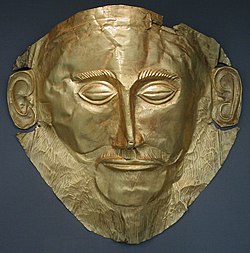

A funeral mask is a piece of decorative art , sometimes made of precious metals or stones (also made of wood, gypsum or clay; in Aleuts, it is made of a whalebone [1] ), which was laid in some cultures during burial on the deceased's face before burial.
It should be distinguished from the posthumous mask , which is a cast from the face of the deceased and remains in the world of the living in memorial quality; in addition, unlike a similar cast, a portrait resemblance in a funerary mask is either not necessary or not in the powers of their creators.
This custom was associated with the cult of ancestors and the idea of the afterlife [2] . In ancient Egypt, as is known from written sources, the mask served to preserve the image of the deceased - the abode or living conditions of his soul. Masks are found not only in burials: apparently, for example, in Siberia, they were used in funeral rites (ritual masks), then they were thrown to the ground, broken or burnt.
In many cases, these masks are individual and portrait; their study allows us to establish, in particular, the physical type of population of the corresponding time.
An option is to create a face relief on the skull of the deceased with plaster or clay - this is called a “skull mask” [3] .
Examples of famous masks
- discovered in Nineveh and Carthage [2]
- Crito-Mycenaean culture - gold masks in the mine tombs of Mycenae, especially the so-called The Mask of Agamemnon
- Ancient Egypt , the most famous example is the burial mask of Tutankhamun
- Fayumsky portrait is a rare example of not a sculptural, but a pictorial funerary mask
- the island of Most (IV century BC)
- Tashtyk culture (South Siberia, I – IV centuries AD), generally Siberia at the end of I thousand BC e. - VII — VIII centuries A.D. e. These masks were painted with geometric patterns, so the researchers suggest that these patterns are an imitation of tattoos on the face of the deceased [4] .
- Iranian territory
- Mesoamerican cultures, for example, Mayan Indians and South American Sican culture (Peru) and Chima - often used jade
- Ancient China , for example, the Liao Dynasty
- Kerch : mask from the so-called Reskuporida tomb [5] [6]
- Astana : masks were made of fabric and metal elements were sewn on top [7]
Notes
- funerary mask
- Agamemnon mask
- fayumsky portrait
- Agamemnon mask
- death mask
- ancestor wax masks
- ↑ Ancient Mask will rewrite the history of the Aleuts (inaccessible link)
- ↑ 1 2 Funeral masks - article from the Great Soviet Encyclopedia .
- ↑ Evdokimov G. L. On the issue of masked tortoises from burials of the Early Bronze Age of the steppe zone of Ukraine // Problems of the study of the catacomb cultural and historical community: Abstracts of the All-Union Seminar. - Zaporozhye, 1990. - P.18 - 20.
- ↑ Iron Age. Tashtyk culture
- ↑ The Secret of the Golden Mask. Exhibition in the Hermitage (Inaccessible link) . Date of treatment March 5, 2009. Archived April 11, 2009.
- ↑ Photo of a mask from Kerch
- ↑ Ritual masks made of silk. Used materials from the article Krishna Riboud, Pratiques Funeraires dans les necropoles d'Astana, UA1222, Memoire No.2, Editions du CNRS Paris, 1987. (link unavailable)
See also
- Wikimedia Commons has media related to The Funeral Mask