The 97th Lifland Infantry General Field Marshal Count Sheremetev Regiment is an infantry military unit of the Russian Imperial Army .
| 97th Infantry Lifland Field Marshal Count Sheremetev Regiment | |
|---|---|
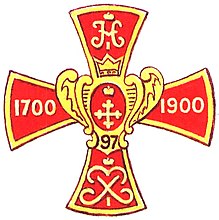 Chest sign | |
| Years of existence | April 6, 1863 - 1918 |
| A country |  Russian empire Russian empire |
| Included in | 25th Infantry Division ( 3rd Army Corps ) |
| Type of | infantry |
| Dislocation | Dvinsk |
| Participation in | Russo-Japanese War , World War I |
Seniority from June 25, 1700 Regimental holiday - August 30 .
Content
- 1 Regiment Formations and Campaigns
- 1.1 Old Trinity Infantry Regiment
- 1.2 Livonian Regiment
- 2 Regiment insignia
- 3 Commanders and chiefs of the regiment
- 3.1 Old Trinity Regiment
- 3.2 Livonian Regiment
- 4 Famous people who served in the regiment
- 5 Other formations of this name
- 6 notes
- 7 Sources
Regiment Formations and Campaigns
Old Trinity Infantry Regiment
The regiment was formed in Moscow on June 25, 1700 [2] from a recruit, consisting of 10 companies, under the name of the infantry Fliverka regiment, and received military baptism on November 19, 1700, near Narva , having lost its commander, 17 officers and 698 lower ranks. The following year, the regiment with the new commander Cooper made a campaign in Kurland and then was appointed to guard the northern borders of the Russian Empire with Ingermanland . In 1703, the regiment, being in the corps of P. M. Apraksin , took part in the "Third Sveisk campaign"; then carried garrison service in St. Petersburg and Shlisselburg . In 1704, a grenadier company was formed under the regiment.
In 1706, the regiment made, under the command of Field Marshal Count Sheremetev , a campaign in Astrakhan to pacify the rebellion of archers and fugitive Cossacks.
March 10, 1708, with the names of the Russian army in the provinces and cities, the regiment was called the Trinity Infantry Regiment. On June 27, 1709, in the battle of Poltava , the regiment guarded the camp of the Russian troops and was then expelled with General Renzel to pursue the Swedes.
The following year, the Trinity Regiment was appointed to the Finnish Army of Admiral Count Apraksin and participated in the siege of Vyborg . On June 20, 1710, the regiment allocated a grenadier company to form the Grenadier Regiment of Prince Baryatinsky . In 1712, the Troitsky regiment fought near Riga , and then, while in the Ingermanland Corps of Count Apraksin, participated in the occupation of Helsingfors and in the battle on the Pelkina River, on October 6, 1713.
Speaking from Bjarneborg on January 26, 1714, the regiment was defeated by the Swedes near the village of Lappola and captured Vazy .
The next six years, the Troitsky regiment spent in Finland , taking part in several searches on galleys in Sweden and the Åland Islands .
In 1722, two companies were appointed to the Lower Corps and, taking part in a campaign in Persia , were on August 23 during the occupation of Derbent and the capture of Baku . On June 9, 1724, these companies entered the formation of the Ryashchinsky Infantry Regiment (disbanded in 1733), and instead, new companies were formed from recruits at the Troitsky Regiment.
From February 16 to November 13, 1727, the regiment was called the 1st Kostroma Infantry Regiment.
On October 23, 1731, the grenadier company was disbanded, and the regiment was made up of 8 fusilier companies. In the same year, the Trinity Regiment made a trip to Poland and Prussia and, being in the building of Count Minich , participated in the capture of Danzig .
During the Crimean campaigns of 1737-1738. the regiment was in the army of Field Marshal Minikh and participated in the assault on Ochakov , during the defeat of the Turks at Stavuchan and during the occupation of Khotin .
On May 13, 1741, a special grenadier company was formed from the grenadiers in the companies. On January 27, 1747, the regiment was made up of three battalions with two grenadier companies. On March 30, 1756, the 3rd Grenadier Company, formed in 1753, was allocated to form the 3rd Grenadier Regiment .
In 1757, the Troitsky regiment took part in the Seven Years' War and, after the siege of Memel, was on August 19 at the battle of Gross-Egersdorf . On August 14, 1758, under Zorndorf , the regiment heroically repulsed the cavalry attack of Seidlitz and lost 20 officers and 502 lower ranks.
During the reign of Emperor Peter III, the regiment was called from April 25 to July 5, 1762 the infantry lieutenant general Jacob Fast regiment. Upon accession to the throne of Empress Catherine II, the regiment was brought on January 14, 1763 into two battalions with an artillery team.
In 1764, the Trinity Regiment was sent to Poland as part of the Stofeln corps. Three years later, the regiment was again moved to Poland and, being in the Krechetnikov corps, participated in the case under Lipyatin and in the assaults of Berdichev and Zhytomyr .
In the campaign of 1769 against the Turks, the Trinity Regiment, while in the 1st Army, acted with honors under Khotin.
On April 23, 1770, the regiment was appointed to the corps of General Essen and spent two years in Poland guarding the Russian rear fortifications.
In 1773, the Trinity Regiment returned to the theater of the Turkish War and was in the battles of Silistria , Kuchuk-Kainardzhi and in the unsuccessful assault on Varna .
In the 2nd Turkish War, the regiment was in the capture of the Hajibey Castle and Kiliya and participated with the Suvorov in the assault on Izmail .
Upon accession to the throne of Emperor Paul I, the regiment was named on November 29, 1796 the Trinity musketeer and then was called on October 31, 1798 the name of the chief, the musketeer Major General Borozdin, 2nd regiment. On March 31, 1801, Emperor Alexander I returned to the regiment the name of the Trinity Musketeers and brought it on April 30, 1802, into three battalions. On May 16, 1803, a company was allocated to form the Vologda Musketeer Regiment .
In 1804, the regiment was moved to the Caucasus and, settling down the Kuban River , made several expeditions against the rebellious kuban. The following year, the Trinity Regiment moved to the Caucasus and took an active part in the conquest of Karabakh and the Sheki Khanate.
In 1808, the regiment, under the command of his chief, Major General Nebolsin , made an expedition to Persia and defeated the Persians under Kara-Bab.
February 22, 1811 the regiment was called the Trinity Infantry.
On February 1, 1812, the battalion occupying the village of Sultan-Budu was surrounded by the 18,000th army of Abbas-Mirza and, having lost all the senior commanders in battle , surrendered the next day. On December 31, 1812, two companies heroically participated in the assault on Lankaran and lost 4 officers and 68 lower ranks.
In 1813, the regiment was transferred to Dagestan , where he spent the next five years. On December 19, 1819, the two companies that occupied, under the command of Staff Captain Ovechkin, the Chirakh post heroically withstood the three-day siege of Surkhay Khan, who arrived with 6,000 Kazikumukh residents.
In 1819, the regiment was ordered to allocate a frame with banners for the formation of a new Trinity Regiment in Russia and the remaining lower ranks to replenish the Absheron Infantry Regiment . However, this was soon canceled, and the regiment itself was renamed Absheron. In 1825, the regiment was returned the name of Trinity [3] .
During the Russian-Turkish war of 1828-1829. The 1st and 2nd battalions were assigned to the army and, crossing the Danube , participated from September 21 to October 30, 1828 in the blockade of Silistria . The following year, the Trinity Regiment was again appointed to the number of troops besieging Silistra and Shumlu .
Livonia Regiment
On January 23, 1833, during the reorganization of our army, the old Troitsky regiment was annexed to the Belozersky infantry regiment and formed in it the 3rd, 4th and 6th reserve battalions. On April 6, 1863, from the 4th reserve battalion and indefinite leave, the two-battalion Belozersky reserve infantry regiment was formed, on August 13, 1863 this regiment was named the Livonian Infantry Regiment and was made up of three battalions with three rifle companies [4] .
During the formation of the regiment, the following distinctions of the Belozersky regiment were transferred: in the 1st battalion - St. George banners with the inscription "For Sevastopol in 1854 and 1855" and the entire regiment - signs on hats with the inscription "For Warsaw on August 25 and 26, 1831. ". On March 25, 1864, No. 97 was added to the name of the Livonia Regiment.
On April 7, 1879, the 4th battalion was formed from three rifle companies and the newly formed 16th company. March 25, 1891, in order to preserve the memory of the famous commanders and military commanders in the Russian army, the regiment was called the 97th Lifland Infantry General Field Marshal Count Sheremetev Regiment. On June 25, 1900, on the day of the 200th anniversary, the regiment was granted the new St. George banner with the additional inscription “1700-1900”. On January 27, 1904, a company was allocated from the Livonian Regiment to form the 3rd battalion of the 16th East Siberian Rifle Regiment.
During the Russo-Japanese War, the Livonian Regiment was mobilized and, arriving at the theater of operations on January 5, 1905, made up the reserve of the commander in chief.
On February 16, 1905, the Livonia Regiment became part of the detachment of General D. A. Topornin, who was sent to Sinmintin to secure the right flank of the Russian army and then on February 17 to the village of Yuhuantun.
With a further advance to Salinp, the Livonian Regiment participated in the attack on the villages of Yandago, Kaulintai and Liontachai. On February 22, during an unexpected attack by the Japanese on the village of Yuhuantun, the Livonian regiment was moved to reinforce its division and heroically knocked out the enemy, losing 24 officers and 870 lower ranks.
When retreating to Telin, the Livonian regiment was at the forefront and, having occupied the village of Ungentun, covered the retreat of the column of General Tserpitsky .
For the heroic attack of February 22, 1905, the Livonian regiment was granted, on July 18, 1909, the St. George silver trumpets with the inscription "For the difference in battle at the village of Yuhuantun on February 22, 1905." The pipes were handed over to the regiment on the 5th anniversary of the battle, on February 22, 1910, in Dvinsk.
During the First World War, the regiment in 1914-1915 took part in the battles near Gumbinnen in East Prussia and then in Belarus near Lake Naroch .
In 1916-1917, the regiment was on the Romanian front .
Regiment Insignia
- Regimental St. George banner with the inscription "For Sevastopol in 1854 and 1855" and "1700-1900", with the Alexander jubilee ribbon
- Badges for hats for lower ranks and badges for officers with the inscription: "For Warsaw, August 25 and 26, 1831"
- St. George silver trumpets with the inscription "For the difference in battle at the village of Yuhuantun on February 22, 1905".
Regiment Commanders and Chefs
Old Trinity Regiment
Chefs: from 03.12.1796 - 04.01.1797 - Lieutenant General Zlotnitsky, Anton Osipovich
- 01.10.1797 - 03.03.1798 - team leader (from 01.27.1797 - Major General) Merlin
- 03/05/798 - 04/17/1801 - major general (from 05/02/1800 - lieutenant general) Borozdin, Andrei Mikhailovich
- 04/17/1801 - 04/26/1802 - Major General von Toll, Peter
- 04/26/1802 - 08.24.1804 - Major General Verevkin, Mikhail Mikhailovich
- 08.24.1804 - 09.23.1804 - Major General Balashov, Alexander Dmitrievich
- 09/29/804 - 12/20/1810 - Major General Nebolsin, Pyotr Fedorovich
- 02/27/1811 - 09/01/1814 - Major General Khatuntsov, Nikolai Mikhailovich
Commanders:
- 02.1700 - 11.19.1700 - Colonel Fliverk, Matvey Ivanovich
- 11.19.1700 - 1702 - Colonel Cooper, Danila Yakovlevich
- 1702 -? - Colonel Abramov, Yuri Khristoforovich
- ? - 1708 - Colonel Abramov, Job
- 1789 - Colonel A. Khvostov
- 09.10.1798 - 09.09.1799 - major (from 11.02.1799 - lieutenant colonel) Ivanov, Nikolai Nikolaevich
- 10/15/1799 - 05/05/802 - Major Voropanov, Nikolai Mikhailovich
- 05/05/802 - 09/29/804 - Colonel Nebolsin, Pyotr Fedorovich
- 03.17.1805 - 01.16.1806 - Colonel Rudzevich, Alexander Yakovlevich
- 09.16.1809 - 03.11.1811 - lieutenant colonel (from 30.08.1811 - colonel) Tikhanovsky, Stepan Leontyevich
- 05/12/1813 - 05/31/1816 - Major Podrevsky, Boris Mikhailovich
- 05.31.1816 - 04.11.1819 - Colonel Leventsov, Athanasius
- 11/04/1819 - 01/23/1821 - Lieutenant Colonel Gartalov (Gortalov, Konstantin Fedorovich?)
- 01/23/1821 - 05/24/1822 - Lieutenant Colonel Voznesensky, Stepan Mikhailovich
- 05/24/1822 -? - Lieutenant Colonel Zhilinsky, Alexander Gavrilovich
Livonia Regiment
Commanders:
- 08.13.1863 - 05.24.1867 - Colonel Duve, Nikolai Ottovich
- 05.24.1867 - 09.19.1875 - Colonel Zankevich, Ippolit Mikhailovich
- 09/19/1875 - 02/07/1877 - Colonel Melnikov, Alexander Vasilievich
- 02/07/1877 - 07/21/1879 - Colonel Kargen, Oscar-Robert Gustavovich
- 08/01/1879 - 05/12/1888 - Colonel (from 05/15/1883 - Major General) Protsenko, Pyotr Petrovich
- 05.21.1885 - хх.хх.1889 - Colonel Wendorf, Mikhail Mikhailovich
- 12/30/1889 - 02/06/1896 - Colonel (from 11/14/1894 Major General) Sommer, Mikhail Karlovich
- 02/07/1896 - 05/31/1898 - Colonel Peshchansky, Georgy Ivanovich
- 07/07/1898 - 08/03/1900 - Colonel Morozov, Faddey Andreevich
- 08/31/1900 - 02/09/1904 - Colonel Malvo, Evgeny Borisovich (actually commanded on 04/04/1901)
- 02/09/1904 - 11/27/1904 - Colonel N.K. Merzhvinsky
- 12.19.1904 - 06.24.1905 - Lieutenant Colonel Molotkov, Alexander Afanasevich
- 06.28.1905 - 11.25.1905 - Colonel V.A. Emmanuel
- 03/12/1905 - 05/02/1905 - temporary regiment commander lieutenant colonel von Wicken, Alexander Ivanovich
- 07.25.1905 - 09.09.1905 - temporarily commander of the regiment, Lieutenant Colonel von Wicken, Alexander Ivanovich
- 06/15/1906 - 12/06/1907 - Colonel Shirokov, Victor Pavlovich
- 01/23/1908 - 06/08/1910 - Colonel Prince Kropotkin, Dmitry Alekseevich
- 06/08/1910 - 02/25/1912 - Colonel V.L. Raikovsky
- 02/25/1912 - 04/13/1915 - Colonel Guntsadze, David Konstantinovich
- 1914-1915 - temporarily commander of the regiment, Colonel Krastyn, Ivan Ivanovich
- 05/20/1915 - 07/16/1916 - Colonel Alekseev, Nikolai Nikolaevich
- 07.16.1916 - 04.24.1917 - Colonel Plekhanov, Sergey Nikolaevich
- 07.24.1917 - 01.20.1918 - Colonel Alferov, Nikolai Fedorovich
Famous people who served in the regiment
- Gopper, Karl Yanovich - Major General, Chief of Staff of the Union for the Defense of the Homeland and Freedom
- Zarako-Zarakovsky, Boleslav Frantsevich - Soviet and Polish military commander, lieutenant general (USSR), division general (Poland)
- Makiyonok, Donat Adamovich - Russian and Polish pilot ace
Other formations of this name
- Livonia jaeger battalion - formed in 1779, in the 1780s it was reorganized into the Livonia jaeger corps, in the late 18th - early 19th centuries the battalions of this corps were turned to form jaeger regiments .
- Livonia Dragoon Regiment - formed on August 29, 1805, from December 17, 1812 it was called the Horse Jaeger, on May 11, 1819 it was renamed the Horse Jaeger of His Majesty the King of Wirthemberg Regiment. It was abolished on March 21, 1833, its 1st division became part of the Mitava Hussar Regiment , where seniority and insignia of the Livonia Dragoon (Horse-Jaeger) regiment were preserved.
Notes
- ↑ Fig. 952. Drummer of the Trinity Musketeer Regiment. 1797-1801. // Historical description of clothing and weapons of the Russian troops, with drawings, compiled according to the highest command : in 30 tons, in 60 books. / Ed. A.V. Viskovatova . - T. 7. - Winkusen Collection
- ↑ According to M.D. Rabinovich , it was formed in February 1700.
- ↑ G. S. Gabayev cites an additional version that the regiment was not returned the name of Troitsky and that he remained to exist under the name of the Absheron regiment.
- ↑ Also on April 6, 1863, a reserve regiment was formed from the personnel of the Kostroma Infantry Regiment , called the Troitsky Infantry Regiment on August 13 of that year, which received No. 107 on March 25, 1864. In the literature, sometimes these regiments are confused and considered to be one.
Sources
- Livland, 97th Infantry, Field Marshal Count Sheremetev, regiment // Lintulaks - Mine (training and mine) detachment of the Baltic Fleet. - SPb. ; [ M. ]: Type. t-va I. D. Sytin , 1914. - S. 18-19. - ( Military Encyclopedia : [in 18 vol.] / Edited by K. I. Velichko [and others ]; 1911-1915, v. 15).
- Gabaev G.S. Painting on Russian regiments of 1812. K. , 1912.
- Grenadier and infantry regiments. Reference book of the Imperial Headquarters. Edited by V.K.Shenka. SPb. , 1909.
- Pantserzhinsky A. I. Sketch of the history of the 97th Lifland Infantry Regiment (from 1700-1888). SPb. , 1890.
- Rabinovich M. D. Regiments of the Petrine Army. 1698-1725. Quick reference. M. , 1977.
- Shtyk N.D. Memo to the 97th Lifland Infantry General Field Marshal Count Sheremetev Regiment. (1700-1909 gg.). Dvinsk, 1910.