Limma ( obsolete. Leimma ) ( Greek λεῖμμα - remainder, lat. Limma , less often leimma ) is the musical interval corresponding to the diatonic semitone (small second) of the Pythagorean system . According to the ancient definition dating back to the Pythagorean school , limma is equal to the difference between a pure quart and two whole tones (hence the name as the “remainder” of a quart after two whole tones are separated from it) and, thus, has a ratio of the frequencies of the upper and lower sounds equal to
- ,
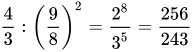
or 90.2250 c . Limma is also obtained by sequentially postponing 5 pure fifths down and then 3 octaves upwards from a given sound (given height) (or laying off 5 pure quarts upwards and then 2 octaves downwards):

Examples: EADGCF, C-FB-Es-As-Des, Cis-Fis-HEAD; the intervals E-F, C-Des, Cis-D obtained as a result of these adjournments are limms.
The most ancient reference to the numerical ratio of lima (256: 243) is the following fragment of Plimet's Timaeus [1] :
He began to divide as follows: first of all, he took one share from the whole, then the second, twice as large, the third - one and a half times the second and three times the first, the fourth - twice the second, the fifth - three times the third, the sixth - eight times the first, and the seventh is twenty-seven times the first.
Original text (Greek)(35b4) ἤρχετο δὲ διαιρεῖν ὧδε. μίαν ἀφεῖλεν τὸ πρῶτον ἀπὸ παντὸς μοῖραν, μετὰ δὲ ταύτην ἀφῄρει διπλασίαν ταύτης, τὴν δ 'αὖ τρίτην ἡμιολίαν μὲν τῆς δευτέρας, τριπλασίαν δὲ τῆς πρώτης, τετάρτην δὲ τῆς δευτέρας διπλῆν, πέμπτην δὲ τριπλῆν (35c) τῆς τρίτης, τὴν δ' ἕκτην τῆς πρώτης ὀκταπλασίαν, ἑβδόμην δ 'ἑπτακαιεικοσιπλασίαν τῆς πρώτης.
After that, he began to fill in the formed double and triple gaps, cutting off all new lobes from the same mixture and placing them between the previous lobes so that in each gap there were two middle members, one of which would exceed the smaller of the extreme members by the same its part, by which part would exceed its larger, and the other would exceed the smaller extreme term and inferior to the larger by the same number.
Original text (Greek)μετὰ δὲ ταῦτα συνεπληροῦτο (36a) τά τε διπλάσια καὶ τριπλάσια διαστήματα, μοίρας ἔτι ἐκεῖθεν ἀποτέμνων καὶ τιθεὶς εἰς τὸ μεταξὺ τούτων, ὥστε ἐν ἑκάστῳ διαστήματι δύο εἶναι μεσότητας, τὴν μὲν ταὐτῷ μέρει τῶν ἄκρων αὐτῶν ὑπερέχουσαν καὶ ὑπερεχομένην, τὴν δὲ ἴσῳ μὲν κατ ' ἀριθμὸν ὑπερέχουσαν, ἴσῳ δὲ ὑπερεχομένην.
Thanks to these clamps, new gaps appeared, 3/2, 4/3 and 9/8, inside the old gaps. Then he filled all the gaps with 4/3 gaps of 9/8, leaving a particle of such a length from each gap that the numbers separated by these remaining gaps would always refer to each other as 256 to 243. Moreover, the mixture from which [god ] took the mentioned shares, was spent to the end.
Original text (Greek)ἡμιολίων δὲ διαστάσεων καὶ ἐπιτρίτων καὶ ἐπογδόων γενομένων ἐκ τούτων τῶν δεσμῶν ἐν ταῖς πρόσθεν διαστάσεσιν, (36b) τῷ τοῦ ἐπογδόου διαστήματι τὰ ἐπίτριτα πάντα συνεπληροῦτο, λείπων αὐτῶν ἑκάστου μόριον, τῆς τοῦ μορίου ταύτης διαστάσεως λειφθείσης ἀριθμοῦ πρὸς ἀριθμὸν ἐχούσης τοὺς ὅρους ἓξ καὶ πεντήκοντα καὶ διακοσίων πρὸς τρία καὶ τετταράκοντα καὶ διακόσια. καὶ δὴ καὶ τὸ μειχθέν, ἐξ οὗ ταῦτα κατέτεμνεν, οὕτως ἤδη πᾶν κατανηλώκει.
At the end of this fragment, we are talking (in modern terms) about representing relations in the form of a work , which corresponds to the representation of a quart as an interval composed of two whole tones and a limm.


The word "limma" ratio 256: 243 was first named in Greek treatises of the II century BC. e., namely, Ptolemy , Theon of Smyrna (with reference to Adrast ), in the so-called "Fragments of Nicomachus " (excerpts from his not preserved work on harmonics).
One of the first evidence in Latin literature is the extensive commentary of the neoplatonist Chalkidius (Kalkidiy) on the "Timaeus" of Plato, compiled in the IV century BC. e. In this treatise, the calculation of Plato is given a musical and theoretical meaning and the term is established for the residual half-tone, that is, the actual limm [2] :
The first consonance - the very one called the quarta - is located in a super-tertiary number. And since the super-tertiary number consists not only of two super-octagonal, but also of another, namely insignificant, so the quart consists not only of two [whole] tones, but also of a half-tone, which the ancients called the limm. Discussing his numerical ratio, [Plato] says that individual super-tertiary numbers have a certain residual particle (it indicates the ratio of a semitone), and this [semitone], as he claims, has a difference of 243 and 256, less than the full supersmind number.
Original text (lat.)Prima enim symphonia est haec ipsa quae adpellatur diatessaron, in epitrito modo posita. Et quia epitritus non solum ex duobus epogdois constat, sed etiam ex alio quoque aliquantulo scilicet, sicut diatessaron non ex solis duobus tonis constat, sed ex hemitonio, quod ueteres limma adpellabant: huius quoque rationis tractatum haamunumamambum dumamunamumamambum dumamunamumamambum dambum ipsam scilicet rationem hemitonii designans, quod ait tantum esse, quantum desit ducentis quadraginta tribus aduersum ducentos quinquaginta sex, quo minus sit plenus epogdous numerus.
In the V century, limma is mentioned in the book 1 “The Marriage of Philology and Mercury” by Martian and in the commentary on the Sleep of Scipio Macrobius [3] . Finally, the term “limma” and its calculation were fixed in the textbook “Basics of Music” by Boethius . Considering the problem of dividing tones by semitones, Boethius defines limm as a smaller semitone (Mus., II.28-29), and calls the remaining (larger) apotoma (Mus., II.30 [4] ). In treatises of the Western European Middle Ages and Renaissance, following the Boethian tradition, both Pythagorean midtones were usually considered as pair opposition.
In later theory, the term "limma" began to refer to certain intervals of other systems, usually corresponding to varieties of diatonic semitone (small second). In such cases, lima in the main meaning of the term indicated above was called Pythagorean (Pythagorean).
Thus, the Edinburgh Encyclopedia (1830) [5] lists more than 10 varieties of limbs; however, the classification and terminology given there is not widespread. According to the terminology of A.J. Ellis [6] , “larger” ( English larger ) limm is the interval with a frequency ratio of 135: 128 (92.18 q ), and “large” (or largest, English great ) limm is the interval 27:25 (133.24 q ). The same intervals in the terminology of G. Riemann [7] are called large ( German großes ) lame or larger ( German größere ) increased prima and, accordingly, large limm or a large small second [8] .
Notes
- ↑ Plato. Timaeus, 35b4–36b6. Per. S. Averintseva
- ↑ Cited from: Platonis Timaeus interprete Chalcidio cum eiusdem commentario, ed. Ioh. Wrobel Leipzig, 1876, p. 115. Interestingly, in an earlier Latin translation of the same fragment "Timaeus", which in 45 BC performed by Cicero , there is no term limm.
- ↑ Somn. II, 4 (Mentioned only, without calculation)
- ↑ Boethius. De institutione musica, liber II
- ↑ LIMMA in The Edinburgh encyclopaedia, conducted by D. Brewster (1830)
- ↑ Ellis's Table of Intervals not Exceeding an Octave
- ↑ Interval table according to Riemann Musiklexicon, in book. Yu. N. Kholopova "Harmony"
- ↑ Currently, terminology dating back to J.-F. Rameau , according to which the interval 135: 128 is called the greater chromatic semitone (larger enlarged prima), and 27:25 - the larger diatonic semitone (longer small second) of the pure (quintz-tertz) system. Such terminology allows, in order to avoid confusion, to keep the term "limma" exclusively for its classical meaning.
Literature
- van der Waerden, B.L. Pythagorean doctrine of harmony // Awakening science. Mathematics of Ancient Egypt, Babylon and Greece / Transl. with goll. I.N. Veselovsky. - M .: GIFML, 1959. - S. 393-434.
- West, Martin L. Ancient Greek Music. - Oxford, 1992 .-- ISBN 0198149751 .
- Mathiesen, Thomas J. Apollo's Lyre. Greek Music and Music Theory in Antiquity and the Middle Ages. - Univ. of Nebraska Press, 1999 .-- ISBN 0803230796 .
- Harmon R. Die Rezepzion griechischer Musiktheorie im römischen Reich // Geschichte der Musiktheorie. Bd. 2: Vom Mythos zur Fachdisziplin. Antike und Byzanz, hrsg. v. F. Zaminer, UA — Darmstadt, 2006, S.437.