Lightning protection ( lightning protection , lightning protection ) is a complex of technical solutions and special devices to ensure the safety of the building, as well as property and people in it. Up to 16 million thunderstorms occur annually on the globe, that is, about 44 thousand per day [1] . Danger to buildings (structures) as a result of a direct lightning strike can lead to:
- damage to the building (structure) and its parts;
- failure of electrical and electronic parts inside;
- death and trauma of living creatures located directly in the building (structure) or near it.
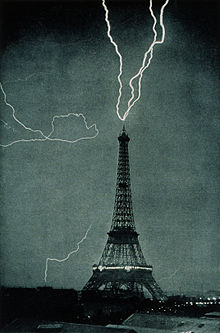
Lightning protection of buildings is divided into external and internal.
Content
- 1 External lightning protection system
- 2 Internal lightning protection system
- 3 Normative documents
- 4 Types of SPDs and typical applications for internal lightning protection
- 5 See also
- 6 notes
- 7 References
External lightning protection system
External lightning protection is a system that intercepts lightning and diverts it to the ground, thereby protecting the building (structure) from damage and fire. At the moment of a direct lightning strike into a building object, a correctly designed and constructed lightning protection device must take on the lightning current and divert it through down conductors to the grounding system , where the discharge energy must be safely dissipated. The passage of lightning current should occur without damage to the protected object and be safe for people inside and outside this object.
The following types of external lightning protection:
- air terminal;
- tensioned air terminal;
- air terminal.
In addition to the aforementioned traditional solutions (given both in the international standard IEC 62305.4 and in the Russian regulatory documents RD 34.21.122-87 and CO 153–343.21.122-2003), lightning protection with an early streamer emission system has been spreading since the mid-2000s, also called active lightning protection. However, there is no reliable evidence that active lightning protection works more efficiently than traditional lightning protection of the same size [2] .
In general, external lightning protection consists of the following elements:
- Lightning rod (lightning rod, lightning rod) - a device that intercepts a lightning discharge. It is made of metal (stainless or galvanized steel, aluminum, copper)
- Down conductors (descents) - part of a lightning conductor designed to divert the lightning current from an air terminal to an earthing switch.
- Earthing switch - a conductive part or a set of interconnected conductive parts that are in electrical contact with the ground directly or through a conductive medium.
Internal lightning protection system
Internal lightning protection is a combination of surge protection devices (SPD). The purpose of the SPD is to protect electrical and electronic equipment from overvoltages in the network caused by resistive and inductive couplings that occur under the influence of a lightning current. Overvoltages caused by direct and indirect lightning strikes are commonly recognized. The first occur in the event of lightning striking the building (structure) or in the communication lines (power lines, communication lines) connected to the building (structure). The second - due to strikes near the building (structure) or a lightning strike near communication lines. Depending on the type of impact, the overvoltage parameters also differ.
Overvoltages caused by direct impact are referred to as Type 1 and are characterized by a 10/350 μs waveform. They are most dangerous, as they carry large stored energy.
Overvoltages caused by indirect impact are referred to as Type 2 and are characterized by an 8/20 μs waveform. They are less dangerous: the stored energy is about seventeen times less than that of Type 1.
SPDs are classified accordingly.
Regulatory documents
In Russia, there is a difficult situation with regulatory documents that regulate the requirements for lightning protection of buildings. Currently, there are two documents on the basis of which it is possible to design a lightning protection system.
These are the “Instructions for lightning protection of buildings and structures” RD 34.21.122-87 [3] dated July 30, 1987 and the “Instructions for lightning protection devices for buildings, structures and industrial communications” CO 153—34.21.122-2003 dated June 30, 2003.
In accordance with the provisions of the Federal Law of December 27, 2002 No. 184-ФЗ "On Technical Regulation", Art. 4, executive authorities have the right to approve documents and acts of a recommendatory nature only. This document also includes the “Instructions for the lightning protection device of buildings, structures and industrial communications” CO 153—34.21.122-2003.
The order of the Ministry of Energy of Russia dated June 30, 2003 No. 280 does not cancel the effect of the previous edition of the “Instructions for Lightning Protection of Buildings and Structures” dated July 30, 1987. Thus, the design organization has the right to use in determining the initial data and in the development of protective measures the position of any of the above instructions or their combination.
The design process is complicated by the fact that none of these instructions illuminates the issue of the use of devices for protection against lightning and switching overvoltages. The old edition of the instruction did not provide for such a section at all, and the new CO 153–34.21.122-2003 covers this issue only at the theoretical level; no instructions on the practical use of protective devices are provided. All issues that are not covered in the manual itself are prescribed to be considered in other regulatory documents of the relevant subject, in particular, the standards of the IEC organization (International Electrotechnical Commission).
In December 2011, the Federal Agency for Technical Regulation and Metrology issued GOST R IEC 62305-1-2010 Risk Management. Lightning protection. Part 1. General principles ”and GOST R IEC 62305-2-2010“ Risk management. Lightning protection. Part 2. Risk assessment. ” These documents are an authentic text of the IEC 62305 standard, consisting of four parts, and are intended to clarify the situation with lightning protection systems in the Russian Federation.
Types of SPDs and typical schemes for using internal lightning protection
Surge protection devices (SPD) are divided into type 1, type 2 and type 3.
Type 1 is capable of letting all the energy of a typical lightning strike through without collapsing. But, behind a device of type 1, a sufficiently large voltage surge (units of kilovolts) remains.
Typically, type 1 is installed only in rural areas with overhead lines. Recommendations require type 1 in buildings with lightning rods, as well as in buildings connected by overhead lines, and in buildings that are separately standing or located next to tall objects (trees).
According to the same recommendations, city apartment and office wiring does not require type 1 (it is believed that type 1 is already on KTP).
Type 2 is not capable of independently, without the preceding type 1, withstand without breaking a lightning strike. However, its survivability is guaranteed in case of combined use with type 1. The surge voltage for type 2 is usually about 1.4-1.7 kV.
Type 3 for its vitality requires the use of types 1 and 2 in front of itself, and is installed directly next to the consumer. It can be, for example, a surge protector or a varistor protection in the power supplies of some household devices (automatic heating boilers). SPD does not protect against prolonged overvoltages, for example, from an increase to 380V during "zero burning". Moreover, prolonged overvoltage can lead to the failure of the SPD. In case of end-to-end burning of the SPD from the phase to the protective earth, a huge amount of heat and a fire in the shield can be released on it. To protect against this, the SPD must be installed with protection - fusible inserts or circuit breakers.
In the case when the input “machine” has a rating <= 25A, it is possible to connect an SPD behind it, in this case the input machine also performs the protection functions of the SPD.
Lightning protection schemes are implemented either with a safety priority or with a priority of uninterrupted operation. In the first case, the destruction of SPDs and other devices is inadmissible, as well as the situation when lightning protection is temporarily turned off, but the operation of automation with a complete disconnection of consumers is permissible. In the second case, a temporary shutdown of lightning protection is permissible, but an interruption in the supply of consumers is unacceptable.
With the simultaneous installation of type 1 and type 2, the distance between them along the cable should be at least 10 m, the distance from type 2 to type 3 and consumers should also be at least 10 m. This creates the inductance necessary for the automatic machine of a higher stage to operate before. It is also possible to use an SPD of types 1 + 2, combining both devices in one housing (it is protected from burning in the same way as type 1).
SPD devices have different designs for various TN-C, TN-S and TT systems. You must choose a device for your grounding system.
See also
- Lightning rod
- Arrester
- Grounding
- Electrical Installation Rules
- Active lightning protection
Notes
- ↑ Lightning protection . Russian encyclopedia on labor protection (2007). Date of treatment June 19, 2014. (unavailable link)
- ↑ ICLP Center Archived November 26, 2013.
- ↑ http://www.snip-info.ru/Rd__34_21_122-87.htm RD 34.21.122-87