The Helmholtz decomposition theorem is a statement on the decomposition of an arbitrary differentiable vector field into two components:
If the divergence and rotor of the vector field defined at each point of a finite open region of V space, then everywhere in V the function can be represented as the sum of the vortex-free field and solenoidal field : Where for all points area V. |




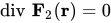

In a more popular formulation for the whole space, the Helmholtz theorem states:
Any vector field , unambiguous, continuous and limited in the whole space, can be decomposed into the sum of the potential and solenoidal vector fields and is presented in the form: Where |



Scalar function called scalar potential, vector function called a vector potential. [1] .


Statement of the theorem
Let F be a vector field in R ³, and let it be twice continuously differentiable and decrease faster than 1 / r at infinity in the case of an unbounded domain. [2] Then the field F is representable as the sum of the vortex-free field (whose rotor is zero) and the solenoidal field (whose divergence is zero).
One of the possible representations for the vector field F in this form is the sum of the gradient and the rotor of two clearly computable functions, as described below:

Where Is the Newtonian operator (if it acts on a vector field like ∇ × F , it acts on each of its components).
If F has zero divergence , ∇ · F = 0, then F is called solenoidal or divergent-free, and the Helmholtz expansion of F is reduced to
In the case of such a representation of the field A is called the vector potential of the field F. For a solenoidal field (that is, a field with zero divergence), it is always possible to construct a vector function (vector potential), the rotor of which this field is. The vector potential for a given solenoidal field is determined with a significant degree of freedom. In particular, without loss of generality, it is possible to impose on it the condition of Coulomb gauge (or normalization) ∇ · A = 0 (a special case of a divergence-free vector potential, see also the problem of restoring a vector function by rotor and divergence below). The gradient of any scalar function can be freely added to the vector potential - from this its rotor, that is, the solenoidal field determined by it, does not change (and if the specified scalar function satisfies the Laplace equation, the condition of the Coulomb calibration does not change, when the vector potential satisfies it) .
If F has a zero rotor, ∇ × F = 0, then F is called an irrotational or locally potential field , and the decomposition F takes the form
In the case of such a representation of the field, φ is called the scalar potential of the field F. For a vortex-free field (that is, a field with a zero rotor) it is always possible to construct a scalar function (scalar potential), the gradient of which this field is. The scalar potential for a given vortex-free field is determined up to an additive constant.
In the general case, F is representable by the sum
- ,
where the negative gradient of the scalar potential is the vortexless component of the field, and the rotor of the vector potential is the solenoidal one. The representation of F as the sum of a vortex-free field and a solenoidal field is not unique, since one can always add an arbitrary function ψ satisfying the Laplace equation to φ, and a vector function H compatible with ψ that is the result of solving the problem of reconstructing a vector function from rotor and divergence (see below) in accordance with the equations ∇ · H = 0, ∇ × H = ∇ψ. Such a substitution not only changes the scalar and vector potentials involved in the Helmholtz expansion, but also significantly changes the vortex-free field -∇ (φ + ψ) and the solenoidal field ∇ × (A + H) , into the sum of which the field F splits.
Fields defined by rotor and divergence
The Helmholtz theorem is closely related to the problem of reconstructing a vector field from divergence and rotor, which is sometimes called the Helmholtz problem .
Let a scalar field be given and vector field which are sufficiently smooth and are either given in a limited area or decrease faster than 1 / r ² at infinity. Find such a vector field , what
- and
When analyzing the existence and uniqueness of a solution to a problem, one should distinguish between:
- the internal problem (the rotor, divergence, and the vector function itself are considered inside a bounded domain with a sufficiently smooth boundary),
- an external problem (the rotor, divergence, and the vector function itself are considered for the space R ³ with a cut out “hole” having a sufficiently smooth boundary),
- problem for the whole space R ³.
The internal problem (provided that it is solvable) has a unique solution if a normal projection is given along the boundary of the region for vector function .
An external problem (provided that it is solvable) has a unique solution if a normal projection is given along the boundary of the region for vector function , and on the vector function imposed a requirement that it decreases at infinity at least as .
The problem for the whole space R ³ (provided that it is solvable) has a unique solution if the vector function imposed a requirement that it decreases at infinity at least as .
In all these cases, the solution to the Helmholtz problem is unique if it exists for given input data.
Necessary conditions for the existence of a solution
The problem has a solution not for all , and :
- From identity it follows that the condition must be met i.e. vector divergence must be equal to zero.
- For an internal problem from identity follows that , i.e., the integral of the boundary condition on the bounding surface must be equal to the integral of the function by area volume.
- For the external problem and for the task given for the whole space R ³, the functions and should quickly go to zero at infinity together with the function itself.
Sufficient conditions for the existence and uniqueness of a solution
A. Internal task : if
- and
- ,
- then solving the field recovery problem on the rotor divergence and boundary condition exists and is unique.
B. External task : if
- and
- integrals and converge upon integration over infinite volume and decrease at infinity as at least like ,
- then solving the field recovery problem on the rotor divergence boundary condition and the condition that falls to infinity at least as , exists and is unique.
B. The problem for the whole space R ³ : if
- and
- integrals and converge upon integration over infinite volume and decrease at infinity as at least like ,
- then solving the field recovery problem on the rotor divergence and the condition that falls to infinity at least as , exists and is unique.
The solvability and uniqueness of the solution of the Helmholtz problem is closely related to the solvability and uniqueness of the solution of the Neumann problem for the Laplace equation in the same domain (see below the algorithm for constructing a solution to the Helmholtz problem).
Decomposition of a vector field into the sum of a vortex-free field and a solenoidal field
Using the problem of restoring a vector function by rotor and divergence, decomposition of a vector field the sum of the vortex-free field and the solenoidal field can be performed as follows:
- For a given vector function computed: function function boundary condition if the vector function set for a subdomain of space with border .
- When it comes to an internal task, then from identity compatibility condition follows . Therefore, all conditions of compatibility of input data for the task and with boundary condition fulfilled, the problem is solvable and has a unique solution. The resulting vector function is an irrotational field.
- Insofar as , conditions for compatibility of input data for the task and with the zero boundary condition are satisfied, the problem is solvable and has a unique solution. The resulting vector function is a solenoidal field.
- Consider the problem , with boundary condition . The compatibility conditions for the input data are satisfied, the problem is solvable and has a unique solution. Moreover, on the one hand, the solution to this problem is the function itself , and on the other hand, the solution to the same problem is a function . Means , the desired representation of the field how the sums of a vortex-free field and a solenoidal field are constructed.
The constructed representation of a vector field as a sum of two fields is not unique. There are vector fields that are simultaneously vortex-free (the rotor is zero) and solenoidal (the divergence is zero). These fields are gradients of scalar functions satisfying the Laplace equation (and only they). Adding any such field to the first term and subtracting it from the second term, we obtain a new partition of the vector field into the sum of the vortex-free and solenoidal fields.
Rotor and divergence vector function recovery
The solution to the problem of restoring the function with respect to the rotor, divergence and the boundary condition can be constructed as follows:
- 1) For a given function function is calculated where is the scalar potential calculated by the formula
- .
- The result is a function , in which and ;
- 2) For a given function function is calculated where is the vector potential calculated by the formula
- .
- The result is a function , in which and ;
- 3) Search function , in which , , and the normal projection on the boundary of the region chosen so that satisfied the boundary condition .
- To find such a function , substitution is done where is the scalar potential must satisfy the Laplace equation . For function we obtain the Neumann boundary condition , and it is easy to verify that the criterion for the solvability of the Neumann problem will be fulfilled. Therefore function always exists, is determined uniquely for an external problem, and up to an additive constant for an internal problem. As a result, the function we need always exists and is unique.
Function is the solution to the task, and the only one. If the boundary condition is not specified, the solution to the problem is all possible functions of the form where , is the gradient of any function satisfying the Laplace equation. If the problem is posed in the whole space R ³, the solution (unique) is the function possessing the desired behavior at infinity.
An Helmholtz Theorem Formulation
As a result, Helmholtz's theorem can be reformulated in the following terms. Let C be a solenoidal vector field ( div C = 0 ), and d be a scalar field in R ³ that are sufficiently smooth and either are given in a bounded region or decrease faster than 1 / r ² at infinity. Then there exists a vector field F such that
- and
If, moreover, the vector field F is considered in the whole space R ³ and disappears as r → ∞, then F is unique. [2] In the general case, the solution is determined up to an additive additive — the gradient of an arbitrary function satisfying the Laplace equation.
In other words, under certain conditions, a vector field can be constructed by its rotor and divergence, and when the problem is defined in the entire space R ³, the solution is unique (under the a priori assumption that the field disappears at infinity quickly enough). This theorem is of great importance in electrostatics , for example , Maxwell's equations in the static case describe fields of this type. [2] As already mentioned above, one of the possible solutions:
See also
- Vector field
- Vector analysis
- Vector Analysis Formulas
- Solenoidal Vector Field
Notes
- ↑ Lee, 1965 , p. 50.
- ↑ 1 2 3 David J. Griffiths, Introduction to Electrodynamics , Prentice-Hall, 1989, p. 56.
Literature
- Kochin N. Ye. - Vector calculus and the beginning of tensor analysis
- Korn G.A., Korn T.M. Math reference book for scientists and engineers . - M .: " Science ", 1974. - S. 177.
- Li Tsong-tao . Mathematical methods in physics. - M .: Mir, 1965 .-- 296 p.