Steyr AUG (Armee Universal G ewehr - Army Universal Rifle) - a small arms complex, launched in 1977 by the Austrian company Steyr-Daimler-Puch (now Steyr Manlicher AG & Co KG). In Austria, the rifle is licensed under the brand name F88. It has interchangeable trunks of different lengths: the main 508 mm, as well as shortened trunks 350 mm and 407 mm and a heavy barrel 621 mm.
| Steyr aug | |
|---|---|
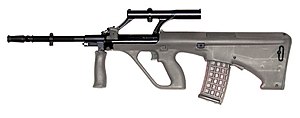  Steyr AUG A1 with a barrel of 508 mm (top) and 407 mm (bottom) Steyr AUG A1 with a barrel of 508 mm (top) and 407 mm (bottom) | |
| Type of | machine |
| A country |  Austria Austria |
| Service History | |
| Years of operation | 1978 - present |
| Adopted | |
| In service | See Operating Countries |
| Wars and conflicts | Timor Leste , War in Afghanistan (since 2001) , Iraq War |
| Production history | |
| Constructor | Horst Vesp Karl Wagner Karl Moser |
| Designed by | 1977 year |
| Manufacturer | Steyr-Mannlicher AG & Co KG , ADI Limited , Lithgow Facility , SME Technologies |
| Years of production | 1978 - present |
| Total released | production continues |
| Options | see existing modifications |
| Characteristics | |
| Weight kg | A1 / A2 empty: 3.3 / 3.6 (with a barrel of 407/508 mm) A3 empty 3.9 (with barrel 455 mm) A3 SF empty: 3.97 (with a barrel of 407 mm) 9 mm without cartridges: 3.3 9 mm XS empty: 2.97 Z empty: 3.7 / 3.75 (with barrel 508/550 mm) empty store : 0.13 / 0.2 (5.56 / 9 mm), 0.09 (civilian) |
| Length mm | A1 / A2 : 690/790 (with a barrel of 407/508 mm) A3 : 745 (with barrel 455 mm) A3 SF : 715 (with a barrel of 407 mm) 9 mm : 665 9 mm XS : 610 Z : 765/805 (with barrel 508/550 mm) |
| Barrel length mm | A1 / A2 : 407, 508 A3 : 365, 407, 455, 508 A3 SF : 365, 407, 508 9 mm : 420, 508 9 mm XS : 325 Z : 407, 508, 550 |
| Height mm | 275 ( A1 / A2 , 9 mm) 245 ( A3 ) 232 ( A3 SF ) 210 ( 9 mm XS ) 185 ( Z with magazine for 9 rounds) |
| Cartridge | 5.56 × 45 mm NATO 9 × 19 mm Parabellum (version of the submachine gun) |
| Caliber mm | 5.56 9 (version of the submachine gun) |
| Work principles | removal of powder gases , butterfly valve (automatic machines) free shutter (submachine gun) |
| Rate of fire rounds / min | 680-750 650-720 (version of the submachine gun) |
| starting speed bullets , m / s | 992 (standard) |
| Sighting range , m | 650 |
| Type of ammunition | detachable box magazine : plastic sector for 9, 30 or 42 rounds (automatic) steel straight for 25 rounds (submachine gun) |
| Aim | A1, A1 9 mm : 1.5X integrated optical sight A2, A2 9 mm, Z : weaver bar A3, 9 mm XS : Picatinny rail A3 SF : 1.5X integrated optical sight equipped with Picatinny rails |

This rifle uses a bullpup layout scheme, in which the magazine and bolt assembly are located behind the fire control handle and the trigger. There are two fire modes: single-shot fire and automatic fire. It is also possible modernization for firing single and with a cut-off of 3 shots.
Content
- 1 History
- 2 Technical description
- 2.1 Mechanism of automation of powder gases
- 2.2 trigger mechanism
- 2.3 Power
- 2.4 Sights
- 2.5 Design Features
- 2.5.1 Housing and layout
- 2.5.2 Modular structure
- 3 Existing modifications
- 4 Operating countries
- 5 Advantages and disadvantages
- 5.1 Advantages
- 5.2 Disadvantages
- 6 Conclusion
- 7 notes
- 8 Literature and sources
- 9 References
History
Steyr AUG appeared as part of a program to develop new infantry weapons for the Austrian army. In the late 1960s, it was decided that it was necessary to rearm the army with StG.58 rifles (licensed copies of the Belgian FN FAL ). A rearmament program was developed, its direct execution was entrusted to the firms Steyr Daimler Puch AG and Swarovski Optic . Steyr Daimler Puch AG was to carry out the development and implementation of a fundamentally new infantry weapon that met the tough competitive requirements of the Austrian army.
The developers were tasked with creating the most universal single infantry weapon that could fulfill all the functions previously carried out by various weapons of an infantry platoon. In addition, the new infantry weapons system was supposed to be relatively light, transportable, ergonomic, reliable, easy to maintain and have good accuracy.
Steyr approached the issue in a rather original way: instead of creating something averaged, it was decided to move along the path of modular assembly. The AUG design consists of interchangeable module blocks; thus, having a set of spare parts, it can be easily turned into any weapon from a submachine gun to a sniper rifle. Three Austrian designers played a significant role in the creation of the new weapon: Horst Wesp, Karl Wagner and Karl Moser, the project was supervised by Walter Stoll from the side of the Austrian army. The developed design cannot claim absolute originality. And before the start of the AUG development, bullpup rifles were created, interchangeable barrels and bolt mounts were used in machine guns from the beginning of the 20th century, but it was Steyr’s designers who managed to create the most successful combination of the designs that existed at that time, which ensured the success of the project and worldwide popularity this weapon. The first working prototypes of the rifle appeared in the mid -1970s , and in 1977 a new weapon was adopted under the designation StG.77 ( German S turm G ewehr 77 ). In 1978, the mass production of Steyr AUG was started, which continues to this day [1] .
In the 1980s, it was decided to expand the functionality of the army universal rifle, a set of modules was developed that allows, by replacing the barrel and bolt group (installing a free shutter), convert it into a submachine gun using 9 × 19 mm Parabellum cartridges for to ensure compatibility with stores, a special adapter adapter [1] [2] is installed under this cartridge.
In the future, the improvement of this type of weapon continued to move along the path of increasing universality. In 2005, the AUG A3 model was introduced, the fundamental difference from earlier models is the rejection of the integrated optical sight in favor of a standard Picatinny rail and replacing the folding front handle with another Picatinny rail. After this modification, it became possible to install almost any standard sight, from a collimator to a night one . Replacing the front folding handle allowed the installation of the vast majority of standard modules, from a tactical flashlight and a folding handle to an under-barrel grenade launcher or even a combat shotgun, two small additional trims on the side of the barrel allow the installation of a focal plane or other necessary additions. Thus, the owner can personally determine the level of functionality he needs and the load of weapons with additional devices [1] .
Technical Description
Automatic (or rather, a family of small arms) Steyr AUG is an automatic weapon operating on the principle of removal of powder gases, with magazine-fed, air-cooled interchangeable barrel, arranged according to the bullpup scheme (in which the breech of the barrel, bolt group and magazine are located behind the handle fire control and trigger). It consists of six easily replaceable units [3] [4] as standard.
Automation mechanism of powder gases
AUG automation is based on a short-stroke gas vent mechanism . Locking the barrel is carried out by turning [1] the shutter with fixing on 7 combat stops for the steel clutch located in the receiver . On the bolt are a sleeve ejector and a spring-loaded reflector. The standard shutter has an ejector located on the right, which ensures the ejection of sleeves to the right. If necessary, the standard shutter can be replaced with an extractor on the left, which will ensure the corresponding direction of flight of the liners . The shutter is located on the bolt frame , which is mounted inside the weapon body on two hollow tubes. In the standard, the left shaft serves as a pusher, transmitting the shutter movement of the handle for cocking weapons. The right one is the gas piston rod. Inside these tubes, behind the shutter, there is a return spring , inside of which a rod - guide passes. The loading handle is stationary when shooting, however, if necessary, it can be rigidly connected to the bolt group by pressing the button located on the handle itself. In the Steyr AUG A2 model, the loading handle can be folded up and has a slightly changed shape [1] .
Trigger mechanism
The trigger mechanism (USM) is made in the form of a separate module located in the butt . It connects to the trigger with pull rods. The fuse is made in the form of a transverse button above the handle of the weapon and blocks the trigger rod. Translation of fire modes is done by pressing the trigger of varying degrees of severity. Incomplete pressing causes a single shot, full - a queue. The hand-held fire translator as such is missing. Almost the entire trigger is made of plastic, with the exception of pins, springs, hammer, trigger rods. To modify the Steyr AUG, rework kits are produced in the light machine gun , modifying the trigger for firing with an open shutter . There are 3 versions of this module that provide different firing modes: single, bursts with a cut-off of 3 shots, continuous bursts [1] [3] .
Nutrition
The Steyr AUG ammunition is supplied from two-row box-shaped magazines made of impact-resistant plastic , with side inserts made of transparent polymer, for visual control of the quantity of ammunition in the store. Three types of stores are available - with a capacity of 9, 30 and 42 rounds. The first type of stores are equipped, as a rule, with models produced for the civilian population [5] . The AUG is equipped with a second type of standard equipment, the third type with a light machine gun, and the increased magazine length of 42 rounds is a certain inconvenience when firing from a prone position. The magazine latch is located behind the magazine slot and is equally accessible for the right and left hands, although it is located somewhat inconveniently [1] [3] . Submachine gun options use steel magazines with 25 rounds.
Sights
The main sighting device for the Steyr AUG A1 is a 1.5X non-removable optical sight integrated into the carrying handle. The sight housing is part of the receiver. But on individual samples intended for use as sniper rifles, instead of a sight and a handle, the Weaver bar was installed. In case of failure of the standard optics, a front sight and a rear sight are located on the upper surface of the housing. Starting from model A2, the scope is removable and allows the installation of various guides for the sights, such as the Vivera bar or Picatinny rail . The A3 model has an already installed Picatinny rail for installing sights and three bars for installing additional devices [1] [3] [6] .
Design Features
Steyr AUG, like any technical product, has a number of specific design features that distinguish it from similar devices.
Enclosure and layout
The case is made of impact-resistant plastic in one piece, with a bracket covering the trigger and the shooter's hand, and in models A1 and A2 with a pistol grip. Windows for the extraction of sleeves are located on the left and right, depending on the type of bolt group, one of them is closed with a plastic cover. Access to the nodes and mechanisms of the weapon is carried out by removing the butt plate of the butt , which is fixed by means of a transverse pin on which the rear sling attachment is located. The hull can be painted in various colors, the most common olive green for the army, there are also desert colors and black for the police forces. The shape of the case gives the Steyr AUG a characteristic futuristic look [1] .
All Steyr AUGs are equipped with a carrying strap, and a 40 mm M203 grenade launcher can be installed on them.
Modular Structure
Steyr AUG in the basic configuration consists of 6 main blocks:
- The barrel unit is quick-detachable, fastened by turning on 8 stops located outside on the breech of the barrel in 2 rows. On the right side of the barrel is a gas block in which a gas piston and a return spring are located. On the left is a spring-loaded latch that locks the barrel in the receiver. At the bottom below the block is a hinge for fastening a folding handle, in model A3 - Picatinny rail. On the muzzle of the barrel is a three-slot arrester . Trunks are available in 4 types with a length of 350 mm, 407 mm, 508 mm, 621 mm. The longest barrel is equipped with folding bipod and is used in case of modification in a sniper rifle or light machine gun . The barrel channel has a right-hand thread with a pitch of 1: 228 mm (1: 9 inches), together with the chamber has a chrome finish. The combat survivability of the barrel is 15,000 rounds [1] [7] .
- The receiver (the main element of the weapon) is made of durable aluminum alloy, reinforced with steel plates in places of the highest load [1] .
- The bolt frame and bolt have 2 guides, one of them transfers force from the gas piston, the second from the cocking handle of the weapon.
- The stock box is made of fiberglass - reinforced polyamide and is the basis of the entire structure. The exterior shape of the stock stock provides the distinctive AUG exterior design. In a plastic case, return springs, a fuse, a receiver latch, a trigger guard with rods [3] are located .
- The store is a two-row, with a capacity of 9, 30 or 42 rounds, made of plastic.
Incomplete assembly-disassembly for maintenance purposes is carried out without the help of special tools. The rifle is disassembled into 6 main modules [1] [3] .
Partial disassembly procedure:
- Separate the store.
- Cock the percussion mechanism, leaving the reload handle in the extreme rear position, locking it in a special recess in the receiver.
- Separate the barrel: use your finger to press down the barrel lock button, turn the barrel with the handle 45 degrees clockwise and remove it.
- Sliding the stopper, remove the receiver and the bolt frame.
- Remove the trigger mechanism: press on the recess in the butt plate of the butt and pull out the pin, separate the butt plate and remove the trigger.
Assemble in the reverse order. As we see from the manual, the simplicity of incomplete disassembly AUG is not inferior to the Kalashnikov assault rifle [3] .
Existing Modifications
Currently, the following major modifications exist:
- Steyr AUG A1 - the basic modification, released in 1977 , has all the basic features characteristic of models of later series. A characteristic feature is a fixed fixed vertical front handle and a built-in small optical zoom , located in the carrying handle.
- The Steyr AUG A2 differs from the basic model in the presence of a universal mount for NATO standard sights ( Weaver bar ) and a folding front handle.
- The Steyr AUG A3 differs from the base model by the presence of four Picatinny rails : the upper one is for mounting sights, the underbarrel grenade launcher or the vertical front handle can be attached to the lower one, and the laser pointer or other necessary additional equipment is attached to the side ones.
- Steyr AUG Z is a civil self-loading version of the AUG A2 [5] .
- Steyr AUG HBAR-T - 5.56 mm Marxman rifle , differs from the base model in a longer and heavier barrel.
- Steyr AUG LMG - 5.56 mm machine gun based on HBAR-T.
Any of the Steyr AUG models can be modified using a standard set of modules in a submachine gun , carbine , machine gun , sniper rifle , machine gun .
A 508 mm barrel is installed as standard on an assault rifle. [1] [7]
В результате замены ствола (на короткий ствол 350 мм или 407 мм) и затворной группы (под пистолетный патрон) получается пистолет-пулемёт под патрон 9×19 мм Парабеллум . Стандартные магазины от Steyr MPi 69 подключаются с помощью специального переходника, идущего в комплекте [1] [7] .
В случае карабина устанавливается укороченный ствол длиной 407 мм, остальное остаётся без изменений. Данная модификация осуществляется при оснащении AUG экипажей техники и, в некоторых случаях, десантников.
В комплектации снайперской винтовки устанавливается удлинённый ствол 621 мм, он может комплектоваться сошками. При установке более толстого и длинного ствола повышается кучность стрельбы, что позволяет использовать AUG в качестве достаточно посредственной автоматической снайперской винтовки под патрон 5,56×45 мм НАТО. [1] [7]
При использовании в комплектации ручного пулемёта производится замена ствола на удлинённый 621 мм и замена затворной группы. Питание боеприпасами осуществляется из магазинов повышенной ёмкости на 42 патрона или из стандартных магазинов на 30 патронов. Полученный ручной пулемёт уступает по тактико-техническим характеристикам многим образцам оружия, изначально имеющим данную конструкцию, но, тем не менее, способен эффективно выполнять все поставленные перед ним задачи [1] [7] .
Steyr AUG в различных модификациях производится в ряде стран по лицензии . Например, в Австралии производится вариант AUG, который имеет обозначение F88А1 [1] .
Operator countries
Steyr AUG is in service with the Austrian army and police, adopted in Australia , New Zealand , Morocco , Bolivia , France , as well as in the armies and law enforcement agencies of other countries, including the US Coast Guard and some US police [7] .
Steyr AUG was developed as part of the rearmament program of the Austrian army according to a new tactical concept that was common in the 1970s and 1980s .
AUG is a universal rifle complex, which allows equipping infantry platoon fighters with all necessary types of light small arms, depending on the task, and minimal means [1] .
In the basic configuration, it is designed for firing at a range of up to 300 meters by forces of small tactical groups of up to a platoon size in the conditions of short-range combat at medium and short distances. The most effective AUG is in urban combat.
To the maximum extent possible, the existing advantages of Steyr AUG can be achieved by arming it with well-trained groups of airborne infantry, police units, motorized infantry, as part of large military formations with a deeply echeloned and duplicated material and technical supply system. AUG performed quite well during the Iraq war , where it was used that way.
- Austria
- Australia - in 1989 adopted by the army, replacing the M16 rifle . It is in service under the designation F88 Austeyr . The options are F88C, F88S-A1, F88SA-1C, F88S-A2 Austeyr.
- Argentina - Replaced M16A2 rifles.
- Bulgaria - used by SOBT .
- Brazil - Used by the Brazilian Intelligence Agency since November 2011.
- United Kingdom - Special Forces in the United Kingdom ( SAS ) [7]
- Croatia - in special forces.
- Djibouti
- Gambia
- Germany - in the special forces of Germany ( GSG-9 ) [7]
- Indonesia
- Ireland [7] - Adopted in 1987 as a replacement for the FN FAL [8] . Steyr AUG A2 and A3 variants are used.
- Italy - in special forces.
- Cameroon - Adopted in 1984 [8]
- Luxembourg - in the arsenal of the army, used Steyr AUG A2.
- Malaysia - in 1989 purchased 100 thousand units. and production license, rifles adopted for service [8]
- Morocco
- Netherlands
- New Zealand - adopted in 1986 [8] . The first 5,000 rifles were manufactured at the Steyr Daimler Puch factory, all the rest were made by Thales Australia (formerly ADI). The New Zealand version is similar to the Australian F88 Austeyr, but does not have a fuse button.
- Oman - in 1981 adopted by the Royal Guard of Oman, later adopted by the armed forces of the country [8]
- Pakistan
- Papua New Guinea - Option F88.
- Poland - used by special forces.
- Saudi Arabia - Adopted in 1980 [8]
- USA - Used by SWAT Special Forces, Border Guards, DEA, and FBI [8]
- Republic of China
- Tunisia - Adopted in 1978 [8]
- Uruguay - ordered [ when? ] 7000 Steyr AUG A2UR for infantry.
- Ukraine - in small numbers in the special unit "Falcon" Organized Crime Control Department of the Ministry of Internal Affairs .
- Philippines
- Falkland Islands - In the Armed Forces.
- Ecuador [7]
Strengths and weaknesses
Like any other weapon, Steyr AUG has its own advantages and disadvantages, some of them are due to the bullpup scheme, part is an individual feature of this model [7] .
Advantages
- The bullpup construction scheme allows you to reduce the total length of the weapon while maintaining the same barrel length.
- The displacement of the bolt group to the butt positively affects the accuracy of fire.
- The center of gravity shifted to the butt allows the fighter to quickly carry fire along the front and in depth thanks to the optical sight of low magnification.
- A rather high reliability of components and mechanisms, the ability to fire when there is water in the bore [7] .
- The ability to rearrange weapon modules according to the tactical task, from a submachine gun to a light machine gun or sniper rifle .
- The ability to adapt for both right-handed and left-handed people by transferring the extractor window.
- Starting with model A2, the presence of a universal mount for NATO standard sights allows you to equip weapons with sights in accordance with the assigned tactical task. In the A3 model, the equipment with universal mounts has only grown, which allowed the Steyr AUG complex to gain even greater flexibility in the settings for the intended tasks.
- The presence of a store made of translucent plastic allows you to visually control the amount of ammunition [7] .
Weaknesses
- Highly located sights make the shooter rise higher from the shelter, for example, when shooting from a prone position [7] .
- In combat conditions, it is difficult for a left-handed person to use a machine configured for a right-handed person, since the extractor window is too close to the person shooting. When firing from the left hand with a right-handed extractor, the cartridges fly directly into the shooter's face. In Steyr AUG, it is possible to change the location of the cartridge window of the ejector, in combat conditions it is almost impossible to replace it [7] .
- The specific location of the store makes reloading much more difficult, especially when shooting from a prone position.
- The location and specific structure of the return spring system can lead to weapon failures when trying to fire after removing the machine from liquid mud. In this case, it will be necessary to manually retake the next cartridge, which is, however, better than the complete destruction of other types of weapons with the location of the magazine after the trigger guard (valid for machine guns in the absence of a gas piston) [7] .
Conclusion
In general, the Steyr AUG is a fairly effective and reliable weapon, allowing the infantry platoon to flexibly adapt to the current tactical situation, the most effective in conducting urban combat and in lightning-fast assault operations. Mechanisms and automation with timely cleaning and replacement are efficient and reliable. Based on the design and tactical and technical characteristics, it can be said that the AUG is a suitable weapon for a small professional army of a non-belligerent country, airborne infantry groups or similar special forces designed for lightning strikes, and special police units [1] [3] [7 ] ] . According to a survey conducted among specialists by the American television channel Military Channel in order to find out the top 10 models of small arms of the 20th century, Steyr AUG took 7th place [9] .
Notes
- ↑ 1 2 3 4 5 6 7 8 9 10 11 12 13 14 15 16 17 18 19 description of Steyr AUG on the site weapon.at.ua
- ↑ description of Steyr AUG on the website tools-of-death.ru
- ↑ 1 2 3 4 5 6 7 8 description Steyr AUG Archived on February 7, 2009. on the site sniper.ru
- ↑ description of Steyr AUG Archival copy of August 21, 2009 on the Wayback Machine at legendary-arms.ru
- ↑ 1 2 Description of AUG Z (English) on the manufacturer’s website
- ↑ Steyr AUG description Archived on May 10, 2008. on the website liveguns.ru
- ↑ 1 2 3 4 5 6 7 8 9 10 11 12 13 14 15 16 17 Sergey Monetchikov. Star Blaster, or Austrian StG.77 assault rifle (AUG) // Bratishka magazine, February 2007
- ↑ 1 2 3 4 5 6 7 8 Steyr AUG assault rifle // Master Gun magazine, No. 69, December 2002. p. 54-58
- ↑ The article "Heroes of our time: The best rifles of the XX century" on the website of the magazine " Popular Mechanics "
Literature and Sources
- Steyr AUG assault rifle // Master Gun magazine, No. 69, December 2002. pp. 54-58
Links
- Description of Steyr AUG A1 / A2 on the manufacturer’s website
- Description Steyr AUG A3 (eng.) on the manufacturer’s website
- Description Steyr AUG A3 SF (eng.) on the website of the manufacturer
- Description Steyr AUG 9 mm (eng.) on the manufacturer's website
- Description of Steyr AUG 9 mm XS on the manufacturer’s website
- Steyr AUG Z user manual (English) (German) on the manufacturer’s website