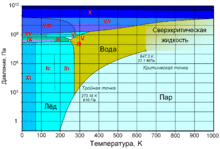

Ice II is a trigonal crystalline variety of water ice with a highly ordered structure. Obtained by compressing ice I h at temperatures from −83 ° C to −63 ° C (190–210 K ) and a pressure of 300 MPa , or by decompressing ice V at −35 ° C (238 K). When heated, ice II is converted to ice III .
Ice II can exist in a metastable state at temperatures below −173 ° C (100 K) and a pressure range from atmospheric to about 5 GPa . At atmospheric pressure and temperatures above −113 ° C (160 K), it irreversibly transforms into ice I h .
At 300 MPa pressure, the density of ice II is 1.16 g / cm³. Its dielectric constant (static) is 3.66.
Ice II has triple points with ice I h , ice III (−34.7 ° C, 212.9 MPa) and ice V (−24.3 ° C, 344.3 MPa), as well as ice V and ice VI ( −55 ° C, 620 MPa).
Ordinary water ice according to Bridgman's nomenclature belongs to ice I h . In laboratory conditions (at different temperatures and pressures), various modifications of ice were created: from ice II to ice XVI.
It is believed that “ice” satellites , for example, Ganymede , can mainly consist of ice II.
Links
- Chaplin, Martin. Ice-two (Ice II) . Water Structure and Science (June 23, 2008). Date of treatment February 27, 2009. Archived March 27, 2012.