Amat [1] ( Amt [2] [3] , Ammat [4] ; Egypt. ˁm-mwt - "devourer" [5] ) - a monster goddess with a hippo body, lion paws and a mane, a crocodile’s mouth in ancient Egyptian mythology . She ate the man’s heart if the great Ennead convicted him at the afterlife of Osiris in Amenti [4] .
| Ammat | ||||||||
|---|---|---|---|---|---|---|---|---|
| ||||||||
 | ||||||||
| Mythology | ancient egyptian | |||||||
| Type of | monster goddess | |||||||
| Name interpretation | Devourer | |||||||
| Latin spelling | Ammut ammit | |||||||
| Floor | ||||||||
| Occupation | devours the hearts of sinners | |||||||
| Character traits | hippo with lion paws, mane, and crocodile jaws | |||||||


The concept of Ammat begins to take shape at the beginning of the New Kingdom and was finally formed during the XIX dynasty [4] .
In the royal tombs of the pharaohs, Ammat is not shown in the scene of weighing the heart, since the pharaoh was considered the bearer and adherent of the truth of Maat during his life, which he can not break. In the tombs of the pharaohs, Ammat was depicted not as a monster, but as a protector [6] . On the bed, decorated with gilded heads of hippos, from the tomb of Tutankhamun ( KV62 ) it is written: “ Pharaoh is loved by her ” [7] . She was responsible for the second hour of the night, but in the case of the Ptolemies in the "Book of the Hours" it was recorded at 10 a.m.

Scene of the weighing of the heart at the trial of Osiris. The Book of the Dead Ani , approx. 1300 BC British museum
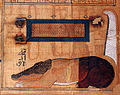
Ammat from the Book of the Dead by Nebkeb (c. 1391-1353 BC)

Bed with a hippo head from the tomb of Tutankhamun
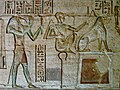
Relief from the temple of Ma'at in Deir al-Medina . Ammat is shown on the right. Ptolemaic period


Notes
- ↑ Oksana Dubrovskaya. Maat . - Mythology. - M .: OLMA-PRESS Education, 2002. - S. [162] (stb. 2). - 302 s. - ISBN 5-94849-107-2 .
- ↑ Dictionary of Egyptian mythology. - M .: Centerpolygraph, 2008 .-- 256 p. - (The Mysteries of Ancient Egypt).
- ↑ Sergey Alexandrovich Tokarev. Myths of the World: Encyclopedia. - Owls. Encyclopedia, 1987.- S. 86. - 728 p.
- ↑ 1 2 3 Ivan Cancer. Myths and legends of ancient Egypt. - Dragonfly, 2013 .-- S. 17, 253.
- ↑ Erman, Adolf; Grapow, Hermann. Wörterbuch der ägyptischen Sprache. - Berlin: Akademie-Verlag. - T. 1. - S. 184.
- ↑ Friedrich Abitz. Pharao als Gott in den Unterweltsbüchern des Neuen Reiches. - Göttingen: Vandenhoeck & Ruprecht, 1995 .-- S. 193. - ISBN 3-7278-1040-8 .
- ↑ Horst Beinlich, Mohamed Saleh. Corpus der hieroglyphischen Inschriften aus dem Grab des Tutanchamun: Mit Konkordanz der Nummernsysteme des "Journal d'entrée" des Ägyptischen Museums Kairo, der Handlist to Howard Carter's Catalog of objects in Tutankhamūns tomb und der Ausstellung Mus Kumüssen - Oxford: Griffith Institut, 1989 .-- S. 137. - ISBN 0-900416-53-X .
- ↑ Christian Leitz ua Lexikon der ägyptischen Götter und Götterbezeichnungen. - Leuven: Peeters, 2002. - T. 2. - S. 114–115. - ISBN 90-429-1147-6 .
Links
- AMT on the site "Encyclopedia of fictional creatures"