Bessed ( Belorussian Besedz ) - a river in Russia and Belarus , the left tributary of the Sozh River (a tributary of the Dnieper ). The length of the river is 261 km, the catchment area is 5600 km². The average annual water flow in the mouth area is 27.8 m³ / s.
| Chat | |
|---|---|
| Belor. Besedz | |
 Conversation near the village of Svetilovichi, Vetkovsky district Conversation near the village of Svetilovichi, Vetkovsky district | |
| Characteristic | |
| Length | 261 km |
| Pool | 5600 km² |
| Water consumption | 27.8 m³ / s (mouth) |
| Watercourse | |
| Source | |
| • Height | above 171.0 m |
| • Coordinates | |
| Mouth | Sozh |
| • Location | 147 km on the left bank |
| • Height | higher than 117.4 m |
| • Coordinates | |
| Location | |
| Water system | Sozh → Dnipro → Black Sea |
| Russia | Smolensk region |
| Belarus | Bryansk region , Mogilev region , Gomel region |
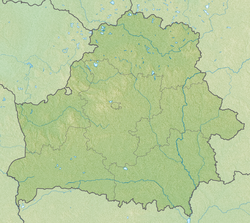


Description
The Besed river originates in the south of the Smolensk region , then flows through the Mogilev region of Belarus (the village of Khotimsk and the city of Kostyukovichi are located in the river basin), crosses the western part of the Bryansk region of Russia (the village of Krasnaya Gora 98 km from the mouth is the beginning of the navigable part of the river), and then again flows through Belarus ( Gomel region ), flowing into Sozh 30 km above Gomel .
Tributaries: Sledge , Zhadunka , Surov , Oleshnya , Palud (right); Olshovka , Column , Kolpita (left).
Name Origin
The name Besed, according to one version, has a Finno-Ugric origin. [one]
According to another version, the name comes from Iranian languages . The hydronym Besed is considered in the same row with the hydronyms Bestan, Bestwest, Obest, Obista, Obst, Bastov, Bastovka, Bostya, etc. The first part of these names ( Ob- , Obe , etc.) is comparable with the Iranian geographic term ob - water "," river ". The second part ( -st , -stan ) goes back to the Iranian word in the meanings of "parking", "camp", "place", which corresponds, for example, to the modern Ossetian root basis -ston in complex words in the meaning of "wide area". [2]
According to V.N. Toporov and O.N. Trubachev, the name of the Besed River is of Baltic origin. The hydronym corresponds with such correspondences as lit. Bestinis, Best-upis , lts. Beste [3] , which is associated with lit. besti "dig; stick in ” [4] .
Notes
- ↑ Kalyadzinsky, Leanid. Archealogy ў przyme geagraphii . The Vedas No. 10 (2426) (March 4, 2013).
- ↑ Rogaleў A.F. Names of the Fatherland of Belarus (Tapanіmіya Belarusі). - Gomel: Bark, 2008 .-- S. 138, 139. - 216 p. - ISBN 978-985-6763-40-6 .
- ↑ V.N. Toporov, O.N. Trubachev. Linguistic analysis of the hydronyms of the Upper Dnieper. - Moscow: Publishing House of the Academy of Sciences of the USSR, 1962 .-- S. 177.
- ↑ A. Vanagas. Lietuvių hidronimų etimologinis žodynas. - Vilnius: Mokslas, 1981 .-- S. 63.
Literature
- Besed // Brockhaus and Efron Encyclopedic Dictionary : in 86 volumes (82 volumes and 4 additional). - SPb. , 1890-1907.