Gao Gang ( Chinese trad. 高崗 , ex. 高岗 , pinyin : Gāo Gǎng , October 25, 1905 - August 17, 1954 ) - Chinese party and statesman, chairman of the State Planning Commission of the PRC (1952-1954).
| Gao Gang | |||||||
|---|---|---|---|---|---|---|---|
| 高岗 | |||||||
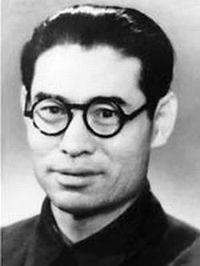 Gao Gang | |||||||
| |||||||
| Head of the government | Zhou Enlai | ||||||
| Predecessor | Position established | ||||||
| Successor | Li Fuchun | ||||||
| Birth | |||||||
| Death | |||||||
| The consignment | Chinese Communist Party | ||||||

Content
Biography
Born in Huaiyuan County , Shaanxi Province, into a poor peasant family. By nationality - Manchurian . In 1926 he joined the CCP .
In the 1930s, one of the organizers and leaders of the Soviet movement in Northwest China. Together with Liu Zhidan, he led a peasant uprising at the junction of the provinces of Gansu and Shaanxi , which resulted in the liberation of the Shaanxi-Gansu-Ningxia region in 1932-1933. The presence of a stable Soviet region with a revolutionary government led by Gao Gang allowed the Chinese Red Army during the Great Campaign of 1934-1935 to advance northward to Shaanxi [2] .
Just before the main forces of the Red Army arrived in Northern Shaanxi by November 1936, Gao Gang and Liu Zhidan were arrested and tortured by a detachment subordinate to Mao Zedong . After the subsequent indignation of the members of the CPC Central Committee, Mao accused the commanders of the forward detachment of arbitrariness, and Gao Gang, Liu Zhidan, and all the surviving party and Soviet workers were rehabilitated [3] .
During the Anti-Japanese War (1937-1945), he served as Secretary of the Northwest Bureau of the CPC Central Committee, Chairman of the Political Advisory Committee of the Shaanxi-Gansu-Ningxia Liberated Region, and also responsible for resolving national issues in the Special Region (in addition to the Han , there were many Dungan , Mongols , Tibetans ). After 1935, he practically managed to nullify nationalist and religious discord in the provinces of the Special Region.
Since 1941, he was a member of the "Central Commission for the campaign to streamline the style" - the steering group for the Zhengfeng campaign ( Liu Shaotsi , Kang Sheng , Chen Yun , Gao Gang and Li Fuchun ) [4] . Despite this, during the course of Zhengfeng he was criticized as a left-wing opportunist and dogmatist for falsifying the history of the Northwest and attributing himself to merit.
At the 7th Congress of the CPC (1945) he was elected a member of the CPC Central Committee, and at the plenum of the Central Committee - a member of the Politburo of the CPC Central Committee. Since 1945, in leading military and party work in Northeast China ( Manchuria ): political commissar and commander of the Northeast Military District, secretary of the Northeast Bureau of the CPC Central Committee, chairman of the People’s Government of Northeast China.
During a trip to the USSR as part of the Chinese delegation led by Liu Shaotsi, he invited Stalin, in the event of an Anglo-American military intervention, to declare Manchuria the seventeenth Union Republic of the USSR (to which Stalin replied that the USSR could not take such a step) [5] .
Since 1949 - Deputy Chairman of the Central People’s Government of the PRC, in 1952-1954 - Chairman of the State Planning Commission of the PRC. He was responsible for the development and implementation of the activities of the first five-year plan. He also served as deputy chairman of the People's Revolutionary Military Council .
In 1952, Mao Zedong, with his support, began the struggle to accelerate the transition to socialism and radicalize the methods of socialist transformation, and to complete the collectivization of the country as soon as possible. The early completion of collectivization, said Gao Gang, is an urgent need, since "the spontaneous slide of the peasantry into capitalism" will lead to the fact that in two or three years China will be further from socialism than at the very beginning of the journey. He reacted negatively to Liu Shaotsi, seeing him as the ideologist of the capitalist development of China, and led the line to completely discredit the ideological and political platform of Liu Shaotsi and his supporters. Personally starting an internal party campaign against Liu and Zhou Enlai , he counted on the support of Mao, who expressed disappointment in both leaders to him in private conversations.
At a meeting of the Politburo on December 24, 1953, Mao criticized Gao and gave him a serious warning that his actions posed a serious threat to party unity. In 1954 he was accused of "anti-party activities." In the case of the “Coalition of Gao Gang and Zhao Shushi against the CCP”, Gao Ganya and Zhao Shushi were labeled “speakers of the bourgeois class within the CCP”. In the “Resolution on the Coalition of Gao Gang and Zhao Shushi against the CCP,” adopted on March 31, 1953, it was said:
“The coalition’s conspiratorial actions against the CCP, Gao Gang and Zhao Shushi ... were not random, but were deep, historical, with social roots. It was in such circumstances that Gao Gang, Zhao Shushi and others gathered together in a coalition against the CCP and launched attacks against the Central Committee of the CCP, in particular the Political Bureau of the Central Committee of the CCP in an attempt to overthrow the time-tested leading core of the CCP Central Committee, led by Comrade Mao Zedong and usurp leadership in the CCP and in our country. Their actions against the CCP undoubtedly correspond to the desires of the counterrevolutionary imperialists and bourgeois elements. In reality, they have already become agents of the bourgeois class within our CPC. ”
He refused to admit the charge and, according to the Chinese official version, "committed suicide." In 1955, he was posthumously expelled from the CCP.
He was one of the most consistent internationalists and supporters of friendship with the USSR in the Chinese Communist Party.
Memoirs of Contemporaries
Gao Gang - pockmarked, tall. He has a dull voice, combed back hair and a leisurely gait. Able and strong-willed worker. <...> He is affable and truthful with us. Keeps itself independent [3] .
Notes
- ↑ 1 2 Encyclopædia Britannica
- ↑ Otto Brown . Chinese notes (1932-1939)
- ↑ 1 2 Vladimirov P.P. A special region of China. 1942-1945 [1]
- ↑ Usov V.N. Chinese Beria Kang Sheng. - M .: OLMA-Press ; Red Proletariat, 2004. - ISBN 5-224-04575-4 ; 5-85197-179-7
- ↑ Kovalev I.V. With a mission in China
Sources
- Great Soviet Encyclopedia / Gao Gang
- Victor Nevelsky. “I propose the creation of the 17th Manchu Soviet Soviet Socialist Republic” // “Southern China”