The Indonesian-Malaysian confrontation of 1963-1966 is a low-intensity armed conflict between Indonesia on the one hand and the Federation of Malaysia , Great Britain , Australia and New Zealand on the other hand over the creation of the state of Malaysia and the inclusion of British possessions on the northern part of Kalimantan Island.
| Indonesian-Malaysian Confrontation | |||
|---|---|---|---|
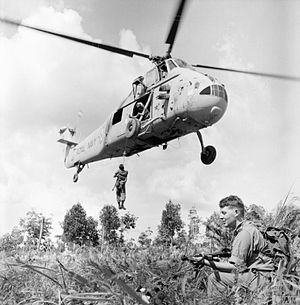 British soldiers landing in Borneo | |||
| date | January 20, 1963 - August 11, 1966 | ||
| A place | northern part of Kalimantan island | ||
| Cause | Indonesia's desire to incorporate Northern Kalimantan, controlled by the Federation of Malaysia, into its country | ||
| Total | After General Suharto came to power , the conflict was settled | ||
| Opponents | |||
| |||
| Commanders | |||
| |||
| Losses | |||
| |||


Content
Conflict Eve (1960-1962)
Initially, Indonesia had nothing against the planned merger of the former British possessions of Malaya , Sarawak , Brunei and North Borneo into the state of Malaysia . On November 20, 1960, Indonesia’s Foreign Minister Subandrio , speaking at a session of the UN General Assembly , stated bluntly that Indonesia did not object to such a union, and at a September 26, 1962 press conference in Singapore, denied any conflict between Indonesia and Malaya. Subandrio only warned Malaya against deploying a US military base on the island of Borneo, promising that in this case Indonesia would deploy a USSR military base on its part of the island. “We will have a common border with Malaysia, how can we remain indifferent in such a situation ,” he said [1] . However, soon the position of the Indonesian president Sukarno changed.
Rebellion in Brunei (1962)
In the fall of 1962, the People’s Party of Brunei, led by a former Indonesian army officer, Azhari, rebelled and proclaimed the independence of the state of Northern Kalimantan. Sukarno stated that the Indonesians would betray their principles if they “did not support the revolution in Northern Kalimantan,” especially since the Brunei had supported the Indonesian rebels with money and volunteers during their struggle against the Netherlands . But the British army quickly defeated the Akhari rebels and pushed them into the jungle. Despite this, the parliament of Indonesia adopted a resolution on their support [2] . In Jakarta, they concluded that Northern Kalimantan is closer to Indonesia than to Malaya.
Beginning of Conflict (1963)
Already on January 20, 1963, Subandrio, returning from Beijing , where he, on behalf of Sukarno, enlisted the full support of the leaders of the PRC , said that Indonesia was forced to go to confrontation with Malaysia, since “this country is currently an accomplice of neocolonialism, pursuing a hostile policy in regarding Indonesia [3] . " At the same time, the commander-in-chief of the ground forces of Indonesia, General Ahmad Yani, said that "the army is ready and awaiting orders." Sukarno then stated that the Federation of Malaysia intends to defend the interests of the “tin, rubber and oil kings of the West,” and Indonesia is opposed to creating this “generation of neocolonialism." At the same time, General Nasution sent the first volunteers to the border with Sarawak , and Azhari arrived in Jakarta and formed a "government in exile" [4] .
Maneuver Attempt (1963)
Six months after the start of the conflict, Indonesia's foreign policy again made an unexpected zigzag. May 31 - June 1, 1963 in Tokyo, with the mediation of Japanese Prime Minister Hayato Ikeda , negotiations were held between Sukarno and Malay leader Abdul Rahman [5] . On June 7, at a trilateral meeting in Manila, Subandrio announced his support for the Filipino President Diosdado Macapagall’s idea of the Confederation of Malaya, the Philippines and Indonesia, Mafilindo . But the creation of such a confederation remained only on paper - Abdul Rahman did not intend to abandon plans to create Malaysia, and the UN commission concluded that the population of Northern Kalimantan , Sabah and Sarawak did not want to unite with Indonesia. The confrontation resumed with even greater force [6] .
Proclamation of Malaysia and direct confrontation (1963-1964)
The day after the creation of Malaysia was proclaimed on September 15, 1963 , Jakarta was engulfed in mass demonstrations. September 17, diplomatic relations between the countries were broken, and the Indonesian embassy in Kuala Lumpur was defeated. The next day, the embassies of Malaya and Great Britain in Jakarta were crushed and burned [7] . Sukarno gave the order to stop all trade with Malaysia, despite the fact that it deprived Indonesia of a third of its foreign markets [8] .
In the fall of 1963, Azhari supporters, Indonesian volunteers and Mao Zedong supporters launched a guerrilla movement in Northern Kalimantan. In early May 1964, Sukarno proclaimed his “Two Commands for the People” (“DVIKORA”), urging the Indonesians to defend the gains of their revolution, support the guerrilla war in Malaya, Singapore , Sabah , Sarawak and Brunei and “crush” Malaysia until January 1, 1965. 21 million people signed up for the volunteer movement to liberate Northern Kalimantan. The fight against Malaysia was also supported by the Chinese living in Indonesia, who gave 200,000 volunteers, donations and even staged the opera “Crush Malaysia”, which was shown throughout the country [9] .
Confrontation (1964-1965)
In June 1964, Sukarno and Abdul Rahman met again in Tokyo, but could not agree [5] . Britain sided with Malaysia, ready to declare war on Indonesia, and the United States , in July 1964, supported Malaysian leader Abdul Rahman. Australia and New Zealand held their troops in Malaysia in accordance with the 1957 treaty on defense and mutual assistance. Sukarno accused the United States of treason and on August 17 called for the struggle to continue, even if "a dozen imperialist powers" stood up for Malaysia .
In August-September, the Indonesian army landed unsuccessful naval and airborne assault forces in the state of Johor [10] , and in September 1964, border clashes broke out between Indonesia and Malaysia in Northern Kalimantan, turning into local battles. Sukarno said: “If we send our soldiers to Malaysia, this does not mean that we violate its sovereignty, since the state of Malaysia does not exist” [11] .
January 7, 1965 , after Malaysia became a non-permanent member of the UN Security Council , Soekarno announced the withdrawal of Indonesia from the UN . In an effort to create a new, “revolutionary UN" with the PRC, he argued that in the fight against Malaysia, "Indonesia has become a beacon for peace and humanity and has occupied an outstanding place among the states of Asia, Africa and Latin America and the socialist countries." The sabotage groups of the Indonesian army constantly acted on Kalimantan, and the President of Indonesia insisted that this “fire of revolution" spread throughout Southeast Asia . Sukarno claimed that Malaysia was created by the British with the help of “glue and scissors” , and when Singapore left the Federation on August 9, 1965 , attributed this to its policy. Meanwhile, preparations for the war with Malaysia absorbed 80% of Indonesia’s already meager budget [12] .
Indonesian Army Opposition
The leadership of the armed forces of Indonesia did not share the revolutionary mood of Sukarno and did not see the point in "crushing Malaysia." Indonesian generals actually scaled down hostilities and secretly made contact with the command of the Malaysian army. In order to stop the sabotage of his decisions by the military, Sukarno on July 11, 1965 placed at the head of the Joint Preparedness Command (KOLAG) his loyal aviation marshal Omar Dani . But the right-wing generals, led by the commander of the ground forces, Lieutenant General Ahmad Yani, managed to strengthen the Army's Strategic Reserve Command (KOSTRAD, performed defense functions on the island of Java), led by General Suharto [13] . It was it that allowed the army command to win the confrontation with Sukarno and Subandrio and suppress the September 30 Movement .
The end of the conflict (1965-1966)
After the failure of the attempted left coup on September 30, 1965, Sukarno’s power quickly began to weaken, and with it the confrontation with Malaysia was weakening. On February 21, 1966, as a result of the reorganization, the Malaysia Crush Command (KOGAM) was created, headed by Sukarno. General Abdul Haris Nasution became his deputy for military affairs, and the head of KOGAM was headed by General Suharto, who did not intend to fight with Malaysia [14] . Replacing the Foreign Minister Subandrio arrested on March 18, the new Foreign Minister Adam Malik also only formally supported the president’s slogans. Moreover, he declared the need for a “revolution” in foreign policy and in April began to look for a basis for new relations with Malaysia and Singapore [15] . At the end of May, he flew to Bangkok , where he held talks with the Minister of Foreign Affairs of Malaysia, Abdul Razak, to normalize relations [16] .
On August 11, 1966, Suharto, bypassing Sukarno, who formally remained president, entered into an agreement with Malaysia in Jakarta to end the confrontation. Under the agreement, hostilities immediately ceased and diplomatic relations were restored between countries immediately. Malaysia pledged to hold free democratic general elections in Sabah and Sarawak to confirm their decision to join the Federation [16] and to officially recognize the sovereignty of Singapore . Negotiations with Great Britain began on the phased granting of independence to Brunei [17] . Soon ceased to exist and the Command to crush Malaysia [18] .
Notes
- ↑ Drugov A. Yu. , Reznikov A. B. Indonesia in the period of “guided democracy” - M .: Nauka , Main edition of oriental literature, 1969. - C. 103.
- ↑ Kapitsa M.S. , Maletin N.P. Sukarno: political biography - M.: Thought , 1980. - P. 214.
- ↑ Drugov A. Yu., Reznikov A. B. Indonesia in the period of “guided democracy”. - C. 105.
- ↑ Kapitsa M.S., Maletin N.P. Sukarno: political biography. - S. 216-217.
- ↑ 1 2 Koloskov B.T. Malaysia yesterday and today - M .: Thought, 1984. - S. 243.
- ↑ Drugov A. Yu., Reznikov A. B. Indonesia in the period of “guided democracy”. - C. 116-117.
- ↑ Drugov A. Yu., Reznikov A. B. Indonesia in the period of “guided democracy”. - C. 118.
- ↑ Kapitsa M.S., Maletin N.P. Sukarno: political biography. - S. 218.
- ↑ Kapitsa M.S., Maletin N.P. Sukarno: political biography. - S. 222.
- ↑ Koloskov B.T. Malaysia yesterday and today. - S. 134.
- ↑ Kapitsa M.S., Maletin N.P.Sukarno: political biography - S. 223.
- ↑ Kapitsa M.S., Maletin N.P. Sukarno: political biography. - S. 236.
- ↑ Kapitsa M.S., Maletin N.P. Sukarno: political biography. - S. 246-247.
- ↑ Kapitsa M.S., Maletin N.P. Sukarno: political biography. - S. 278.
- ↑ Kapitsa M.S., Maletin N.P. Sukarno: political biography. - S. 286.
- ↑ 1 2 Koloskov B.T. Malaysia yesterday and today. - S. 139.
- ↑ Brunei // SmilePlanet.ru
- ↑ Kapitsa M.S., Maletin N.P. Sukarno: political biography. - S. 295−296.
Literature
- Drugov A. Yu., Reznikov A. B. Indonesia in the period of “guided democracy”. - M.: Science , Main Edition of Oriental Literature, 1969.
- Kapitsa M.S., Maletin N.P. Sukarno: political biography. - M.: Thought , 1980.
- Koloskov B.T. Malaysia yesterday and today. - M.: Thought, 1984.
Links
- M. Zhirokhov, A. Kotlobovsky. "Confrontation" - an undeclared war
- Britain's Small Wars - Borneo