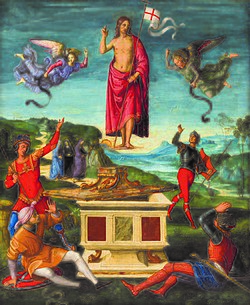
( Raphael , 1499-1502)
Christ rises from the tomb surrounded by amazed guards
Guard at the tomb - the guard described in the Gospel of Matthew , assigned to guard the tomb of Christ after his burial .
Content
- 1 gospel description
- 2 Apocryphal legends
- 2.1 The Gospel of Nicodemus
- 2.2 The Gospel of Peter
- 3 Number, names and further fate of the guards
- 4 Visual Arts
- 5 notes
- 6 References
Gospel Description
( Matt. 27: 62-66 ) | The next day, which follows Friday, the high priests and Pharisees gathered at Pilate and said: Sir! We remembered that the deceiver, while still alive, said: after three days I will be resurrected; so command that you guard the tomb until the third day, so that His disciples, coming in at night, do not steal Him and say to the people: He is risen from the dead; and the last deception will be worse than the first. Pilate said to them: You have a guard; go, guard, as you know. They went and put a guard at the tomb, and put a seal on the stone. |
Further, the evangelist reports that when an angel came down from heaven and rolled away a stone from the tomb, “those who were afraid of him, came to awe and became as dead” ( Matthew 28: 4 ). Then “some of the guards, entering the city, announced to the high priests everything that was former” ( Matthew 28:11 ) and, having received money from them, they began to tell that the disciples stole the body of Jesus at night.
Apocryphal Tales
A more detailed, in comparison with the story of Matthew , story of the guard is contained in the New Testament apocrypha : “ Gospels of Nicodemus ”, “ Gospels of Peter ” and briefly in “Letter from Claudius Procules to Fulvia.” [one]
The Gospel of Nicodemus
( Master Franke , c. 1424 )
“The Gospel of Nicodemus” (III century) does not tell who put the guard to the tomb, it is narrated after the Resurrection of Jesus , when the guards came to tell the Sanhedrin about this:
When we guarded the tomb, the earth shook, and we saw that an angel of God rolled off the grave stone and sat on it, and its appearance was like lightning, and its robe like snow, and from fear of it we were dead. We heard an angel say to the women who came to the tomb of Jesus: “Do not be afraid! I know that you are looking for Jesus, who was crucified on the cross, - He has risen ... ” [2] .
- Gospel of Nicodemus 13.
The high priests gave the guards silver and ordered: “Say this: when we slept, the disciples of Jesus came at night and stole His (body).” Apocrypha reports that the soldiers complied with the order and "their words spread among all."
The Gospel of Peter
(fragment of the fresco by Piero della Francesca “ Resurrection of Christ ”, c. 1463 )
The Gospel of Peter (the first half of the 2nd century ) reports that the scribes and Pharisees, frightened of the signs that accompanied Jesus' death ( solar eclipse , earthquake , resurrection of the dead, the torn curtain of the Temple ), asked Pontius Pilate the guards to protect the cave, where it was laid body of Jesus.
Pilate gave them Petronius, the centurion , to guard the tomb. And with them the elders and scribes went to the tomb. And, having rolled a large stone, along with the centurion and warriors piled to the entrance to the tomb. And, sealed with seven seals, they set up a tent and began to guard. [3]
- Gospel of Peter, 8: 31-33
Changing, the guards in two guarded the tomb all night. In the morning, they saw “ how the heavens opened up, and two men descended from there, radiating radiance and approaching the tomb. The stone that was rolled to the door, falling off by itself, moved away, and the tomb opened, and both young men entered . " The warriors woke up the centurion, the Jewish elders, and with them became witnesses as two people came out from the tomb, supporting the third, and the Cross following them. At that moment they heard a voice from heaven : “ “ Have you proclaimed the dead? ”And there was an answer from the cross:“ Yes. ”
Terrified guards flee from the risen Christ
The guards came to Pilate and told him what had happened. At the request of the elders (“ For it is better, they said, that we should be guilty of the greatest sin before God, but not fall into the hands of the Jewish people and not be stoned ”), the prosecutor forbade the soldiers to tell what they saw.
The number, names and further fate of the guards
The number and names of the soldiers, with the exception of their superior Petronius, are not reported in the early Christian texts. In the medieval apocrypha “ Letters of Pilate and Herod the Tetrarch ” 12 soldiers are reported under the leadership of the centurion. [4] There are also known false testimonies of the Resurrection of Jesus attributed to Gormisius, biographer Pontius Pilate, who allegedly reports that he “saw two people sitting, the rest lying on the ground by the fire ”. [5]
Church tradition refers to the number of guards at the tomb of the centurion Longinus , who pierced the body of the crucified Christ with a spear . According to the life, he, having witnessed the Resurrection of Jesus, believed in him and, having refused the money of Pilate and the high priests, began to testify of the miracle he had seen. [6] He was baptized by the apostles , began to preach, took refuge in Cappadocia from the persecution of Pilate, but was found and suffered martyrdom.
Fine Art
Figures of guards in Western European art are present in the images of the Resurrection of Jesus. They are placed around the tomb from which Christ rises. Often they are portrayed from two to six, they stand as dead or look with horror at what is happening. [7] There are also known images of a guard sleeping around the tomb.
In Orthodox iconography of the Resurrection of Christ, images of guards are extremely rare, since the icon of this event is the image of " Descent into Hell ." Rare images of guards are known in Orthodox fresco painting, for example, in the Church of the Assumption of the Virgin on the Volotov Field (second half of the XIV century ). [8]
Notes
- ↑ Letter from Claudius Proculum to Fulvia
- ↑ Gospel of Nicodemus
- ↑ Gospel of Peter
- ↑ Village B.G. Jesus Christ in the documents of history . - SPb. : Aletheia, 2013 .-- 576 p. - ISBN 978-5-91419-817-3 . - VII. Pseudo-historical texts. S. 452–455.
- ↑ Martynov A.V. The Confessed Way M., 1989. S. 127-128
- ↑ The Life and Suffering of the Holy Martyr Longin the Centurion
- ↑ Maykapar A. New Testament subjects in painting (The Resurrection of Christ) (inaccessible link) . Date of treatment February 17, 2009. Archived January 25, 2009.
- ↑ Sleeping guards at the Holy Sepulcher (fresco in a church on the Volotov Field)