Common-like ( Latin: Strigiformes ) - a detachment of birds of prey, including more than 200 large and medium-sized species, mainly nocturnal birds, distributed throughout the world. There are two modern families in the squad: owl , or real owl, and barn owl.
| Owls | ||||||||||||||||||||||||||||
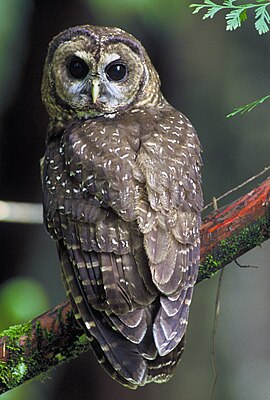 Owl northern spotted | ||||||||||||||||||||||||||||
| Scientific classification | ||||||||||||||||||||||||||||
|---|---|---|---|---|---|---|---|---|---|---|---|---|---|---|---|---|---|---|---|---|---|---|---|---|---|---|---|---|
| ||||||||||||||||||||||||||||
| International scientific name | ||||||||||||||||||||||||||||
Strigiformes Wagler , 1830 | ||||||||||||||||||||||||||||
| Synonyms | ||||||||||||||||||||||||||||
| ||||||||||||||||||||||||||||
| Families | ||||||||||||||||||||||||||||
| ||||||||||||||||||||||||||||
| Area | ||||||||||||||||||||||||||||
| ||||||||||||||||||||||||||||
| Geochronology appeared 58.7 million years
◄ Nowadays◄ Cretaceous-Paleogene extinction | ||||||||||||||||||||||||||||

Brief description: large head, large round eyes in front of the head, beak short, predatory. It hunts at night, the plumage is soft, the flight is silent, the nails are long and sharp, masking color.
Content
Anatomical features
Owls in their anatomical signs differ from daytime predators and therefore stand out in an independent detachment. The features of the skeleton of owls include: the existence of processes of the main bone, a kind of triple articulation of the lower jaw with the skull, very short phalanges of the third finger, the mobility of the outer finger, which can be folded back, and finally, in most species (except for barn owls ), the notches on the posterior edge of the thoracic bones. Five rows of harder, studied feathers form a radiant nimbus, the so-called facial disc . The feathery feathers of the wide wings are wide, rounded at the ends and bent toward the body; the outer webs of the first three feathers are often fringed or serrated, which allows the owl to fly almost silently; the third and fourth feathers are longer than the rest. The tail feathers of a cropped or rounded, usually short tail, are also bent to the bottom. The legs are usually feathered to the ground.
The sharp long claws of them are strongly bent. The beak of an owl, bending from the very base, has no notches along the edges and ends with a short hook, with the help of which owls can produce a characteristic click, expressing strong excitement or irritation. A short wax is always covered with bristly feathers.
The eyes of the owls are very large and look straight ahead, according to the position of the eye sockets on the front of the facial parts of the skull, that is, the owl cannot move its eyes like a human. The eyes of owls stand motionless throughout their life. The world for owls seems black and white. Contrary to popular belief that owls do not see anything during the day, owl eyes are not so sensitive to daylight; an eagle owl , for example, sees perfectly during the day, even at a great distance. The pupil of owls narrows and expands greatly, not only when the lighting changes, but also with each inhalation and exhalation. Both vision and hearing of owls are extremely subtle. It is almost four times thinner than a cat. The outer ear is relatively large and can be covered by a rolling fold of skin that is feathered outside; the radiant feathers sitting around the ear openings form, as it were, the outer shell of the ear.
Owls can turn their heads 270 ° without harm to health thanks to a number of adaptations. Firstly, the carotid arteries of owls in the area of the lower jawbone have a balloon-like expansion, which creates a blood supply in case blood supply “from below” decreases with a sharp turn. Because of this feature, the network of small blood vessels extending from the main arteries is enlarged, which facilitates the delivery of blood to the brain. Secondly, so that the blood vessels are not pinched in the corresponding holes in the cervical vertebrae when the head is rotated, these holes are about 10 times wider than the diameter of the arteries passing through them. Thirdly, the carotid arteries are connected to the vertebral special jumper-anastomoses in case the carotid arteries are strongly compressed during rotation [2] .
Most owls are dull; usually black spots, stripes and specks are more or less densely scattered over the main gray or rusty background; but this coloring of owls always harmonizes with the surrounding background and completely hides them at dusk.
Behavior and diet
Some owls hunt during the day, as, for example, from Russian owls - the white owl ( Bubo scandiacus ), the sparrow syrup ( Glaucidium passerinum ) and the hawk owl ( Surnia ulula ), some others, like the house owl ( Athene noctua ), hunt the same way both day and night. However, most owls are real night birds, and many of them fly freely even on completely dark nights, which can be judged by their cry. The flight of owls is completely silent and allows them to fly up to the sleeping birds completely imperceptibly. On the hunt, owls, rushing inaudibly over the ground, emit a sharp cry from time to time, frightening their prey with their unexpectedness. Owls seem to use this to spot the latter. The usual food of owls is small rodents ; smaller species of owls feed mainly on large insects, and some on fish . Owls rarely attack birds. Apparently, when hunting rodents in almost complete darkness, owls are oriented by sound, as they have very good hearing. In this regard, an erroneous idea arose that owls are able to see in complete darkness (for example, they see in the infrared range) [3] . Owls can live without water for months, quenching their thirst with the blood of their prey. But without special need they don’t behave like that - they need water not only for drinking, but also for swimming.
There is a misconception that owls form the so-called. flocks called Parliament of Owls. Owls are lone hunters, and the aforementioned name “parliament” comes from an ironic reference to the French parliament of 1912, when the economic crisis was combined with the inaction of parliamentarians. Dissatisfaction with their policies on the part of the working class has led to the emergence of sharp epithets, one of which sounded that way. Such an ironic name has strengthened as a common name and is now quite often used in everyday life as a winged expression.
Habitats
Owls are settled around the world, from the equator to the cold northern countries, they can be found everywhere: on the seashore, and in the mountains, and in the desert, and in the steppe, and even in cities. Most owls live in forests or wooded areas, and only a few, like the wading owl ( Asio flammeus ), prefer open places. Some owls - for example, a house owl and a barn owl ( Tyto alba ) - willingly settle under the roofs and in the attics of houses. In most cases, hollows of old trees serve as nests, and eggs are usually laid without any litter. Also, crevices of rocks, caves, holes in walls, underground burrows of various mammals, abandoned nests of other birds can serve as nests. Some owls, such as the long-tailed owl , can also be occupied by artificial sovietniki .
Reproduction
Owls are monogamous and form permanent pairs. They do not build nests themselves. They occupy secluded places, rocky crevices, grooves and nests abandoned by large birds. They usually breed once a year, but with plenty of food they can breed more often. Owl eggs are relatively small, always white and have a characteristic almost spherical shape. Usually an owl lays 3 to 10 eggs. Females incubate eggs, but both parents take part in feeding the chicks. Hatching lasts about a month. Owls incubate from the first egg, so often chicks of different ages live in the nest. Parents try to feed the older chicks, which is why they are even more ahead in the development of younger brothers; in famine, elders can even eat younger chicks. The development of owl occurs on the chick type.
Economic value
Owls bring significant benefits to agriculture, destroying mouse-like rodents . For example, the owl is capable of catching up to a thousand mice and voles in a year, which during this period would destroy up to 500 kg of grain . Because of this, all species of owls are protected .
Fossil species
- Ornimegalonics is a fossil giant fast-moving owl.
Owl in Culture
Owls have a significant place in legends, myths and historical records. Because of human ignorance and superstition, birds have long been persecuted; only with the advent of a more scientific approach to natural history did real facts about owls begin to supplant and obliterate their dubious reputation.
Thoughts about owls practically did not change from the earliest times until the nineteenth century. More than two thousand years ago, Ovid in his " Metamorphoses " spoke very negatively about owls:
| He became a vile bird, a thing of threatening grief, A slow-moving owl, for mortals a harbinger of calamity [4] . |
In another of his works, “ Fasts, ” Ovid mentions an owl in a record about witchcraft - in ancient Rome they believed that witches could turn magic into a scoop with magic, or the scoops themselves turned into sorceresses and, climbing through the window into children's bedrooms, drank from sleeping children blood. For this, the unfortunate birds, accidentally caught near a human dwelling, were nailed to the doors to repel evil in the future. Similar practices were carried out in Europe, for example in Germany, but only at a later time.
Virgil also mentions the owl in the 12th book of Aeneas , before the end of the conflict between Aeneas and Thurn : after hearing a cry from afar and seeing flapping wings, Uturn , the sister of Turn, says in desperation:
| [...] Do not multiply, the vile birds, My horror: I recognize the dying noise and blows Your wings [5] . |
Owl, according to Virgil, flew to the roofs of Carthage and predicted the treason, devastation and death of Didone . Another owl, according to legend, predicted the death of Caesar [6] .
One of the earliest references to owls is in the Bible. The Jewish prophet Isaiah depicted the future of Babylon, which became the nesting site of owls and other animals:
... the houses will be filled with mournful creatures; and the owls will settle there, and the satyrs will dance there ... and the owl and the raven will settle there ... and they will become the abode of dragons, and a place for the owls ... and the satyr will appeal to others; and the scoop will hide there and find a place to rest.
- Is. 13:21 , 34:11, 13-14
- Owl - a symbol of wisdom, an attribute of the ancient Greek goddess Athena .
- Owls are also called people who are accustomed to going to bed late and getting up late (as opposed to larks ).
- In the Harry Potter books of J. Rowling, owls are used as a means of communication between wizards (owl post).
- In the series of books by Katherine Laski “ Legends of the Night Watch ”, the main characters are intelligent owls, inheriting the qualities, abilities and character of people. The books reliably describe habits, habits and lifestyle of different types of owls in many ways.
- Owl - a symbol of the television game " What? Where? When? ".
- In Sergei Lukyanenko ’s book “ Night Watch ”, one of the Great Sorceresses was enclosed in the body of an owl.
- In the animated series Futurama , owls at the beginning of the fourth millennium are analogous to current rats.
Babylon
The famous Babylonian bas-relief, created more than four thousand years ago, depicts a formidable naked woman-goddess with owl wings and legs, trampling two skinny lions as a sign of her strength. She stands between two large owls, possibly companions or guardians. It has not yet been established who exactly the relief depicts: the Babylonian goddess Ishtar , the demoness Lilith , Anat Khananeyev , the Sumerian Inanna or Ereshkigal , the sister of Inanna and the mistress of the underworld. The British Museum , which stores the image, called it "Queen of the Night" [7] .
Egypt
In Egyptian writing, the sovaglyph denotes the letter “M”. Unlike other bird symbols, always drawn in profile, the owl is depicted with its head turned towards the viewer.
Although the owl was not elevated to the rank of a cult bird, such as a falcon , ibis or vulture , it was treated with extreme respect and even subjected to mummification . Several species of owls, including barn owls, were identified from the mummified remains.
Attacking people
Although humans and owls often live together in harmony, there have been times when owls have attacked humans. For example, in January 2013, a man from Inverness , Scotland had severe bleeding and was shocked by an owl attack, which was probably an owl 50 cm high. Photographer Eric Hosking lost his left eye after trying to photograph a dark owl that inspired him on the 1970 autobiography Eye for a Bird.
Ernest Seton-Thompson mentions the death of a hunter who inadvertently approached a wounded (and pretended to be dead) owl. A large bird clutched a man in the chest with his claws and the hunter died of internal bleeding.
See also
- Owls
Notes
- ↑ Strigiformes (English) information on the Paleobiology Database website. (Retrieved May 14, 2018) .
- ↑ Why doesn't an owl have a headache?
- ↑ How an owl “sees with its ears”
- ↑ Publius Ovid Nason. Metamorphoses. Translation from lat. S.V.Shervinsky. - M .: Fiction, 1977.
- ↑ Virgil. Collected works. Translation by S. Osherov edited by F. Petrovsky. - SPb. : Biographical Institute "Studio Biography", 1994.
- ↑ DS Bunn, AB Warburton, RDS Wilson. The barn owl. - Poyser, 2010 .-- 288 p. - ISBN 978-1408139585 .
- ↑ Desmond Morris. Owl (Animal). - Reaktion Books, 2009 .-- 224 p. - ISBN 978-1861895257 .
Literature
- Paul Sterry Animal World: Owls. - Mn. : Belfax, 1995 .-- 80 s. - ISBN 985-407-009-3 .
- Yu. B. Pukinsky. Life of our birds and animals: Life of owls. - L .: Publishing house of the Leningrad University, 1977. - 240 p.
- Owls // Brockhaus and Efron Encyclopedic Dictionary : in 86 volumes (82 volumes and 4 additional). - SPb. , 1890-1907.