
Wat ( Thai. วัด ไทย ) is a Buddhist temple complex, or Buddhist monastery , in Thailand , Laos and Cambodia .
A Buddhist temple, or rather, a monastery in Thailand, is not just one building, but a whole complex of structures, temples and monuments within a courtyard surrounded by a wall. The Thai monastery, with rare exceptions, consists of two parts: phutta-vata and sangha-vata [1] .
It contains the main Buddhist buildings - temples (bot, wihan, sim) and stupas (chedi, prang, that), as well as separate pavilions for especially significant statues of Buddha (hopra, hopka), a monastery library (hotai), a bell tower , living quarters for monks (kuti), a school , outdoor gazebos for relaxation (sala) and a number of other religious and utility rooms.
In Thailand, the number of cotton wool in 1998 was 30,678 [2] . Hospitals , nursing homes , as well as hotels for visitors and other institutions, are often located in small buildings attached to wards. For example, hospice for AIDS patients is located in Vata Phrabakhtnampu near Lopburi , while in Vata Thamkrabok (140 km north of Bangkok ) there is a rehabilitation center for drug addicts [3] .
In Cambodia, the Angkor Wat complex (literally, “ Angkor Temple ” [4] ) is a UNESCO World Heritage Site [5] . In Thailand, World Heritage sites with many vats are the historical cities of Ayutthaya [6] and Sukhothai with neighboring cities [7] .
Images
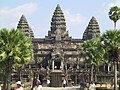
Main Entrance to Angkor Wat ( Cambodia )
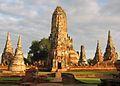
Wat Chaiwatthanaram ( Ayutthaya , Thailand )

Wat Ruag ( Phrapraphedang , Thailand )
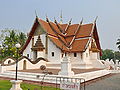
Wat Phumin ( Nan , Thailand )
Wat Pa Maha Chedi Keo (Khuhan, Sisaket , Thailand )

Notes
- ↑ Dictionary of religious terms . Archived February 2, 2013.
- ↑ Religion, Thailand at a Glance
- ↑ Wat Thamkrabok
- ↑ Etymology of the name "Angkor" . Archived February 1, 2013.
- ↑ UNESCO World Heritage Center. Angkor
- ↑ UNESCO World Heritage Center. Historic City of Ayutthaya
- ↑ UNESCO World Heritage Center. Historic City of Sukhothai and Associated Historic Towns
Literature
- Gozheve N. A. Sema and the fence of Lao wool. // Scientific reports of the State Museum of the East: Scientific publication. - Moscow, 2002. - No. XXV . - S. 49-63 .
See also
- Wat Wangwivekaram