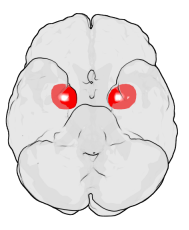
The amygdala ( lat. Corpus amygdaloideum ), amygdala [1] - a characteristic area of the brain , having the form of the amygdala, located in the white matter of the temporal lobe of the hemisphere under the shell , about 1.5–2.0 cm posterior to the temporal pole. There are two amygdala in the brain - one in each hemisphere [2] . The tonsil plays a key role in the formation of emotions, is part of the limbic system . Refers to subcortical olfactory centers. It plays an important role in the functioning of memory , decision making and emotional reactions [3] .
| Amygdala | |
|---|---|
 | |
 | |
| Catalogs | |
Structure

The areas of the brain called the amygdala nuclei include several structures with similar functional characteristics in humans and animals [4] . These structures include the basolateral complex, cortical nuclei, median nucleus, central nucleus, and interstitial cells. The basolateral complex, in turn, is divided into lateral, basal and accessory nuclei [3] [5] [6] . Anatomically, the amygdala [7] , in particular, its central and medial nuclei [8] , are sometimes included in the basal ganglia.

Hemispheric Differences
The right and left amygdala differ in function. The study showed that electrical stimulation of the right tonsil caused negative emotions, mainly fear and sadness. Stimulation of the left tonsil, on the contrary, caused mainly positive emotions (happiness) and only occasionally negative ones [9] . Another study proves that the amygdala plays a role in the human self-promotion system [10] .
Each hemisphere has a certain specialization in the perception and processing of information. The right and left amygdala have autonomous memory systems, but function together to store, encode and interpret information about emotions.
The right hemisphere is associated with negative emotions. It plays a role in expressing fear and generating stimuli that provoke fear. The consolidation of fear, in which the neutral stimulus gets an unpleasant color, is also controlled by the right hemisphere. When a person is exposed to a familiar negative stimulus, it is also processed by the right half of the brain and causes a response in the form of fear or disgust. A similar response forces the individual to avoid negative stimuli in the future.
The right hemisphere is also associated with long-term memory , which consists of facts and information about previously experienced events, memories of which can be called up consciously. It also plays a significant role in short-term memory. Short-term memory includes the autobiographical aspects of memory, which allow you to revive the memory of the emotional and tactile sensations that were experienced at a particular moment. This type of memory may not be conscious. The right amygdala plays a role in the association of time and place with the belonging of any emotional experiences [11] .
Development
For several years, the amygdala undergoes significant changes in both men and women [12] . In women, the amygdala develops faster than in men. In women, the tonsil reaches its peak one and a half years earlier than in men. Perhaps a later development in men is due to the fact that the male amygdala is larger than the female.
Sexual differences can also be due to differences in the hormonal background and structure of the nervous system in men and women. The amygdala contains a large number of androgen receptors - nuclear receptors that bind testosterone. Androgen receptors play a role in DNA synthesis, which is responsible for gene expression. Although testosterone is present in small quantities in women, its levels are much lower than in men. The abundance of testosterone in the male body affects the development of the amygdala. In addition, the amount of gray matter in the tonsil can be predicted by testosterone levels. It also causes enlarged tonsils in men.
Differences in development can be traced not only in individuals of different sexes. The right and left amygdala also develop differently. The left amygdala reaches the peak of development 1.5-2 years earlier than the right. Despite the early development of the left tonsil, the right continues to increase in volume for a long time. The right amygdala is responsible for fear and face recognition. Early development of the left tonsil provides the ability to respond to dangers in childhood [12] . Even in childhood, the amygdala provides a different reaction to the opposite and the same sex. In the puberty period, this difference in reactions increases several times [13] .
Gender Differences
The amygdala is one of the most studied areas of the brain regarding the difference between the sexes . In males, the amygdala is greater in childhood [14] , adulthood [15] , and also in adult rats [16] .
In addition to differences in size, there are other differences between the sexes. The activation of the amygdala was studied when watching horror films in men and women. The results of the study showed that different hemispheres are activated in different sexes. Increased activity was observed in men in the right hemisphere, while in women - in the left [17] . Studies have also shown that women, on average, remember emotionally charged events better than men [18] .
The right amygdala is also associated with the decision-making function and the generation of negative emotions [19] , which may explain why men often react to stressful situations by demonstrating physical strength. The left amygdala to a greater extent evokes memories of the details of a stressful event, provokes a mental reaction rather than a physical one.
Functions
Links to other parts of the brain
The amygdala sends impulses to the hypothalamus , the dorsomedial thalamus , the reticular thalamic nucleus, the nuclei of the trigeminal and facial nerves, the ventral region of the tire , the blue spot and the dorsolateral nucleus of the tire [5] . The medial nucleus is involved in the process of smell and perception of pheromones . It receives information from the olfactory bulb and olfactory cortex [20] . The lateral nucleus, which sends impulses to the basolateral complex and the centromedial nucleus, receives information from the sensory organs. These structures are also involved in the development of emotions in rats and cats [5] [6] [21] .
Emotional Reflexes
In higher vertebrates, including humans, the amygdala plays a crucial role in the formation and storage of autobiographical memory memories associated with emotionally colored events. Studies show that during the formation of a conditioned fear reflex, stimuli reach the basolateral complexes of the tonsil, especially the lateral nucleus, where such stimuli are processed and stored. The association between the stimuli and the unpleasant consequences that follow can be due to long-term potentiation [22] [23] , that is, a steady signal amplification between the involved neurons [24] [25] .
It is believed that the memory of emotions remains in synapses throughout the brain. For example, the memory of fear experienced is stored in the synapses of the lateral nucleus of the tonsil, the central nucleus and the nucleus of the terminal strip. Of course, this is not the only zone of memories of fear [26] . The central core along with the hippocampus are also involved in the processes of creating reflexes of self-preservation and defensive behavior, reactions of the autonomic nervous system , as well as endocrine processes (release of the stress hormone). Damage to the amygdala leads to a disruption in the formation of a conditioned reflex of fear [24] .
Tonsils are also involved in the processes of appetite formation. Disorders of the amygdala in rats showed a decrease in learning stimulated by food [27] [28] . Damage to the basolateral core alone did not cause a similar effect [29] . This study proves that different tonsil nuclei play a different role in the formation of appetite-related reflexes [30] [31] . The basolateral nucleus also plays a role in learning through olfactory stimuli. For example, nonvolatile pheromones cause activation of the vomeronasal system in mice, while volatile pheromones cause only olfactory pheromones [32] [33] .
Memory Modulation
The amygdala is also involved in the formation of long-term memory. Long-term memory is formed after the learning process only after some time. Information is gradually moving from short-term memory to long-term using the mechanism of long-term potentiation. Studies show that the tonsil regulates memory processes in other areas of the brain. The formation of a conditioned reflex of fear is also due to long-term potentiation [22] [23] .
It turns out that the stronger the emotional shock that accompanied an event, the brighter the memories of this event. Learning accompanied by emotions will be retained longer. Experiments have shown that when training mice, the administration of stress hormone enhances the effectiveness of training [34] . Training in such experiments included typical tasks for the formation of a conditioned reflex, for example, the formation of avoiding a certain stimulus, such as electric shock, or more complex tasks, for example, passing through a maze. Injections of drugs that activate the amygdala contributed to better memorization of tasks [35] .
Buddhist monks engaged in meditation provoked the activity of the amygdala and islet [36] . Higher tonsil activity was recorded in experienced monks [37] [38] .
More emotionally colored information enhances tonsil activity, which directly correlates with information retention. Tonsil neurons generate various vibrations, such as theta waves. Such activity of neurons can provoke synaptic mobility (plasticity), increasing the number of connections between areas of the new cortex and temporal lobe that are involved in the formation of memory [39] .
A study using the Rorschach test showed that the number of original interpretations of test pictures is higher in people with a large amygdala. Thus, the creative activity of the brain can be related to the size of the amygdala [40] .
Neurophysiological Foundations of Functioning
Early studies on primates gave the first explanations of the mechanisms of functioning of the tonsils, as well as the basis for further research. In 1888, rhesus macaques with the temporal cortex removed were examined for impaired nerve function [41] . Heinrich Kluver and Paul Bussey further expanded this study by removing the anterior temporal lobe and noted hyperreactivity, hyperemotionality, loss of fear, hypersexuality and hypoorality (the tendency to put foreign objects into the oral cavity) in the experimental subjects. Some monkeys were not able to recognize familiar objects, showed a complete lack of fear of the experimenters. This behavior disorder was called Kluver-Bussy syndrome [42] , and further studies have shown that these reactions were due to the absence of the amygdala. In macaque mothers, a violation of maternal reflexes was observed [43] . In 1981, it was discovered that damage to the tonsils by radio waves also causes Kluver-Bussy syndrome [44] .
With the development of MRI technology, neurophysiologists have made several important discoveries regarding the amygdala. Disorders of the tonsils lead to various mental disorders. In children with anxiety disorders, a decrease in the left amygdala was observed. The use of antidepressant drugs gave an increase in the left tonsil [45] . The left amygdala also plays a role in sociophobia , obsessive-compulsive disorder , post-traumatic stress and general anxiety . In 2003, patients with borderline personality disorder reported an increase in the left tonsil. Some of these patients have difficulty distinguishing between the neutral facial expressions in the picture and those expressing fright [46] . In individuals with psychopathy , decreased autonomic reactions were observed [47] . Tonsil hyperactivity was recorded when viewing images with frightened faces. Patients with sociophobia showed increased tonsil activity [48] . Patients with depression showed increased activity when observing frightened individuals, but these effects were stopped by taking antidepressants [49] .
In patients with bipolar disorder, the amygdala is smaller than in healthy people [50] . Many studies prove the association of the amygdala with autism [51] .
Studies in 2004 and 2006 showed that patients who showed frightened faces from other races showed an increase in amygdala activity. Even if the pictures shown did not reach the area of consciousness and were perceived, only at the subconscious level [52] [53] . At the same time, the amygdala is not decisive in the formation of the fear reaction. In persons with bilateral removal of the tonsil, a fairly quick reaction to frightening pictures is observed [54] .
Recent studies show that parasites, especially toxoplasma , lay cysts in the amygdala. This provokes the development of specific disorders, such as paranoia in infected people [55] .
It is also suggested that the amygdala can participate in the formation of positive emotions by interacting with other areas of the brain [56] .
Sexual orientation
Recent studies have shown the dependence of the state of the amygdala and human sexual orientation. For homosexual men, the amygdala works more in the female type (the left prevails), and for homosexual women it works more in the male type (the right prevails) [57] [58] .
Social Interactions
The size of the tonsil is directly proportional to the size (number of contacts) and complexity (number of social groups to which the person belongs) of the person’s social interaction network [59] [60] . The larger the amygdala, the more complex the network of social interactions. People with a large amygdala are better able to remember and evaluate the appearance of other people [61] . The amygdala also takes part in recognizing emotions by facial expression. But it does not take part in determining the direction of the gaze of the person in question [62] [63] .
The emotional intelligence of a person also depends on the amygdala. Presumably, the large size of the tonsils allows you to better integrate into society and communicate with people [64] .
The amygdala is responsible for reactions related to violations of a person’s personal space. These reactions are absent in individuals with damage to this area of the brain [65] .
Aggression
Animal studies have shown that the amygdala excites both sexual and aggressive behavior. At the same time, removal of the tonsil leads to inhibition of these functions. This proves that the amygdala is involved in the formation of aggression [66] .
Fear
Cases of bilateral absence of the amygdala were recorded in patients with a rare disease - Urbach-Vite disease [67] [68] . Such patients are not able to experience fear, which proves the indispensable role of the amygdala in the generation of fear [69] .
Alcoholism
Миндалевидное тело играет роль в развитии алкоголизма, так как повреждается под действием интоксикации и последствий опьянения [70] . Алкоголизм притупляет реакции мозга, ответственные за эмоциональное восприятие [71] . Протеинкиназа C в миндалевидном теле ответственна за реакцию организма на этанол , морфин и регуляцию поведения. Этот белок вовлекается в контроль функционирования других белков и играет роль в развитии толерантности к большим количествам алкоголя [72] [73] .
Тревожность
Возможно существование связи между миндалевидным телом и тревожностью [74] . Например, тревожным расстройствам чаще подвержены женщины. В одном эксперименте детёныши дегу отнимались у их матерей, но оставались от них на достаточном расстоянии, чтобы слышать их призывные звуки. В ответ на данные условия у особей мужского пола наблюдалась повышенная продукция серотониновых рецепторов миндалевидного тела, в то время как женские особи их теряли. Таким образом, мужские особи были менее подвержены стрессу.
Группы клеток миндалевидного тела активируются при ощущении страха или агрессии. Это происходит потому что миндалевидное тело отвечает за рефлекс борьбы. Тревожные и панические атаки могут происходить в те моменты, когда на миндалевидное тело действуют раздражители, провоцирующие организм на вступление в схватку.
Миндалевидное тело напрямую ассоциировано с условным страхом. Условный страх — это определение, используемое для описания поведения, возникающего при сочетании нейтрального раздражителя с раздражителем, провоцирующим страх. Миндалевидное тело является центральным звеном ядра страха в организме. Страх измеряется изменением вегетативной активности, включая повышение сердцебиения, повышенное давление крови, а также рефлексы моргания и вздрагивания.
Центральное ядро миндалевидного тела имеет прямые связи с гипоталамусом и стволом мозга — зонами, ответственными за страх. Эта связь подтверждена исследованиями, в которых у животных удалялось миндалевидное тело. Животные с удаленной миндалиной показывали более слабую реакцию на раздражители и демонстрировали нехарактерное для данного вида поведение.
Чувство тревоги запускается катализатором (триггером) — внешним стимулом, который провоцирует стресс и вызывает отрицательные эмоции. Такими триггерами могут быть определённые запахи, картинки и внутренние чувства, обычно связанные со стрессовыми событиям, воспоминания о которых сохранились в памяти. Миндалевидное тело готовит организм к двум возможным программам действий: стоять и сражаться с опасностью или же развернуться и убежать. Лучшее понимание роли миндалины в регуляции тревожности может привести к открытию новых способов лечения тревожных расстройств [75] .
Посттравматическое стрессовое расстройство
Существует связь между работой миндалевидного тела и реакций мозга на посттравматические состояния. Многие исследования доказывают, что за посттравматический стрессовый синдром может быть ответственно миндалевидное тело. У пациентов с данным синдромом наблюдался всплеск активности миндалевидного тела, когда им показывали картинки с изображенными на них людьми, испытывающими страх [76] .
Биполярное расстройство
Дисфункция миндалевидного тела в формировании выражений лица подробно описана для биполярного расстройства. Пациентам с биполярным расстройством свойственна повышенная активность миндалевидного тела [77] [78] .
Политическая ориентация
Исследование на 90 участниках показало корреляционную связь размера миндалевидного тела с политическими взглядами. В результатах проведённого в 2011 году опыта его авторы связывают повышенный объём серого вещества в коре пояса мозга со склонностью к либерализму, а повышенный объём серого вещества в правом миндалевидном теле — c консервативными взглядами [79] .
See also
- Покрышка
- Таламус
- Области мозга
- Механизмы памяти
Literature
- Анатомия человека. Сапин Михаил Романович, Швецов Эдуард, Феникс, 2008 г. ISBN 5-222-04099-2
- Основы нейрофизиологии: Учебное пособие для студентов вузов, Шульговский В. В. Ш95 . — М.: Аспект Пресс, 2000. с. 277. ISBN 5-7567-0134-6
- Neurophysiology: A Conceptual Approach, Fifth Edition 5th. Roger Carpenter, Benjamin Reddi ISBN 978-1444135176
- Amygdala Joseph E. LeDoux, Scholarpedia , 3(4):2698. DOI : 10.4249/scholarpedia.2698
Links
- ↑ Amygdala - Define Amygdala at Dictionary.com . Дата обращения 9 ноября 2016.
- ↑ University of Idaho College of Science. amygdala (2004). Дата обращения 15 марта 2007. Архивировано 31 марта 2007 года.
- ↑ 1 2 Amunts K., Kedo O., Kindler M., Pieperhoff P., Mohlberg H., Shah N., Habel U., Schneider F., Zilles K. Cytoarchitectonic mapping of the human amygdala, hippocampal region and entorhinal cortex: intersubject variability and probability maps (англ.) // Anat Embryol (Berl) : journal. - 2005. - Vol. 210 , no. 5—6 . — P. 343—352 . — DOI : 10.1007/s00429-005-0025-5 . — PMID 16208455 .
- ↑ Bzdok D, Laird A, Zilles K, Fox PT, Eickhoff S.: An investigation of the structural, connectional and functional sub-specialization in the human amygdala. Human Brain Mapping, 2012.
- ↑ 1 2 3 Ben Best. The Amygdala and the Emotions (2004). Дата обращения 15 марта 2007. Архивировано 9 марта 2007 года.
- ↑ 1 2 Solano-Castiella E., Anwander A., Lohmann G., Weiss M., Docherty C., Geyer S., Reimer E., Friederici AD, Turner R. Diffusion tensor imaging segments the human amygdala in vivo (англ.) // NeuroImage : journal. - 2010. - Vol. 49 , no. 4 — P. 2958—2965 . — DOI : 10.1016/j.neuroimage.2009.11.027 . — PMID 19931398 .
- ↑ See Amygdala in the BrainInfo database
- ↑ Larry W. Swanson; Gorica D. Petrovich. What is the amygdala? (англ.) // Trends in Neurosciences : journal. - Cell Press , 1998. — August ( vol. 21 , no. 8 ). — P. 323—331 . — DOI : 10.1016/S0166-2236(98)01265-X .
- ↑ Lanteaume, L. et al. Emotion induction after direct intracerebral stimulations of human amygdala (англ.) // Cerebral Cortex : journal. — 2007. — June ( vol. 17 , no. 6 ). — P. 1307—1313 . — DOI : 10.1093/cercor/bhl041 . — PMID 16880223 .
- ↑ Murray, Elizabeth A. Amygdala function in positive reinforcement // The Human Amygdala. — Guilford Press, 2009.
- ↑ Markowitsch, H. (1998). Differential contribution of right and left amygdala to affective information processing. IOS Press. 11(4), 233—244.
- ↑ 1 2 Uematsu, A.; Matsui, M.; Tanaka, C.; Takahashi, T.; Noguchi, K.; Suzuki, M.; Nishijo, H. Developmental trajectories of amygdala and hippocampus from infancy to early adulthood in healthy individuals (англ.) // PLOS One : journal. - 2012. - Vol. 7 — P. e46970 . — DOI : 10.1371/journal.pone.0046970 .
- ↑ Telzer, EH; Flannery, J.; Humphreys, KL; Goff, B.; Gabard-Durman, L.; Gee, DG; Tottenham, N. 'The cooties effect': Amygdala reactivity to opposite- versus same-sex faces declines from childhood to adolescence (англ.) // Journal Of Cognitive Neuroscience : journal. - 2015. - Vol. 27 , no. 9 — P. 1685—1696 . — DOI : 10.1162/jocn_a_00813 .
- ↑ Caviness, VS; Kennedy, DN; Richelme, C.; Rademacher, J.; Filipek, PA The Human Brain Age 7–11 Years: A Volumetric Analysis Based on Magnetic Resonance Images (англ.) // Cerebral Cortex : journal. - 1996. - Vol. 6 , no. 5 — P. 726—736 . — DOI : 10.1093/cercor/6.5.726 . — PMID 8921207 .
- ↑ Goldstein, JM; Seidman, LJ; Horton, NJ; Makris, N; Kennedy, DN; Caviness Jr, VS; Faraone, SV; Tsuang, MT Normal Sexual Dimorphism of the Adult Human Brain Assessed by in Vivo Magnetic Resonance Imaging (англ.) // Cerebral Cortex : journal. - 2001. - Vol. 11 , no. 6 — P. 490—497 . — DOI : 10.1093/cercor/11.6.490 . — PMID 11375910 .
- ↑ Hines, Melissa; Allen, Laura S.; Gorski, Roger A. Sex differences in subregions of the medial nucleus of the amygdala and the bed nucleus of the stria terminalis of the rat (англ.) // Brain Research : journal. - 1992. - Vol. 579 , no. 2 — P. 321—326 . — DOI : 10.1016/0006-8993(92)90068-K . — PMID 1352729 .
- ↑ Cahill, L; Haier, RJ; White, NS; Fallon, J; Kilpatrick, L; Lawrence, C; Potkin, SG; Alkire, MT Sex-Related Difference in Amygdala Activity during Emotionally Influenced Memory Storage (англ.) // Neurobiology of Learning and Memory : journal. - 2001. - Vol. 75 , no. 1 . — P. 1—9 . — DOI : 10.1006/nlme.2000.3999 . — PMID 11124043 .
- ↑ Hamann, Stephan. Sex Differences in the Responses of the Human Amygdala (англ.) // Neuroscience : journal. - Elsevier , 2005. - Vol. 11 , no. 4 — P. 288—293 . — DOI : 10.1177/1073858404271981 . — PMID 16061516 .
- ↑ Lanteaume, L.; Khalfa, S.; Régis, J.; Marquis, P.; Chauvel, P.; Bartolomei, F. Emotion Induction After Direct Intracerebral Stimulations of Human Amygdala (англ.) // Cerebral Cortex : journal. - 2006. - Vol. 17 , no. 6 — P. 1307—1313 . — DOI : 10.1093/cercor/bhl041 . — PMID 16880223 .
- ↑ Carlson, Neil. Physiology of behavior. — Pearson, 12 January 2012. — P. 336. — ISBN 978-0205239399 .
- ↑ Groshek, Frank; Kerfoot, Erin; McKenna, Vanessa; Polackwich, Alan S.; Gallagher, Michela; Holland, Peter C. Amygdala Central Nucleus Function is Necessary for Learning, but Not Expression, of Conditioned Auditory Orienting (англ.) // Behavioral Neuroscience : journal. - 2005. - Vol. 119 , no. 1 . — P. 202—212 . — DOI : 10.1037/0735-7044.119.1.202 . — PMID 15727525 .
- ↑ 1 2 Maren. Long-term potentiation in the amygdala: a mechanism for emotional learning and memory (англ.) // Trends Neurosci : journal. — 1999. — December ( vol. 22 , no. 12 ). — P. 561—567 . — DOI : 10.1016/S0166-2236(99)01465-4 . — PMID 10542437 .
- ↑ 1 2 Blair, HT Synaptic Plasticity in the Lateral Amygdala: A Cellular Hypothesis of Fear Conditioning (англ.) // Learning & Memory : journal. - 2001. - Vol. 8 , no. 5 — P. 229—242 . — DOI : 10.1101/lm.30901 .
- ↑ 1 2 Ressler, Kerry; Davis, Michael. Genetics of Childhood Disorders: L. Learning and Memory, Part 3: Fear Conditioning (англ.) // Journal of the American Academy of Child & Adolescent Psychiatry : journal. - 2003. - Vol. 42 , no. 5 — P. 612—615 . — DOI : 10.1097/01.CHI.0000046835.90931.32 . — PMID 12707566 .
- ↑ Carlson, Neil R. Physiology of Behavior. — Pearson, 12 January 2012. — P. 364. — ISBN 978-0205239399 .
- ↑ Carlson, Neil R. Physiology of Behavior. — Pearson, 12 January 2012. — P. 453. — ISBN 978-0205239399 .
- ↑ Paton, Joseph J.; Belova, Marina A.; Morrison, Sara E.; Salzman, C. Daniel. The primate amygdala represents the positive and negative value of visual stimuli during learning (англ.) // Nature : journal. - 2006. - Vol. 439 , no. 7078 . — P. 865—870 . — DOI : 10.1038/nature04490 . — PMID 16482160 .
- ↑ Redondo, RL; Kim, J; Arons, AL; Ramirez, S; Liu, X; Tonegawa, S. Bidirectional switch of the valence associated with a hippocampal contextual memory engram (англ.) // Nature : journal. - 2014. - Vol. 513 . — P. 426—430 . — DOI : 10.1038/nature13725 . — PMID 25162525 .
- ↑ Parkinson, John A.; Robbins, Trevor W.; Everitt, Barry J. Dissociable roles of the central and basolateral amygdala in appetitive emotional learning (англ.) // European Journal of Neuroscience : journal. - 2000. - Vol. 12 , no. 1 . — P. 405—413 . — DOI : 10.1046/j.1460-9568.2000.00960.x . — PMID 10651899 .
- ↑ See recent TINS article by Balleine and Killcross (2006) Шаблон:Vs
- ↑ Killcross S., Robbins T., Everitt B. Different types of fear-conditioned behaviour mediated by separate nuclei within amygdala (англ.) // Nature : journal. - 1997. - Vol. 388 , no. 6640 . — P. 377—380 . — DOI : 10.1038/41097 . — PMID 9237754 .
- ↑ Moncho-Bogani, J; Lanuza, E; Hernández, A; Novejarque, A; Martínez-García, F. Attractive properties of sexual pheromones in mice: innate or learned? (англ.) // Physiology & Behavior : journal. — Elsevier , 2002. — September ( vol. 77 , no. 1 ). — P. 167—176 . — DOI : 10.1016/s0031-9384(02)00842-9 .
- ↑ Moncho-Bogani, J; Martinez-Garcia, F; Novejarque, A; Lanuza, E. Attraction to sexual pheromones and associated odorants in female mice involves activation of the reward system and basolateral amygdala (англ.) // Eur J Neurosci : journal. — 2005. — April ( vol. 21 , no. 8 ). — P. 2186—2198 . — DOI : 10.1111/j.1460-9568.2005.04036.x .
- ↑ «Researchers Prove A Single Memory Is Processed In Three Separate Parts Of The Brain» http://www.sciencedaily.com/releases/2006/02/060202182107.htm
- ↑ Ferry B., Roozendaal B., McGaugh J. Role of norepinephrine in mediating stress hormone regulation of long-term memory storage: a critical involvement of the amygdala (англ.) // Biol Psychiatry : journal. - 1999. - Vol. 46 , no. 9 — P. 1140—1152 . — DOI : 10.1016/S0006-3223(99)00157-2 . — PMID 10560021 .
- ↑ «Cultivating compassion: Neuroscientific and behavioral approaches» a talk given by Richard J. Davidson found online at Archived copy . Дата обращения 4 июля 2010. Архивировано 14 июля 2010 года.
- ↑ Lutz, Antoine; Brefczynski-Lewis, Julie; Johnstone, Tom; Davidson, Richard J. Regulation of the Neural Circuitry of Emotion by Compassion Meditation: Effects of Meditative Expertise (англ.) // PLoS ONE : journal / Baune, Bernhard. - 2008. - Vol. 3 , no. 3 — P. e1897 . — DOI : 10.1371/journal.pone.0001897 . — PMID 18365029 .
- ↑ Hutcherson, Cendri A.; Seppala, Emma M.; Gross, James J. Loving-kindness meditation increases social connectedness (англ.) // Emotion : journal. - 2008. - Vol. 8 , no. 5 — P. 720—724 . — DOI : 10.1037/a0013237 . — PMID 18837623 .
- ↑ Paré D.; Collins DR; Pelletier JG Amygdala oscillations and the consolidation of emotional memories (англ.) // Trends in Cognitive Sciences : journal. - Cell Press , 2002. — Vol. 6 , no. 7 — P. 306—314 . — DOI : 10.1016/S1364-6613(02)01924-1 . — PMID 12110364 .
- ↑ Asari T., Konishi S., Jimura K., Chikazoe J., Nakamura N., Miyashita Y. Amygdalar enlargement associated with unique perception (неопр.) // Cortex. — 2010. — Т. 46 , № 1 . — С. 94—99 . — DOI : 10.1016/j.cortex.2008.08.001 . — PMID 18922517 .
- ↑ Brown, S.; Shafer, E. An investigation into the functions of the occipital and temporal lobes of the monkey's brain (англ.) // Philosophical Transactions of the Royal Society B : journal. — 1888. — Vol. 179 . — P. 303—327 . — DOI : 10.1098/rstb.1888.0011 .
- ↑ Kluver, H.; Bucy, P. Preliminary analysis of function of the temporal lobe in monkeys (англ.) // JAMA : journal. — 1939. — Vol. 42 , no. 6 — P. 979—1000 . — DOI : 10.1001/archneurpsyc.1939.02270240017001 .
- ↑ Bucher, K.; Myersn, R.; Southwick, C. Anterior temporal cortex and maternal behaviour in monkey (англ.) // Neurology : journal. — Wolters Kluwer , 1970. — Vol. 20 , no. 4 — P. 415 . — DOI : 10.1212/wnl.20.4.402 . — PMID 4998075 .
- ↑ Aggleton, JP.; Passingham, RE. Syndrome produced by lesions of the amygdala in monkeys (Macaca mulatta) (англ.) // Journal of Comparative and Physiological Psychology : journal. - 1981. - Vol. 95 , no. 6 — P. 961—977 . — DOI : 10.1037/h0077848 . — PMID 7320283 .
- ↑ http://pn.psychiatryonline.org/content/40/9/37.full (недоступная ссылка) [ need to clarify ]
- ↑ Donegan, Nelson H; Sanislow, CA; Blumberg, HP; Fulbright, RK; Lacadie, C; Skudlarski, P; Gore, JC; Olson, IR; McGlashan, TH; E., Bruce. Amygdala hyperreactivity in borderline personality disorder: implications for emotional dysregulation (англ.) // Biological Psychiatry : journal. - 2003. - Vol. 54 , no. 11 — P. 1284—1293 . — DOI : 10.1016/S0006-3223(03)00636-X . — PMID 14643096 .
- ↑ RJR Blair. The amygdala and ventromedial prefrontal cortex: functional contributions and dysfunction in psychopathy (англ.) // Philosophical Transactions of the Royal Society B: Biological Sciences : journal. — 2008. — 23 April ( vol. 363 , no. 1503 ). — P. 2557—2565 . — DOI : 10.1098/rstb.2008.0027 . — PMID 18434283 .
- ↑ Studying Brain Activity Could Aid Diagnosis Of Social Phobia . Monash University. 19 January 2006.
- ↑ Sheline; Barch, DM; Donnelly, JM; Ollinger, JM; Snyder, AZ; Mintun, MA et al. Increased amygdala response to masked emotional faces in depressed subjects resolves with antidepressant treatment: an fMRI study (англ.) // Biological Psychiatry : journal. - 2001. - Vol. 50 , no. 9 — P. 651—658 . — DOI : 10.1016/S0006-3223(01)01263-X . — PMID 11704071 .
- ↑ Blumberg; Kaufman, J; Martin, A; Whiteman, R; Zhang, JH; Gore, JC; Charney, DS; Krystal, JH; Peterson, BS et al. Amygdala and hippocampal volumes in adolescents and adults with bipolar disorder (англ.) // JAMA : journal. - 2003. - Vol. 60 , no. 12 — P. 1201—1208 . — DOI : 10.1001/archpsyc.60.12.1201 . — PMID 14662552 .
- ↑ Schultz RT Developmental deficits in social perception in autism: the role of the amygdala and fusiform face area (англ.) // Int J Dev Neurosci : journal. - 2005. - Vol. 23 , no. 2—3 . — P. 125—141 . — DOI : 10.1016/j.ijdevneu.2004.12.012 . — PMID 15749240 .
- ↑ Williams, Leanne M.; Belinda J. Liddell; Andrew H. Kemp; Richard A. Bryant; Russell A. Meares; Anthony S. Peduto; Evian Gordon. Amygdala-prefrontal dissociation of subliminal and supraliminal fear (англ.) // Human Brain Mapping : journal. - 2006. - Vol. 27 , no. 8 . — P. 652—661 . — DOI : 10.1002/hbm.20208 . — PMID 16281289 .
- ↑ Brain Activity Reflects Complexity Of Responses To Other-race Faces , Science Daily , 14 December 2004
- ↑ Tsuchiya N., Moradi F., Felsen C., Yamazaki M., Adolphs R. Intact rapid detection of fearful faces in the absence of the amygdala (англ.) // Nature Neuroscience : journal. - 2009. - Vol. 12 , no. 10 — P. 1224—12225 . — DOI : 10.1038/nn.2380 . — PMID 19718036 .
- ↑ Vyas; Kim, SK; Giacomini, N; Boothroyd, JC; Sapolsky, RM et al. Behavioral changes induced by Toxoplasma infection of rodents are highly specific to aversion of cat odors (англ.) // Proceedings of the National Academy of Sciences of the United States of America : journal. - 2007. - Vol. 104 , no. 15 . — P. 6442—6447 . — DOI : 10.1073/pnas.0608310104 . — PMID 17404235 .
- ↑ Gazzaniga, MS, Ivry, RB, & Mangun, GR (2009). Cognitive neuroscience: the biology of the mind. NY: WWNorton&Company. Шаблон:Page needed
- ↑ Swaab, DF Sexual orientation and its basis in brain structure and function (англ.) // Proceedings of the National Academy of Sciences of the United States of America : journal. - 2008. - Vol. 105 , no. 30 — P. 10273—10274 . — DOI : 10.1073/pnas.0805542105 . — PMID 18653758 .
- ↑ Swaab, Dick F. Sexual differentiation of the brain and behavior (неопр.) // Best Practice & Research Clinical Endocrinology & Metabolism. — 2007. — Т. 21 , № 3 . — С. 431—444 . — DOI : 10.1016/j.beem.2007.04.003 . — PMID 17875490 .
- ↑ Bickart, Kevin C; Wright, Christopher I; Dautoff, Rebecca J; Dickerson, Bradford C; Barrett, Lisa Feldman. Amygdala volume and social network size in humans (англ.) // Nature Neuroscience : journal. - 2010. - Vol. 14 , no. 2 — P. 163—164 . — DOI : 10.1038/nn.2724 . — PMID 21186358 .
- ↑ Szalavitz, Maia How to Win Friends: Have a Big Amygdala? Time (28 декабря 2010). Дата обращения 30 декабря 2010.
- ↑ Bzdok, D.; Langner, R.; Caspers, S.; Kurth, F.; Habel, U.; Zilles, K.; Laird, A.; Eickhoff, Simon B. ALE meta-analysis on facial judgments of trustworthiness and attractiveness (англ.) // Brain Structure and Function : journal. - 2010. - Vol. 215 , no. 3—4 . — P. 209—223 . — DOI : 10.1007/s00429-010-0287-4 . — PMID 20978908 .
- ↑ Mormann, F.; Niediek, J.; Tudusciuc, O.; Quesada, CM; Coenen, VA; Elger, CE; Adolphs, R. Neurons in the human amygdala encode face identity, but not gaze direction (англ.) // Nature Neuroscience : journal. - 2015. - Vol. 18 , no. 11 — P. 1568—1570 . — DOI : 10.1038/nn.4139 . — PMID 26479589 .
- ↑ Huijgen, J.; Dinkelacker, V.; Lachat, F.; Yahia-Cherif, L.; El Karoui, I.; Lemaréchal, J.; George, N. Amygdala processin of social cues from faces: An intracrebral EEG study (англ.) // Social Cognitive And Affective Neuroscience : journal. - 2015. - Vol. 10 , no. 11 — P. 1568—1576 .
- ↑ Buchanan, TW, Tranel, D. & Adolphs, R. in The Human Amygdala (eds. Whalen, PJ & Phelps, EA) 289—318 (Guilford, New York, 2009).
- ↑ Kennedy DP, Gläscher J., Tyszka JM, Adolphs R. Personal space regulation by the human amygdala (англ.) // Nature Neuroscience : journal. - 2009. - Vol. 12 , no. 10 — P. 1226—1227 . — DOI : 10.1038/nn.2381 . — PMID 19718035 .
- ↑ TL Brink. (2008) Psychology: A Student Friendly Approach. «Unit 4: The Nervous System.» pp 61 [1]
- ↑ Feinstein, Justin S.; Adolphs, Ralph; Damasio, Antonio; Tranel, Daniel. The Human Amygdala and the Induction and Experience of Fear (англ.) // Current Biology : journal. - Cell Press , 2011. - Vol. 21 , no. 1 . — P. 34—8 . — DOI : 10.1016/j.cub.2010.11.042 . — PMID 21167712 .
- ↑ Staut, CCV; Naidich, TP Urbach-Wiethe Disease(Lipoid Proteinosis) (неопр.) // Pediatric Neurosurgery. — 1998. — Т. 28 , № 4 . — С. 212—214 . — DOI : 10.1159/000028653 . — PMID 9732251 .
- ↑ http://bps-research-digest.blogspot.com/2013/02/extreme-fear-experienced-without.html [ need to clarify ]
- ↑ Stephens, D. N; Duka, T. Cognitive and emotional consequences of binge drinking: Role of amygdala and prefrontal cortex (англ.) // Philosophical Transactions of the Royal Society B : journal. - 2008. - Vol. 363 , no. 1507 . — P. 3169—3179 . — DOI : 10.1098/rstb.2008.0097 . — PMID 18640918 .
- ↑ Marinkovic, Ksenija; Oscar-Berman, Marlene; Urban, Trinity; o'Reilly, Cara E.; Howard, Julie A.; Sawyer, Kayle; Harris, Gordon J. Alcoholism and Dampened Temporal Limbic Activation to Emotional Faces (англ.) // Alcoholism: Clinical and Experimental Research : journal. - 2009. - Vol. 33 , no. 11 — P. 1880—1892 . — DOI : 10.1111/j.1530-0277.2009.01026.x . — PMID 19673745 .
- ↑ Newton, P; Ron, D. Protein kinase C and alcohol addiction (англ.) // Pharmacological Research : journal. - 2007. - Vol. 55 , no. 6 — P. 570—577 . — DOI : 10.1016/j.phrs.2007.04.008 . — PMID 17566760 .
- ↑ Lesscher, HMB; Wallace, MJ; Zeng, L.; Wang, V.; Deitchman, JK; McMahon, T.; Messing, RO; Newton, PM Amygdala protein kinase C epsilon controls alcohol consumption (англ.) // Genes, Brain and Behavior : journal. - 2009. - Vol. 8 , no. 5 — P. 493—499 . — DOI : 10.1111/j.1601-183X.2009.00485.x . — PMID 19243450 .
- ↑ Ziabreva, Irina; Poeggel, Gerd; Schnabel, Reinhild; Braun, Katharina. Separation-induced receptor changes in the hippocampus and amygdala of Octodon degus: Influence of maternal vocalizations (англ.) // The Journal of Neuroscience : journal. - 2003. - Vol. 23 , no. 12 — P. 5329—5336 . — PMID 12832558 .
- ↑ Davis, M. The role of the amygdala in fear and anxiety (англ.) // Annual Review of Neuroscience . - 1992. - Vol. 15 . — P. 353—375 . — DOI : 10.1146/annurev.ne.15.030192.002033 . — PMID 1575447 .
- ↑ Carlson, Neil R. Physiology of Behavior. — Pearson, 12 January 2012. — P. 608. — ISBN 978-0205239399 .
- ↑ Laura A; Thomas et al. Elevated amygdala responses to emotional faces in youths with chronic irritability or bipolar disorder. (англ.) // Neuroimage Clinical : journal. - 2013. - Vol. 2 , no. 2 — P. 637—645 . — DOI : 10.1016/j.nicl.2013.04.007 . — PMID 23977455 .
- ↑ MT Keener et al. Dissociable patterns of medial prefrontal and amygdala activity to face identity versus emotion in bipolar disorder. (англ.) // Psychological Medicine : journal. - 2012. - Vol. 42 , no. 9 — P. 1913—1924 . — DOI : 10.1017/S0033291711002935 . — PMID 22273442 .
- ↑ Political Orientations Are Correlated with Brain Structure in Young Adults: Current Biology
Links
- amygdala : тематические медиафайлы на Викискладе
- I nternational committee for amygdala and health studies