
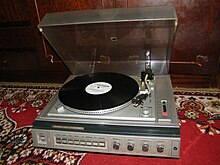


Electron - according to the terminology adopted in the USSR [1] - an electro-acoustic device that structurally combines an electric player (EPU) , a full power amplifier for audio signals and a domestic built-in or external speaker system designed to reproduce sound from phonograph records .
In everyday life, the microphone was usually called a player , but the official term “ electric player” meant a device that did not have a built-in amplifier (except, perhaps, an amplifier-corrector ) [1] . Until the end of the 1950s, in the USSR, devices similar to an electronic phone were called “radiogramophones” [2] , sometimes “electro-gramophones”, “radio gramophones”, etc. Only by the beginning of the 1970s was the term “electronic” established.
Content
Device
The main unit of all electrophones is an electric playing device (EPU), made in the form of a functionally complete unit. The EPU includes an electric motor, a massive disk, a tonearm with a pickup head and various auxiliary devices: a self-locking device, an automatic machine for installing a pickup on the input groove of the phonograph record, a microlift for smooth lowering and raising the pickup head, etc. [3] Thus, the microphone can imagine as an electronic control unit placed in a housing with a power source, controls, amplifier and speaker system. Unlike the electric player, the microphone does not require any additional devices to play back the record.
History
Electrons (like electric players) owe their appearance to one of the first Waitafon sound cinema systems [4] . The phonogram of the film was reproduced from a phonograph record by an electrophone, the drive of rotation of which was synchronized with the roll shaft of the film of the film projector . The new technology of electromechanical sound reproduction provided loud sounding, the quality is much higher than the previous "gramophone" cinema display standards - "Homon Chronophone" and others [5] .
The first electrophone in the USSR was developed in 1932 and received the name ERG (“Electro-Radiogrammophone”) [6] . It was assumed that its production would be deployed at the Moscow Electrotechnical Plant "Moselectric", but this did not happen. In the prewar and war years, Soviet industry mainly produced record players without built-in power amplifiers, and the first mass-produced electrophone was released only in 1953. It had the name UP-2 (“universal player”) of the Elfa factory in Vilnius [7] . It was assembled on three radio tubes and could play both ordinary records at that time with a playback speed of 78 rpm and long-playing records with a playback speed of 33 rpm. In the UP-2 electrophone, replaceable steel “gramophone” needles were also used.
In 1957, the first Soviet electrophone was released, suitable for reproducing surround sound - "Jubilee-Stereo." It was a high-quality device that already had three speeds of rotation (a speed of 45 rpm was added - standard in the USA), a built-in amplifier with seven lamps, and two external speakers. But the cost of the "Jubilee" at that time was very high - 1200 rubles (before the monetary reform of 1961) with an average salary in the country at that time of about 700 rubles [8] .
The official name “electrophone” (and not “radiogramonphone”) was first received by the Youth device, manufactured since 1965. It was also one of the first electrophones in which the electronic control unit was designed as a unified unit. In the "Youth" was set III-EPU-20 or II-EPU-40 [9] .
The first transistor electrophone in the USSR was Concert-3, which was produced from 1967, but tube electrophones continued to be produced until 1980. It is curious that the outdated model that was not left the production line was called “Youth” [10] .
In total, about 40 different models of electrophones were produced in the USSR. Since the 80s. some of them were equipped with imported electronic control units (most often - Polish, Unitra firms). Of the unusual designs, it is worth noting the Karavel-203-stereo electrophone, which has been produced at the Kirov factory Ladoga since 1982. The gramophone in it was reproduced in an upright position, and the tonearm needle moved rectilinearly along the radius of the plate, in contrast to the traditional movement along an arc. In addition to the technical innovations that were unusual at that time, this microphone was also distinguished by its “futuristic” appearance [11] .
Modernity
In Russia, the development and production of electrophones as a whole ceased with the collapse of the USSR, although small batches of the old spare parts were produced before 1994. The use of phonograph records as carriers of audio recordings decreased significantly in the 1990s , and many electrophones were discarded by users due to uselessness or due to bounce. Consumer electronics manufacturers from Southeast Asia, according to reporters, “picked up the fallen banner,” resuming the release of record players built into music centers .
Since 2006, record sales have shown steady growth [12] , so electrophones have become re-purchased. A lot of Soviet-made models and spare parts for them are constantly on sale in the domestic secondary market of consumer electronics, and foreign manufacturers are introducing new models of electrophones to the market. But most music lovers and lovers of the so-called “vinyl sound” usually prefer players to electrophones, since they don’t have to pay for the built-in amplifier and speakers, which are cheap in low-quality models, and almost any experienced user already has this equipment.
See also
- Turntable
- Phonograph
- Radiola
- Jukebox
- Record player
- Cd player
Notes
- ↑ 1 2 . INTERSTATE STANDARD. RADIO ELECTRONIC APPLIANCES HOUSEHOLD. Terms and Definitions. (p. 30).
- ↑ Prozorovsky Yu. N. Radiogrammophone. - M.-L.: Gosenergoizdat, 1950
- ↑ Encyclopedia "Technique". - M.: Rosman. 2006.
- ↑ D. Merkulov. ... and I don’t hear what she sings . Archive magazine . “ Science and Life ” (August 2005). Date of treatment January 7, 2015.
- ↑ Oliver Chesler. Gaumont Chronophone . Time Machine . Wire To The Ear (June 15, 2012). Date of treatment January 9, 2015.
- ↑ Electro-radiogramonphone network lamp "ERG"
- ↑ Network tube radiogramophone "UP-2"
- ↑ Yubileyny-Stereo network tube radiogramophone
- ↑ Electron network lamp "Youth"
- ↑ Electron network tubes "Youth" and "Youth-301"
- ↑ Transistor network microphone "Caravel-203-stereo"
- ↑ The old technique is still alive . Date of treatment November 6, 2013.
Literature
- Anisimov N.V. Transistor radios, radios, electrophones, tape recorders. Directory. - K .: Technika, 1980
- Degrell L. Turntables and records. Translation from Hungarian V. K. Piskarev edited by Yu. A. Voznesensky. - M.: "Radio and communications", 1982