Rabotorgola - sale and purchase ( trade ) of people into slavery . The most widespread manifestation of the slave trade in history was the export of slaves from Africa ; in this regard, the most common image of a black slave. However, the slave trade is not directly related to the racial affiliation of slaves. With the development of social morality, the slave trade transformed from privilege to crime , lost its mass character, but, nevertheless, did not completely disappear.
History
Antiquity

The origin of the slave trade dates back to times not preserved in written history . Oral traditions , recorded much later, already mention its existence. The most ancient sources of Egypt and Mesopotamia indicate that slavery, and with it the slave trade, constituted a noticeable, if not decisive, part of the economy of antiquity.
Arab slave trade in Africa
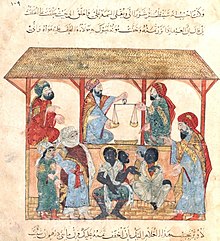
In ancient times, Negro slaves were exported to Egypt , Phenicia , Greece , and Rome . Later, Arabs began to export them to North Africa , Arabia , Turkey , Persia . In the 19th century , Zanzibar and Egypt became the main center of the Arab slave trade. From here, the slave traders went with armed detachments inland to Africa - to the countries along the headwaters of the Nile and Congo and to the Great Lakes region , made devastating raids there , founded, in some places, fortified stations, and delivered slaves to the coastal points of eastern Africa. The prohibition of the slave trade in Egypt by the British authorities in Egypt at the end of the 19th century, the European colonization of tropical East Africa, and the measures taken by the Belgian authorities in the Congo led to a sharp reduction in the Arab slave trade and its conversion to illegal. In this form, it continued throughout the XX century . In Saudi Arabia, slavery was officially abolished only in the 80s of the XX century .
Golden Horde, Crimean Khanate, Ottoman Empire and other Near-Asian states
The slave trade was an important part of the extensive economy of the medieval states created by nomads, such as the Arab Caliphate , the Golden Horde , the Crimean Khanate, and the Ottoman Empire . The Mongol-Tatars , who enslaved the vast masses of the conquered population, sold slaves to both Muslim merchants and Italian merchants, who had owned colonies in the northern Black Sea region since the middle of the 13th century ( Kafa (now Feodosiya ) since 1266, Vosporo , Chembalo , Tana (Azov ), in the Constantinople market (to make up for rowers in galleys ), etc.
One of the busiest ways the slave trade led from Azov Tana to Damietta in Egypt , at the mouth of the Nile . Due to the slaves exported from the Black Sea , the Mameluke guard of the Baghdad Abbasids and Cairo Ayyubids was replenished. The famous Mameluk Sultan Beybars I , who defeated the Mongols in 1259 , was a slave from the Black Sea region, presumably a Kipchak sold by the Tatar-Mongols to Egypt. The Crimean Khanate , who replaced the Mongol-Tatars in the northern Black Sea region, was also actively engaged in the slave trade. The main slave market was in the Cafe. Slaves captured by Crimean troops in the Polish-Lithuanian state , in Moscow Russia , in the North Caucasus were sold mainly to the Muslim countries of Western Asia. After major raids on Russia in 1521 and in 1571 , up to 100 thousand prisoners were sold into slavery. A large slave trade center was located in the Astrakhan Khanate , where slaves captured by the Nogais and the Kazan Khanate were sold. A significant part of the slaves captured by the nomads was sold to Ottoman Turkey . Of the slaves replenished Janissary Guard and the Sultan administration.
In addition, African slaves fell into the Ottoman Empire, transported to centers of the Arab slave trade (such as Fez ) or to the port cities of Abyssinia along trans-Saharan trade routes .
Europe
The slave trade in Western Europe existed throughout the Middle Ages , in particular the Scandinavian Vikings and Italian merchants. The Genoese and Venetians , who owned trading posts in the Black and Azov Seas, bought slaves ( Slavs , Turks , Circassians ) and sold them to the Mediterranean countries, both Muslim and Christian. Slavic slaves were noted in the XIV century in the notarial acts of some Italian and southern French cities (Roussillon).
Slaves began to be imported into Western Europe primarily by the Portuguese from Africa in the middle of the 15th century , and from the beginning of the 16th century, the Spaniards began to deliver them to the West Indies , and the Portuguese to Brazil . During the sixteenth and seventeenth centuries , slave trade constituted a royal privilege, transferred to private individuals, mostly as a monopoly , with the obligation to deliver a certain number of slaves to the colonies at a certain time. The rise of Negro trade followed with the founding of large trading companies in Holland , France and England ( 1621 - 1631 ), which received privileges to export slaves from West Africa, in the space from the tropic of Cancer to the Cape of Good Hope .
In 1698, the English parliament allowed private individuals to engage in the slave trade. [one]
Africa, Americas
As a result of the voyages of Henry the Navigator in the second quarter of the 15th century , a small consignment of black inhabitants of West Africa was brought to Portugal . Some of them remained to live in the courts of noble persons, some were sold on the slave market . Henry immediately introduced a state monopoly on the trade of black slaves.
And in 1452, Pope Nicholas V, with his bullus Romanus Pontifex, authorized the Portuguese to seize African lands and enslave their inhabitants [2] .
In 1510, the first 250 Africans from the coast of the Gulf of Guinea were brought to the gold mines of Hispaniola [3] , to Spanish possessions in South America. Slaves were first brought to the territory of Honduras and Guatemala in 1526 , and Colombia - 1533 [4] .
Little by little, an entire system of slave trade developed; hunting slaves in Africa or buying them for nothing from coastal tribes became a special profession. Slaves were driven ashore in caravans, hand-bound and with wooden forks on their necks; then they were loaded onto ships by masses and delivered to American ports. Many of them died from crowding, disease, poor nutrition [5] .
The export of slaves from Africa , their sale in South America , the purchase of sugar and other raw materials for the purpose of trade in exchange for rum and other products of the North American colonies , and then the sale of export goods in Europe proved to be very profitable.
Such a scheme was called the Golden Triangle Trading . The price of any product (whether it be slaves, rum or sugar) at each link of this trade chain after transportation increased several tens of times, not only covering trade costs, but also providing enrichment to trading dealers.
In the North American colonies, especially in Virginia , the British first used Scottish and Irish prisoners of war as slaves. The Africans were first imported in 1620 , and the British government imposed them on the colonies, introducing a monopoly. In total, about 12.5 million slaves from Africa were delivered to North and South America [6] , of which about 10.5 million survived. According to some estimates, before the ban on the slave trade in the 19th century, more than 14 million people were exported from African countries [1] . Blacks in the British colonies of North America were used mainly in plantations, for example, when growing cotton.
Slave Market
Abolition of the slave trade in the colonies of European powers
The miserable fate of black slaves began to stir up protests in the XVIII century . In Britain, the political movement to abolish the slave trade unfolded in the 18th century . The first bill to ban the slave trade was introduced by William Wilberforce (William Wilberforce, 1759-1833) in Parliament in 1791, but was not supported by a majority vote. In 1798, the first African Slave Association emerged. At her request, the British Parliament appointed a commission to investigate the situation of African slaves, resulting in the first act to alleviate their situation. The stimulus for a wide discussion about the situation of slaves in the colonies was the autobiography of Olaud Equiano , although, according to modern scholars, much of his book is fictitious.
The liberation of the blacks initially caused the decline of some colonies, but the situation quickly returned to normal by attracting civilian blacks, coolies and Chinese . In the French colonies, some measures to alleviate the situation of slaves were taken in the so-called "Code noir" 1685 and 1724 . During the French Revolution in 1794 , universal liberation was proclaimed, but in fact it took place only in Haiti as a result of the triumphant slave uprising . In other French colonies, slavery was restored, and was finally abolished only during the 1848 revolution . In Cuba , which was a Spanish colony , out of 1,650 thousand people, there were 530 thousand people in color. The liberation of slaves occurred there later than in the United States , where it took place as a result of the civil war between the Northern and Southern states , which ended in 1865 .
Ban on the slave trade
On March 25, 1807, the British Parliament passed the “ ”
In 1823 , the transportation of slaves from one colony to another was prohibited, in 1834 - the obligation to complete liberation after four years. Earlier, blacks trade was equated to piracy : warships conducted searches of merchant ships in the Atlantic Ocean .
At the interstate level, black trade was first openly condemned on behalf of the international union at congresses: Vienna ( 1815 ) and Verona (1822-1823), but at that time congressional decisions did not lead to any positive results. All the efforts of Great Britain in this direction crashed against the opposition of Spain and Portugal , who were afraid of ruining their colonies from the immediate cessation of the arrival of black slaves, and partly of France , who did not want to strengthen the sea power of England and humiliate their own flag by granting, in peacetime, the British cruisers the right to inspect and search of suspicious ships floating in African waters. The moral value of the condemnation of black trade by the two congresses was, nevertheless, a significant achievement. It influenced the gradual conclusion by all maritime powers of tracts that organized observation squadrons and granted contracting parties the right to inspect and arrest suspicious vessels .
As part of the British fleet, a special West African squadron was formed, which was engaged, inter alia, in the seizure of ships of slave traders.
On May 15, 1820, the US Congress equated the slave trade with piracy punishable by death, but searches of American ships by foreign nationals were not allowed. Since 1820, the US Navy ships joined the fight against the slave trade in African waters.
The US government tried to arrange the export of freed slaves back to Africa, where a special colony of Liberia was created for them. A similar colony for freed slaves was created in 1843 by the French authorities in what is now Gabon .
According to the British-Portuguese agreement, a joint commission was set up in Sierra Leone to inspect ships involved in or suspected of being involved in the slave trade. This was important because Portuguese colonies accounted for about 43% of all African slave exports at the beginning of the 19th century. From June 1819 until the end of 1840, mixed commissions in Sierra Leone with the participation of the Spaniards, Portuguese and Brazilians examined cases of 425 slave ships seized by the British squadron. In the course of these proceedings, 59,341 slaves were released.
Since at first British ships did not have the right to seize ships on which slaves were not found, many captains of ships with slaves began to throw them overboard as British ships approached. However, since 1835, British captains were allowed to detain slave traders on the basis of indirect evidence. The government of Portugal did not agree with the toughening of the inspections, considering that the presence of shackles and large boilers for cooking rice on board could not be a reason for detaining the ship. However, Great Britain forced Portugal to sign a treaty on July 3, 1842, recognizing the right to seize the ships of slave traders even in the absence of slaves. Similar instructions were given in 1849 to American ships.
Nevertheless, tens of thousands of Africans were still imported into the countries of South and North America. Only in Brazil from 1830 to 1856 brought 760 thousand slaves. Only the complete abolition of slavery could stop the transatlantic slave trade.
Since the 1840s , all European criminal laws have introduced strict penalties for workers and non-traffickers, equating the slave trade with robbery. Such a decision was also contained in the Russian Penal Code of 1845 (Article 1411), according to which even those responsible for preparing and arming the ship for the slave trade were punished as for drawing up a gang for robbery . The draft new criminal code did not distinguish between these two acts, identifying equally for both hard labor for a period not exceeding 8 years. A vessel intended for the slave trade, both under the Code and under the project, was subject to confiscation . These measures were, however, completely inadequate to combat the slave trade, as the resolution of the Berlin Conference of 1885 did not reach the goal, not only prohibiting the slave trade and all maritime and land operations delivering slaves, but also obliging to facilitate the destruction of the slave traders and, in particular, take measures to ensure that the lands of the contracting states in the Congo Basin cannot serve either as a market or as a means of transportation for trafficking in persons of any race.
After the Berlin conference in Europe , especially in France, England and Germany , there was a strong movement against slavery, led by the French cardinal Charles Lavieri ; but it had as few practical consequences as the Lavieri project on the foundation of a special alliance, like medieval knightly orders, for the struggle against Arabs- Negro merchants.
В течение полувека со времени наложения запрета на работорговлю ведущими европейскими державами контроль за его осуществлением ограничивался преимущественно атлантическим побережьем Африки, а экспорт рабов из Восточной Африки практически не прекращался. С большим трудом британцам удалось заставить некоторых правителей Восточной Африки подписать договоры о запрете работорговли. В 1848 году такое соглашение подписал эмир Маската , а в 1849 году к нему присоединились вожди племен, живших на побережье Персидского залива . В 1873 году работорговля была запрещена на Занзибаре .
Однако и после подписания этих соглашений контроль за их выполнением был достаточно слабым. По данным Либовица, из Занзибара в район Персидского залива с 1867 по 1869 год было вывезено 39 645 рабов, в то время как британские корабли в Индийском океане за это же время освободили лишь 2645 человек.
Сложность борьбы с работорговлей была связана в Африке со значительной площадью территорий, малодоступных для крупных европейских отрядов, противостоянием отдельных племён, низким уровнем культуры обитателей, среди которых воинственные арабы являлись в конце XIX века сторонниками института рабства, продолжавшего существовать в мусульманских государствах. Число негров, ежегодно уводимых в рабство, определяли в миллион человек. Правда, положение рабов среди мусульман признавалось сносным, но охота за неграми внутри Африки и торговля ими сопровождалась бесчеловечными жестокостями. Однако сохранившиеся в Африке центры работорговли уже не могли сравниться по масштабам сделок с невольничьими рынками, которые ранее были вовлеченны в трансатлантическую работорговлю.
Брюссельская конференция 1890 г., собравшаяся с целью выработки международной системы мер к действительному уничтожению рабовладения и работорговле в Африке (к постановлениям её, кроме европейских держав, примкнули Персия и Занзибар), выработала следующие меры борьбы с работорговлей:
- устройство укрепленных станций, прокладка железных и других дорог;
- устройство пароходных рейсов и телеграфных линий;
- ограничение ввоза оружия;
- охрана караванов, побережья и высот;
- снаряжение летучих отрядов для защиты туземцев;
- содействие миссиям и научным экспедициям;
- принятие всех беглых рабов на суда и станции договаривающихся держав и дарование им свободы.
В России закон 1893 г. подчинил особому надзору, согласно постановлениям брюссельской конференции, вывоз оружия и боевых припасов на территорию африканского материка , ограниченную 20 параллелью северной и 22 параллелью южной широты, и на острова, отстоящие не далее 100 морских миль от этой части материка. Вместе с тем, признавалась обязанность русского правительства карать за работорговлю и иностранцев, попавших в руки русских властей.
Работорговля в современном мире
Сегодня работорговля существует в некоторых странах Азии , Африки , Восточной Европы и Латинской Америки . Например, в Нигере основными посредниками в торговле рабами являются туареги . По данным организации , в 2003 году в Нигере в рабстве находилось 870 тыс. человек.
В борьбе с современной работорговлей участвуют неправительственные организации , как например, организация Association for Community Development ( Бангладеш ), Bonded Liberation Front ( Индия ), Anti-Slavery International ( США ).
Работорговля и ООН
ЮНЕСКО объявила 23 августа Международным днём памяти жертв работорговли и её ликвидации .
See also
- Рабовладельческий строй
- Рабство
- Сексуальное рабство
- Торговля людьми
- Невольничий рынок
- Крепостное право в России
Notes
- ↑ 1 2 Байер Б., Бирнштайн У. и др."История человечества" АСТ.Астрель. 2002. ISBN 5-17-012785-5
- ↑ The Bull Romanus Pontifex
- ↑ Львова Э. С. История Африки в лицах: Биографические очерки. Вып. 1: Африка в доколониальную эпоху. — М. : Муравей , 2002. — 256 с. - 1000 copies. — ISBN 5-8463-0083-9 . [one]
- ↑ Thomas, Hugh. The Slave Trade . Simon and Schuster, 1997.
- ↑ Негры // Энциклопедический словарь Брокгауза и Ефрона : в 86 т. (82 т. и 4 доп.). - SPb. , 1890-1907.
- ↑ Estimates
Links
Literature
- Васильевский М. Г. , Липовский А. Л. , Тураев Б. А. Рабство // Энциклопедический словарь Брокгауза и Ефрона : в 86 т. (82 т. и 4 доп.). - SPb. , 1890-1907.
- Негроторговля // Энциклопедический словарь Брокгауза и Ефрона : в 86 т. (82 т. и 4 доп.). - SPb. , 1890-1907.
- Работорговля // Прокат — Раковины. — М. : Советская энциклопедия, 1955. — С. 427-428. — ( Большая советская энциклопедия : [в 51 т.] / гл. ред. Б. А. Введенский ; 1949—1958, т. 35).
- Каргалов В. В. На степной границе: Оборона «крымской украины» Русского государства в первой половине XVI столетия / Отв. ed. A. M. Sakharov . - M .: Nauka , 1974.- 184 p. - ( Popular Science Series of the USSR Academy of Sciences ).