Isaac Zakharovich (Zerahovich) Steinberg (in Jewish publications - Itskhok-Nakhmen Steinberg ; July 13, 1888 , Dinaburg - January 2, 1957 , New York ) - People's Commissar of Justice of the RSFSR from December 1917 to March 1918, member of the Left Socialist Revolutionary Party and writer . The older brother of A.Z. Steinberg .
| Isaac Zakharovich Steinberg | |||||||
|---|---|---|---|---|---|---|---|
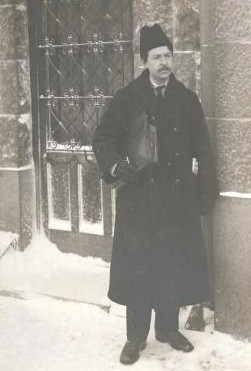 | |||||||
| Predecessor | P.I. Knock | ||||||
| Successor | P.I. Knock | ||||||
| Birth | July 13, 1888 Dinaburg , Russian Empire | ||||||
| Death | January 2, 1957 (68 years old) New York , USA | ||||||
| Children | |||||||
| The consignment | |||||||

Content
Biography
Born in the family of merchant Zerah Steinberg and his wife, Hyena Elyasheva (daughter of a Coven rabbi, sister of Jewish literary critic Isroel Bal-Mahshoves בעל-מחשבות ). Cousin of the Russian poet, director of the Jewish scene in Berlin, Nikolai Elyashov . He studied at the heder , Pernovskaya gymnasium.
He studied at Moscow University , since 1905 in the revolutionary movement, in 1906 he joined the Socialist Revolutionaries. He was arrested in 1908 and sent to Tobolsk province for 2 years. After exile, he left for Germany , graduated from Heidelberg University and defended his master's thesis. After returning to Russia, he was engaged in advocacy and journalism. During the First World War, he conducted anti-war and revolutionary work, was arrested in 1915 and exiled to the Ufa province.
In 1917 he worked as a lawyer in Ufa , where he led the club of the Left Socialist Revolutionaries of the Ufa province . He was elected a vowel of the City Duma, was a member of the Executive Committee of the Ufa Council of Workers and Soldiers and the All-Russian Council of Peasant Deputies; participant of the "Democratic Conference" in Petrograd; Member of the Provisional Council of Russia (Pre-Parliament) (September-December) 1917.
October 26, 1917 condemned the uprising in Petrograd , but became part of the Ufa Provincial Commissar Commissioner of Agriculture. He was elected to the Constituent Council on the list of Social Revolutionaries from the Ufa province. He was a member of the Central Committee of the Left Socialist Revolutionary Party.
From December 10, 1917 to March 1918 he was the People's Commissar of Justice in the SNK of the RSFSR . In addition to the general leadership of the People’s Commissariat, he was in charge of the personnel department and prison management, and was the editor of the criminal justice department. On December 18, 1917, some members of the Constituent Assembly were arrested on the Dzerzhinsky warrant (as members of the "Union for the Defense of the Constituent Assembly"), but I. Z. Steinberg released them [1] . On December 19, 1917, he signed the “Instruction” to the Revolutionary Tribunal on the termination of systematic repressions against individuals, institutions and the press and sent a corresponding telegram to the Soviets at all levels. In December 1917 - January 1918 The Council of People's Commissars several times examined Steinberg’s claims against the Cheka . On December 31, 1917, the SNK, on his initiative, decided to delimit the functions of the Cheka and the Investigative Commission under the Petrosoviet.
After the scandal caused by the murder of A.I. Shingarev and F.F. Kokoshkin on the night of January 6-7, 1918, on January 7, the Council of People's Commissars , after hearing the report of Steinberg, instructed the NKJ "to verify as soon as possible the thoroughness of political prisoners in prisons ... all the same , who within 48 hours cannot be charged, release ” [1] .
According to the decision of the Soviet government, Steinberg determined the amounts that the prisoners in Kresty had to pay as a deposit before being released for health reasons, as the prison doctor Ivan Manukhin was trying :
“The Left S.-R. was then the Commissioner of Justice I.Z. Steinberg. A soft, sympathetic person, he, as a representative of the new government, was bound by a decree of the Bolshevik majority and, according to this decree, demanded that each prisoner pay a certain amount for his bail. The size of the contribution varied depending on the commissioner's idea of the degree of “bourgeois” of the person. I had to bargain. Relatives of the next prisoner were usually in the waiting room and immediately paid the amount that they managed to bargain for. Cheaper than all, I.Z. Steinberg rated N. M. Kishkin - 3000 rubles, but this money was not there and the Political Red Cross had to buy it. <...> Having received a document of release from Steinberg, I usually led the prisoner out of the Crosses myself. <...> and I told everyone the same thing: “Immediately leave Petrograd.” Of my patients at Kresty, one V. L. Burtsev flatly refused to leave my prison on bail. His courage of the old revolutionary, whom the prison does not fear in the least, and his devotion to revolutionary activity, which he devoted his whole life to, apparently shamed the new rulers, and I managed to get him released on all four sides without bail ” [2]
On January 11, at his suggestion, SNK decided to investigate the activities of the members of the board of the People’s Commissariat, the Bolsheviks M. Yu. Kozlovsky and P. A. Krasikov , who were accused of unlawful activity by Steinberg. February 18, 1918 released V. Burtsev from prison. In March-April 1918, Steinberg confronted with F.E. Dzerzhinsky . On March 15, 1918 he left the SNK in protest against the conclusion of the Brest Peace, and on March 19, as part of the Southern delegation of the Central Committee of the PLSR (s), he went to Kursk to organize partisan detachments. From there he went to the south of the country, visited Kharkov , Rostov-on-Don, and took part in the All-Ukrainian Congress of Soviets in Yekaterinoslav. Elected to the Presidium of the All-Ukrainian Central Committee of the PLSR (s) from the Russian Left Socialist Revolutionaries. Together with B. D. Kamkov and V. A. Karelin, he became the organizer of the Main Military Headquarters of the Left Social Revolutionaries in Taganrog . In the spring of 1918, he actively participated in the II Congress of the PLSR (s). He delivered a speech approving the withdrawal of the Left Socialist Revolutionaries from the SNK and warned of the danger of the Soviet bureaucracy [3] [4] .
He was arrested by the Cheka on February 10, 1919. He spent 4.5 months in custody.
In 1923 he went abroad to work in the Vienna International, after which the All-Russian Central Executive Committee deprived him of Soviet citizenship. He lived in Berlin. Together with A. Schreider, he founded the Scythians publishing house [5] . He was a member of the faction of the PLSR and the AKP (maximalists) of the International Bureau of the Revolutionary Socialist Parties (Vienna International).
Steinberg is mentioned in the memoirs of the writer Roman Goule :
Now, from a beautiful far time, looking at these "Scythians", I must say that they were humanly good, pretty people (those whom I knew - Schreider, Bakal, Lundberg), but politically, in their "revolutionary romanticism" - some frivolous. It is strange that this group of “Scythians” consisted almost of the Jews who, by their national character, I think, are not located in any “Scythians”. Moreover, the former People’s Commissar I. Steinberg was an Orthodox, religious Jew, observing all the rites of Judaism [6] .
Steinberg was engaged in Yiddish literary and journalistic activities under the name Yitzhok-Nakhmen Steinberg. He was the theorist of territorialism and the editor-in-chief of the Afn Schwel magazine ( On the Doorstep ) in Berlin .
In 1933, after the Nazis came to power in Germany, he moved to London . In 1939-1943 he lived in Australia , where he unsuccessfully tried to organize a Jewish settlement, then moved to the United States.
He died in 1957 in New York .
The son is the famous American art critic Leo Steinberg (Zalman-Leib Steinberg, 1920-2011).
Ideas
Steinberg advocated the creation of a society based on the self-government of labor collectives, his views were close to anarchism. However, Steinberg believed that even in a stateless society, “crystals of power”, due to psychological and organizational reasons, would remain. This is a relationship between a doctor and a patient, a teacher and a student, an experienced specialist and a novice. These hierarchies will not necessarily be formal.
It is possible that they, or many of them, will have the character of informal domination, personal dominance. Even if these hierarchies are built on completely voluntary principles, they are fraught with the transformation into new pyramids of power. Steinberg compares a free society with a solution in which small solid crystals float. So that the liquid does not crystallize completely, it must be constantly mixed and remove the foci of crystallization. Each such case should be considered separately, and make sure that it does not become the cause of the emergence of new, stable hierarchies. If you do not follow this process, then a society that has declared the final victory of “anarchy” may, without noticing it, turn into a dictatorship. Therefore, Steinberg spoke of the creation of a stateless federation, constantly struggling with such a "crystallization".
An example of a possible struggle is the dispersal of management functions. Steinberg wrote about the possible negative consequences of the concentration of power in the hands of elected bodies of national self-government - the councils of which he was a supporter. The councils are in constant communication with the meetings of voters, the compact groups of which determine the key areas of work of the councils and monitor the execution of their orders. And in case of non-fulfillment of the orders of the assembly, the latter immediately withdraw or replace the delegates. But Steinberg understood that the grassroots congregations, although they exercise the supreme "power", still could not control every single action of the elected bodies that solve specific issues of everyday life. Therefore, Steinberg believed, it is important to break the single fist of the power of the Soviets, dividing the management of society between political and economic councils. The former, elected from workers of certain territories and / or enterprises, will concentrate in their hands the functions of defense and ensuring order. The second, created by elected representatives of production and consumer associations of workers (syndicates - unions of self-governing enterprises and cooperative unions), will manage economic life, deciding what, how and for whom to produce. The various branches of government of the soviets balance each other, preventing abuse.
Steinberg's concept became the core of the Left Eser doctrine.
Works
- Diary of a socialist revolutionary. - Ufa, 1917.
- The moral image of the revolution. - Berlin, 1923.
- Steinberg, I.Z. From February to October 1917 - Berlin-Moscow, 1920.
- When I was a People’s Commissar. - Berlin, 1929.
- Spiridonova: Revolutionary Terrorist. - London, 1935.
- Australia: The Unpromised Land. - London, 1948
- In The Workshop Of The Revolution, 1955.
Notes
- ↑ 1 2 Leonov S.V. State Security of the Soviet Republic at the Time of the October Revolution and Civil War (1917-1922) // State Security of Russia: History and Present. - M., 2004.
- ↑ Manukhin I. Memoirs of 1917 - 18 I. “February” // New Journal. 1958. No. 54. S. 110
- ↑ Steinberg Yitzhak Nachman // Electronic Jewish Library.
- ↑ Second Congress of the Party of Left Socialists-Revolutionaries-Internationalists
- ↑ Scythian Publishing House
- ↑ Roman Gul. I took Russia. Volume 1. Part 2
Literature
- Essays on the history of the Bashkir Autonomous Soviet Socialist Republic. T. 2. - Ufa, 1966.
- V.I. Lenin and the Cheka. Collection of documents (1917-1922). - M., 1987.