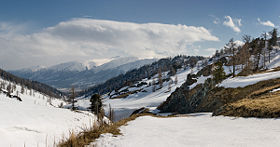
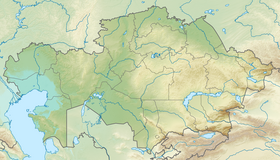
The Katon-Karagai State National Natural Park ( Kazakh: Katon-Karagay memeklettik Altty Tabi-i Parki ) is a national park in the Katon-Karagai region of the East Kazakhstan region within the Central Altai and South Altai physical and geographic regions . The territory of the national park, became part of the Kazakh part of the Altai-Sayan ecoregion. It was established in accordance with the Decree of the Government of the Republic of Kazakhstan No. 970 dated July 17, 2001. This is the largest national park in Kazakhstan [1] .
| Katon Karagai National Park | |
|---|---|
| kaz. Katonқaragay ұlttyқ parkі | |
 | |
| IUCN Category II ( National Park ) | |
| basic information | |
| Area | 643,477 ha |
| Established | July 17, 2001 |
| Management organization | Forestry and Hunting Committee |
| Location | |
| A country |
|
| Region | The East Kazakhstan region |



In 2014, the park was included in the UNESCO World Heritage List [2] .
Content
- 1 Flora and fauna
- 2 Organization
- 3 References
- 4 notes
Flora and Fauna

The rich species diversity of flora and fauna is concentrated here and the species listed in the Red Book of Kazakhstan are preserved. According to preliminary data, over 1000 species of higher vascular plants grow in the park. 30 species are listed in the Red Book: it is Rhodiola rosea, Raponticum safflower, Altai rhubarb, Snow strider, Siberian Siberian, Iris Ludwig, etc.
Forests , which are the main property of the park, occupy 34% of the territory and are represented mainly by coniferous species. This is spruce , Siberian cedar , larch and fir , birch and aspen , a wide variety of shrubs and shrubs .
The fauna is represented by 363 species of vertebrate animals: bone fish (6), amphibians (2), reptiles (6), birds (284), mammals (65). Taimen , Altai Ular , black stork , gray cranes and belladonna , burial ground , osprey , saker falcon , peregrine falcon , humpback turpan , snow leopard , stone marten are listed in the Red Book.
Organization
According to the legal regime of protection, the territory of the park is divided into the following zones and subzones:
- The reserve regime zone is 1 512.4 km² (23.5%);
- Custom-made zone - 4,922.4 km² (76.5%);
- Subzones:
- Recreational use;
- Limited economic activity;
- Administrative activities;
- Serving visitors and tourists.
- Subzones:
The last two subzones are located in settlements that are not part of the national park. The whole territory is divided into 30 sites for the protection and restoration of natural complexes.
Links
Notes
- ↑ Katon-Karagay and Bolshenarym. Mountain Altai in Kazakh
- ↑ Two Kazakhstani natural parks were included in the UNESCO World Heritage List . "Today.kz". Date of treatment July 2, 2014. Archived July 2, 2014.