" Kawachi " ( Japanese 河内 , English Kawachi , in some Russian-language sources, "Kawachi") is a type of battleship of the Imperial Navy of Japan . In total, two ships of this type were built - “ Kavati ” (河内, Kawachi ) and “ Setzu ” (摂 津, Settsu ).
| Line ships of the Kawati type | |
|---|---|
| 河内 型 戦 艦 | |
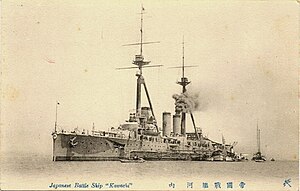 Battleship "Kavati" on a postcard | |
| Project | |
| A country |
|
| Manufacturers |
|
| Subsequent type | Fuso-class battleships |
| Main characteristics | |
| Displacement | 21 157 tons - “Kavati”, 21,787 tons - Setzu |
| Length | 160.3 m - Kavati 162.5 m - Setzu |
| Width | 25.75 m |
| Draft | 8.25 m - Kavati 8.5 m - Setzu |
| Reservation | The main belt is 127 ... 305 mm, upper belt - 100 ... 178 mm, GK towers - 279 mm, SK battery - 152 mm, conning tower - 254 mm, deck - 27 mm |
| Engines | 16 Miyabara steam boilers, Curtis turbines |
| Power | 25 000 liters from. (18.6 Mw ) |
| Speed | 20 knots (37 km / h ) |
| Crew | about 1000 people |
| Armament | |
| Artillery | 4 × 305 mm / 50 calibres, 8 × 305 mm / 45, 10 × 152 mm 8 × 120 mm / 40, 12 × 76 mm / 40, 4 × 76 mm / 28 |
| Mine torpedo armament | 5 × 457 mm TA |

Content
- 1 Design
- 1.1 Armament
- 1.2 Booking
- 1.3 Power plant
- 2 Service
- 3 notes
- 4 Literature
Design
The design of Kavati-type battleships was based on the design of the turbine half- dreadnought Aki , which in turn was an improved version of the Satsuma half-dreadnought.
Armament
The main caliber consisted of two types of guns. In the bow and stern turret were installed two 305-mm guns with a length of 50 calibers, which were ordered from the British company Armstrong Whitworth . On each side, two towers were installed with shorter (45 calibers) 305 mm Japanese-made guns. Airborne guns were usually charged at an elevation angle of 5 °, although any angle from 0 ° to + 13 ° could be charged. These guns had elevations from −5 ° to + 25 °. Such a composition and location of the main caliber is considered unsuccessful. Firstly, due to the location of the side towers, a maximum of 8 out of 12 main guns could be aimed at one target. Secondly, shells from short and long guns fly along different paths, which complicates targeting while firing from guns of different lengths. This violates one of the basic tenets of the principle "only big guns" - uniformity, which makes the series more likely intermediate between battleships and battleships , like the Aki from Satsuma , but closer to the battleships .
The mid-caliber armament consisted of ten 152 mm guns. Unlike most battleships in other countries, 152 mm guns were protected by 152 mm armor.
Mine artillery consisted of eight 120-mm and 16 76-mm guns.
Booking
Main armor belt: Krupp armor with a thickness of 305 mm in the middle of the sides.
Power plant
A twin-shaft steam turbine unit with a capacity of 25,000 liters was installed on the battleships. from. (18.387 M W ), including two turbines of the Curtis system with direct drive [1] [2] . According to the project, it was supposed to provide a maximum speed of 20 knots at 245 rpm. The total mass of the power plant (excluding fuel) was 2033 tons at the Kavati and 2073 tons at the Setzu, the specific power was 7.55 liters. from. / ton [3] .
Initially, it was planned to install active turbines of the Curtis system on battleships with 7 forward and 2 reverse gears, similar to those installed on the Aki battleship and the Ibuki armored cruiser. However, in 1908, through the naval attache in the United States, it became known about the appearance of improved turbine modifications that could reduce fuel consumption and reduce the size of shaft bearings. As a result, Kavati-type battleships received Curtis turbines with a capacity of 12,500 liters. from. with 15 forward stages (of which 6 high-pressure stages were separate disks, and 9 low-pressure stages were combined into one drum) and 2 rear stages. The disk of the first high-pressure stage had 4 rows of blades, the next 5 - in 3, and 9 low-pressure stages combined in a drum - in 2. Like the Aki and Ibuki turbines, the first stage had expanding nozzles, and the remaining stages were parallel, but the expansion coefficient at the first stage increased to 1.177 compared with 1.13 at Ibuki. The step disks had a diameter of 3.581 m, the diameter of the turbine on the casing was 4.317 m, and its maximum width at the attachment point at the attachment point of the inner and outer shells reached 4.93 m. The turbines were installed in two engine rooms with a length of 18.29 m and a total area 307.64 m², separated by a longitudinal bulkhead [1] [2] [4] .
Waste steam was collected in two condensers , which on ships were slightly different. Kavati condensers had a total cooling area of 1254 m² and included 5695 cooling tubes, with a water flow rate of 2.4 m / s and its maximum value of 7150 tons / h. At Setz, the capacitors had an area of 1115 m², including 5060 tubes with a flow rate of 2.72 m / s and its maximum value of 7200 tons / h. In both cases, the centrifugal pump system was used, which was returned after the experience of using the centrifugal and vacuum pump system at Ibuki, which proved to be not very effective. According to the project, the steam consumption in the turbines was to be 6.57 kg / l. from. per hour, at the Kavati tests, an even lower value was reached - 6.13 kg / l. from. per hour, which showed its high profitability in terms of steam consumption. At the same time, for reversing, the flow rate was very high - 13.76 kg / l. from. per hour at a capacity of 12 835 liters. from. (design 10 500 l. from.) [5] .
A couple of turbines were powered by sixteen (eight one-sided and eight two-sided) water tube boilers with large diameter pipes and mixed heating Miyabar design. The working pressure of superheated steam (overheating by 12 ° Celsius relative to saturated) is 19.3 kgf / cm² [6] [7] [8] . The total heating surface of the boilers was 4973.27 m². The boilers developed by Vice Admiral Jiro Miyabara had a relatively simple design of horizontal drums for water and steam, connected by slightly curved tubes; The Japanese fleet appreciated them for their durability, lack of leaks, a large amount of coolant and its effective circulation. The boilers were placed longitudinally in three engine rooms: on average and aft, 10.36 m long and 16.46 m wide, there were four double-sided boilers, eight one-sided in the bow length of 10.97 m. The total area of boiler rooms is 522.29 m². The chimneys of each boiler room were reduced to a separate chimney, due to the space between the bow and middle boiler rooms occupied by the barbets and cellars of the towers, the ships received a three-pipe silhouette unique to the Japanese fleet with a large distance between the first and second chimneys. Fuel reserves included up to 2300 tons of coal (a normal reserve of 1100 tons) in bunkers and 400 tons of fuel oil in tanks. This proportion probably appeared due to the high cost of petroleum products at that time, which allowed only limited use for heating boilers [6] [9] .
The battleships had two three - bladed propellers with a diameter of 4.06 m, with a pitch of 3.15 m, a blade sweep area of 6.86 m² and a design speed of 245 times per minute. Due to the large size of the turbines, the distance between the supports of the propeller shafts was 6.933 m, which led to a noticeable deformation of the shafts when idle, there was also an increased heating of the bearings during operation - two main flaws of this steam turbine plant. The right screw rotated the shaft clockwise, and the left screw in the opposite direction. Behind the screws was one semi-balanced steering wheel with an area of 28.37 m² [10] [5] .
| Results of sea trials of battleships [9] | |||
|---|---|---|---|
| Displacement, tons | Power plant capacity, l. from. | Speed, knots | |
| Cavati | 20,823 | 30 399 | 21,024 |
| “Setzu” | 21,443 | 32,200 | 21,008 |
The electric power system consisted of four generators of 176 kW and two of 88 kW each, generating direct current with a voltage of 110 V. Generators of 176 kW were located in pairs in two generator compartments: on the starboard side of the bow tower of the main gun and on the port side of the stern, symmetrically with them there were compartments of hydraulic pumps. In addition, there was a 25 kW generator supplying on-board radio equipment [9] .
Service
The lead ship , Kavati , was laid down on April 1, 1909 , launched on October 15, 1910 , and commissioned on March 31, 1912 . He played a secondary role in the First World War . In 1918 , while anchoring, he sank as a result of the explosion of a powder cellar.
“ Setzu ” - laid on January 18, 1909 , launched on March 30, 1911 , commissioned on July 1, 1912 . He played a secondary role in the First World War . Withdrew from the fleet in 1924 . Almost until the end of World War II, he served as a radio-controlled target ship.
Notes
- Comments
- Used literature and sources
- ↑ 1 2 Milanovich, 2017 , p. fifteen.
- ↑ 1 2 Malov, 2013 , p. 46-47.
- ↑ Milanovich, 2017 , p. 14-15.
- ↑ Lacroix, Wells, 1997 , p. 737.
- ↑ 1 2 Malov, 2013 , p. 47.
- ↑ 1 2 Milanovich, 2017 , p. 16.
- ↑ Malov, 2013 , p. 47-49.
- ↑ Lacroix, Wells, 1997 , p. 735.
- ↑ 1 2 3 Malov, 2013 , p. 49.
- ↑ Milanovich, 2017 , p. 15-16.
Literature
- in English
- Eric Lacroix, Linton Wells II. Japanese cruisers of the Pacific war. - Annapolis, MD: Naval Institute Press, 1997. - 882 p. - ISBN 1-86176-058-2 .
- Kathrin Milanovich. The Japanese battleship Kawachi and Settsu // Warship. - 2017 .-- S. 8-23 . - ISBN 978-1844864720 .
- in Russian
- Arseny Malov. "Kawati" and "Settsu" - the first Japanese dreadnoughts // Arsenal collection. - 2013. - No. 3 . - S. 31–55 . - ISBN 977-2306669779.