Ferdinand Fabre ( French: Ferdinand Fabre , 1827 - 1898 ) - French poet and novelist .
| Ferdinand Fabre | |
|---|---|
| fr. Ferdinand fabre | |
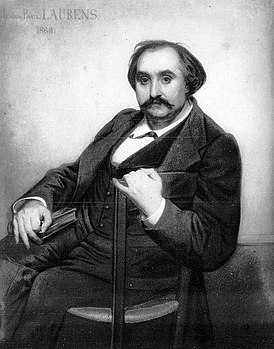 | |
| Date of Birth | June 9, 1827 |
| Place of Birth | Bedarje ( Languedoc-Roussillon , France) |
| Date of death | February 11, 1898 (70 years old) |
| A place of death | Paris (France) |
| Citizenship | France |
| Occupation | poet , prose writer |
| Language of Works | French |
In his youth, he was preparing for a spiritual rank and graduated from a course in a theological seminary.
In 1853 he published a collection of poems "Feuilles de lierre". But poetic creation was not a true sphere of Fabre; he later realized this himself.
In 1862, his novel Les Courbezon appeared, drawing general attention to it; Here, Fabre showed himself to be a convinced realist, a true portrayer of a familiar atmosphere.
His novels can be divided into two main categories.
In some he masterfully depicts the life of the clergy, contrasting the faiths and deeds of materialist priests, ambitious and opportunists to people , expressing his dislike of the Jesuits , sympathetically referring, in general, to the village clergy (“L'abbé Tigrane”, “Lucifer”, “ Madame Fuster ”,“ Mon oncle Célestin ”, 1881).
Other novels are devoted to the characterization of village life, the life of peasants living among Sevennes. Fabre does not close his eyes to the negative aspects of the village people, he notes rudeness of morals, greed, vengefulness, ignorance, but at the same time he brings out individual peasants with more attractive and cultural drives, willingly describing, sometimes in a very beautiful, picturesque form, the mountain nature (“Les Courbezon ”,“ Barnabe ”,“ Xaviére ”,“ Le chévrier ”and others).
Fabre also owns the drama from the village life "L'hospitalière".

Being a supporter of a real, almost naturalistic trend, Fabre was not, however, a follower of this or that school, held a separate position, did not have real followers or students. The Brockhaus and Efron Encyclopedia believed that “in their original and interesting content, close connection with the medium depicted by the author and the general humane color, Fabre’s novels are among the most interesting works of French fiction of the 19th century and would deserve much more popularity.”
Literature
- Georges Pellissier . Études de littérature contemporaine. - P. , 1898. - Ch. II.
- Georges Pellissier . Le mouvement littéraire contemporain. - P. , 1901.
Links
- Fabre, Ferdinand // Brockhaus and Efron Encyclopedic Dictionary : in 86 volumes (82 volumes and 4 additional). - SPb. , 1890-1907.