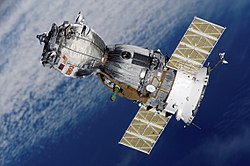
A manned spacecraft is a manned spacecraft designed to fly people in outer space and, in particular, deliver people to space and return them safely to Earth (or another planet / satellite / space station ).
In his work “The Spaceship” in 1924, Konstantin Eduardovich Tsiolkovsky , speaking about the apparatus intended for the flight of a person into space, basically called it differently: - a celestial ship [1] .
The first manned spacecraft was the Soviet ship Vostok-1 , on which Yuri Gagarin made the first full-fledged space flight, flying around the Earth at the first space speed .
One of the main problems in the design of this class of spacecraft is the creation of a safe, reliable and accurate system for returning the crew to the earth's surface in the form of a wingless descent vehicle (SA) or spacecraft . In addition, an important feature is the presence of an emergency rescue system (CAC) at the initial stage of launch by a launch vehicle (LV) . The projects of the first generation spacecraft did not have a full-fledged rocket SAS - instead of it, as a rule, the ejection of crew seats was used, winged space planes are also not equipped with a special SAS. Also, the spaceship must be equipped with a crew life support system (LSS) .
Due to the high complexity of creating the PAC, only three countries have them - the USSR / Russia , USA , China . At the same time, Chinese spacecraft largely repeat the Soviet spacecraft Soyuz.
For several years, the Soyuz spacecraft have been the only means of mankind's entry into space. [2]

Including only in the USA and the USSR reusable systems with PAC- spaceplanes were created (currently decommissioned). Also, India , Japan , Europe / ESA , Iran , the DPRK have plans to create a GAC.
Spaceships and Projects
- 1st generation spacecraft:
- East ( 6 flights , project completed)
- Sunrise ( 2 flights , project completed)
- Mercury ( 6 flights , project completed)
- Gemini ( 12 flights , project completed)
- Shuguang and manned FSW (projects stopped)
- 2nd generation spacecraft:
- Union ( 136 flights , 2 accidents, 3 accidents without casualties (including 2 suborbital flights), (continues to fly)
- L1 / Probe (project completed)
- L3 (the project was stopped at the stage of unmanned flight tests)
- Apollo ( 21 flights , project completed)
- TKS - Supply Supply Vehicle (project completed)
- Shenzhou ( 11 flights , fly )
- Fuji (project suspended)
- OV (project under development)
- CRV (manned ATV) (project under development)
- manned HTV (project under development)
- Reusable ships
- X-20 Dyna Soar (project not implemented)
- Spiral (project suspended)
- LKS (project not implemented)
- Space shuttle ( 135 flights , 2 disasters (including 1 at launch), project completed)
- X-30 NASP (project suspended)
- VentureStar (project suspended)
- ROTON (project suspended)
- Delta Clipper (project)
- Kistler K-1 (project suspended)
- Dream Chaser (project in the unmanned flight test phase)
- Silver Dart (project)
- Dawn (project stopped)
- Buran (1 unmanned flight, the project is suspended)
- Hermes (project stopped)
- Senger-2 (project stopped)
- HOTOL (project stopped)
- HOPE (project stopped)
- ASSTS (project stopped)
- Kanko Maru (draft)
- Shenlong (project under development)
- MAX (project stopped)
- Clipper (project stopped)
- Partially reusable spaceships:
- Dragon V2 (project in the unmanned flight test phase)
- Federation (project under development)
- Starliner (unmanned flight test project)
- ACTS (project under development)
- Orion (project under development)
Notes
- ↑ Works on astronautics. Exploring world spaces with jet devices . K. E. Tsiolkovsky; Ed. and M.K. Tikhonravova - M .: Engineering, 1967. - 376 p.
- ↑ Russian "Unions" - the only means of crew delivery to the ISS »Engineering Resource. Engineering: mechanical engineering news, articles. Catalog: machine-building plant and enterprises. . www.i-mash.ru. Date of treatment January 21, 2018.
Links
- The history of the development of domestic manned space exploration / ed. O. N. Ostapenko. - Publishing house "Capital Encyclopedia", 2015. - V. 2. - 752 p. - ISBN 978-5-903989-27-0 .