Paphiopedilum armeniacum (possible Russian names: Paphiopedilum apricot-like [2] , or Paphiopedilum apricot-like [3] ) is a perennial terrestrial jagged plant of the Orchidaceae family .
| Paphiopedilum armeniacum | |||||||||||||||||||||||||||||
| Scientific classification | |||||||||||||||||||||||||||||
|---|---|---|---|---|---|---|---|---|---|---|---|---|---|---|---|---|---|---|---|---|---|---|---|---|---|---|---|---|---|
| |||||||||||||||||||||||||||||
| International Scientific Name | |||||||||||||||||||||||||||||
Paphiopedilum armeniacum SC Chen & FY Liu 1982 | |||||||||||||||||||||||||||||
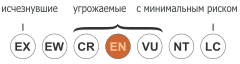
| Security status | |||||||||||||||||||||||||||||
Content
Synonyms
According to the Royal Botanic Gardens at Kew [4] :
- Paphiopedilum armeniacum var. mark-fun Fowlie , 1983
- Paphiopedilum armeniacum var. markii O.Gruss , 1997
- Paphiopedilum armeniacum f. markii ( O. Grass ) Braem in GJBraem , 1998
- Paphiopedilum armeniacum var. parviflorum ZJLiu & J.Yong Zhang , 2001
- Paphiopedilum armeniacum var. undulatum ZJLiu & J.Yong Zhang, 2001
Etymology
The species name "armeniacum" is derived from the Latin name of the apricot - armeniáca. This name is due to the fact that apricots are spread in Europe from Armenia . Flowers of all known lemon-yellow plants. The species does not have an established Russian name, in the Russian-language sources the scientific name Paphiopedilum armeniacum is usually used.
Description History
Liu Chen was first discovered in Yunnan ( China ) in 1979 [5] .
For some time it was suggested that Paph. armeniacum may be a natural species of Paphiopedilum delenatii [6] .
After more copies became available to botanists, in 1982 Paph. armeniacum described as a new species.
Natural varieties
According to the Royal Botanic Gardens in Kew [4] there are no registered species.
- Paphiopedilum armeniacum fma. markii [7] - the form has a pure yellow flower without a red smear on staminodynia and it does not have a speck inside the lip .
Biological description
Escape sympodial type.
The stem is almost completely hidden by the bases of 5-7 leaves.
The rhizome is elongated, sockets are located at a distance of 15 cm from each other.
Leaves 6-15 cm long, 1-2.5 cm wide, variegated, with dark green spots on a lighter greenish-bluish background.
Peduncle single, green, pubescent, single-flowered, up to 23-26 cm tall.
The flower is bright yellow, 6-11 cm in diameter. Staminodynia is reddish.
Chromosomes : 2n = 26 [5] .
Range, environmental features
China (western Yunnan province ).
Plants were found on limestone hills and rocks in the forests between the Saluin and Mekong rivers, near the border with Burma (26.5 ° N). At heights of up to 2000 meters above sea level.
In places of natural growth, extreme temperatures of up to 30 ° C and −4 ° C were recorded.
Relative humidity ranges from 60% in the period from January to March by 80% for the entire summer period.
Precipitation: from 30 mm in January to 155 mm in June.
The average air temperature (day / night) is from 15/0 ° C in January to 24 / 16.5 ° C in July.
Flowering period: from December to March [8] .
Belongs to the number of protected species (first CITES appendix) [9] .
Red Book of IUCN .
In culture
Paph. armeniacum forms stolons up to 15 cm, at the end of which a daughter plant develops, which makes it difficult to grow in pots. In this regard, it is recommended to grow plants in baskets of wire mesh or wooden planks.
The temperature group is moderate. If you simulate natural conditions, the plants should be kept at the following temperatures: in the summer 23-24 ° C during the day and 16-17 ° C at night; in winter 15-16 ° C during the day and 0-2 ° C at night. According to some sources, plants can hibernate at higher night temperatures of 8–10 ° C [10] . For successful flowering, a day / night temperature difference of 7-10 ° C and a decrease in temperature in the winter are required.
According to reports from some collectors, this species blooms more easily and more quickly when seasonal and daily temperature drops simulate natural conditions. Adaptation of plants to conditions in a city apartment with minimal seasonal and daily temperature differences is possible, but it may take about two years [11] .
Lighting: bright diffused light (18000-25000 lux [8] ).
The main components of the substrate: see article Paphiopedilum .
pH 7.48-7.9 [5] .
Some authors consider Paph. armeniacum calcephil [12] . When pouring soft water into the soil, it is recommended to add limestone pebbles. If the water used for irrigation is hard, calcium-containing additives are not needed.
The frequency of watering is chosen in such a way that the substrate inside the pot has had time to almost completely dry, but did not have time to dry completely. In winter, watering is reduced.
When salts accumulate in the substrate, plant growth slows down.
Not all plants bloom every year [13] .
During the growing period, 1 / 4-1 / 2 of the recommended dose of mineral fertilizers for orchids is applied every week or every two weeks. In spring and summer, it is recommended to use fertilizers with a high nitrogen content if plants are planted in a substrate consisting of one bark. In autumn, fertilizers with a predominance of phosphorus are introduced, which stimulates future flowering. Fertilizers are not used during the winter [8] .
Some famous clones :
- Paph. armeniacum 'Candor Starson' HCC / AOS
- Paph. armeniacum var. F Mark (album) 'Candor Excalibur' AM / AOS
- Paph. armeniacum 'RainForest' AM / AOS
The species is actively used in hybridization [14] .
The best primary hybrids of Paph. armeniacum are obtained by crossing with other members of the same section or with multi-flower species ( Paph. rothschildianum , Paph.philippinense or Paph. praestans ). But even in this case, some plants refuse to bloom or produce improperly formed flowers. When crossed with species from other groups, the proportions of defective hybrids are more serious [13] .
Diseases and pests
Some Primary Hybrids ( Grexes )
- Armeni White 1987 - armeniacum × delenatii (pollen)
- Arsand Shigeta 1998 - armeniacum (pollen) × sanderianum
- Canary Waltz 1993 - armeniacum (pollen) × chamberlainianum
- Doll Star 1988 - armeniacum (pollen) × sukhakulii
- Dollgoldi 1988 - armeniacum (pollen) × rothschildianum
- Fumi's Gold 1991 - armeniacum (pollen) × concolor
- Wossner Armiday 1996 - armeniacum × dayanum (pollen)
- Franz Glanz 1993 - armeniacum × emersonii (pollen)
- Golden Diamond 1989 - armeniacum × fairrieanum (pollen)
- Mary Ott 1994 - armeniacum (pollen) × glaucophyllum
- Paph Kiryu 1989 - armeniacum (pollen) × godefroyae
- Karyol Vaughn's Gold 1995 - armeniacum × haynaldianum (pollen)
- Lady Trouble 1989 - armeniacum (pollen) × hookerae
- Norito Hasegawa 1992 - armeniacum (pollen) × malipoense
- Michael Gibson 1993 - armeniacum × mastersianum (pollen)
- Fumi's Delight 1994 - armeniacum × micranthum (pollen)
- Wossner Vollmond 1991 - armeniacum (pollen) × niveum
- Michael Tibbs 1995 - armeniacum × philippinense (pollen)
- Golddollar 1988 - armeniacum (pollen) × primulinum
- Wossner Stonarmi 1993 - armeniacum (pollen) × stonei
- Wossner Goldmarie 1995 - armeniacum × victoria-mariae (pollen)
- Wossner Armeregina 1994 - armeniacum (pollen) × victoria-regina
- Wossner Armenigold 1996 - armeniacum × adductum (pollen)
- Wossner Bellarmi 1992 - armeniacum (pollen) × bellatulum
- Wossner Armeniglan 1996 - armeniacum (pollen) × glanduliferum
- Wossner Kolarmi 1997 - armeniacum (pollen) × kolopakingii
Notes
- ↑ On the conditionality of specifying the class of monocotyledons as a higher taxon for the group of plants described in this article, see the APG Systems section of the Monocotyledons article .
- ↑ The Russian name “Pafiopedilium apricot-like” is used in the article by G. Kolomeitseva. In the footsteps of Venerins Bashmachkov. The Million Friends Magazine No. 5-6, 2000
- ↑ The Russian name "Paphiopedilum apricot" is used in the book Hedgehog Zdenek, Orchids. Illustrated Encyclopedia. Publisher: Labyrinth, 2005
- ↑ 1 2 World Checklist of Paphiopedilum armeniacum . The Royal Botanic Gardens, Kew.
- ↑ 1 2 3 slipperorchids.info
- ↑ Cribb, P, Tang, C. The Chinese Species of Paphiopedilum. Orchid Review 91 (1075): 160-165, May; 1983.
- ↑ Gruss in Die Orchidee, 48 (5): 215-216 (1997)) Braem, Baker & Baker in The Genus Paphiopedilum, 1: 69 (1997)
- ↑ 1 2 3 View sketch on the website Orchidarium.pl
- ↑ Roberts, JA et al. (comp.). 1995. CITES Orchid checklist. (CITES Orchid L)
- ↑ Paphiopedilum armeniacum Culture
- ↑ E. Morozov. Paphiopedilum culture in questions and answers.
- ↑ Bob & Lynn Wellenstein. Supplementing Calcicolous Paphs.
- ↑ 1 2 Harold Koopowitz, James Comstock, Carol Woodin. Tropical Slipper Orchids. Timber Press, 2008
- ↑ armeniacum
Literature
- Baker C, Baker M, 1995, Paphiopedilum armeniacum. Amer. Orchid Soc Bull. 64. (7): 738-741.
- Braem, GJ 1988. Paphiopedilum. A monograph of all tropical and subtropical Asiatic slipper-orchids. 111.
- Cribb, PJ 1987. The genus Paphiopedilum. (Gen Paphiopedilum) 148.
- Cribb, P. 1998. The genus Paphiopedilum, second edition. (Gen Paphiopedilum 2) 231.
- Cribb P, 1984, The golden slipper orchid of Yunnan. Garden (London), 109. (9): 352-353.
- Cribb P, 1984, The golden slipper orchid: Paphiopedilum armeniacum. Orchid Rev. 92. (1090): 246.
- Koopowitz H, Hasegawa N, 1984, The status of Paphiopedilum armeniacum. Orchid Dig., 48. (3): 95-98.
- Cribb P, Luo YB, Siu G, 1998, Paphiopedilum armeniacum, Yunnan. Orchid Rev. 106. (1223): 271-273.
- Liu ZJ, Zhang JY, 2001, Paphiopedilum armeniacum var. parviflorum, a new orchid variety from southwestern China. Acta Phytotax. Sin. 39. (5): 459–460.
- Perner H, 1999, The bitter sea turns sweet: Paphiopedilum armeniacum in its natural habitat. Orchid Dig. 63. (1): 27-30.
- Hasegawa N, 1998, Paphiopedilum armeniacum: a marvelous, Parvisepalum slipper orchid. Orchid Dig. 62. (1): 43-46.
- Perner H, 1998, Paphiopedilum armeniacum Chen et Liu am Naturstandort. Orchidee 49. (5): 203-208.
- Gruss O, 1997, Paphiopedilum armeniacum var. markii gruss. Orchidee 48. (5): 215-216.
- Gruss O, 1993, Paphiopedilum armeniacum SC Chen et FY Liu 1982. Orchidee 44. (6): center page pullout pp. 743-744.
- Sagawa Y, 1989, Paphiopedilum armeniacum. Hawaii Orchid J. 18. (3): 12-13.
- Harold Koopowitz, James Comstock, Carol Woodin. Tropical Slipper Orchids. Timber Press, 2008.
Links
- Paphiopedilum armeniacum view essay on the Slipperorchids website
- Paphiopedilum armeniacum Culture. Charles and Margaret Baker (eng.)
- Paphiopedilum armeniacum Essay on Internet Orchid Species Photo Encyclopedia (English)
- Paphiopedilum armeniacum (English) : information on the GRIN website. (eng.)
- Paphiopedilum armeniacum at Electronic Plant Information Center of Royal Botanic Gardens, Kew
- Paphiopedilum armeniacum at Tropicos.org. Missouri Botanical Garden. (eng.)