Desmostylia [1] [2] ( lat. Desmostylia ) - a detachment of extinct marine mammals living in the Oligocene - Miocene ( 33.9-5.33 million years ago) [3] .
| † Desmostylia |
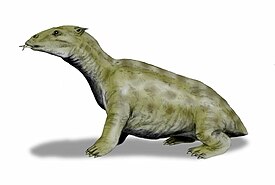
Reconstruction of Desmostylus hesperus |
| Scientific classification |
|---|
| No rank : | Bilateral symmetrical |
|
| International scientific name |
|---|
Desmostylia Reinhart , 1953 |
Geochronology33.9-5.33 Ma | million years | Era | F-d | Era |
|---|
| | Th | TO
but
th
n
about
s
about
th | | 2,588 | | | 5.33 | Pliocene | N
e
about
g
e
n | | 23.03 | Miocene | | 33.9 | Oligocene | P
but
l
e
about
g
e
n | | 55.8 | Eocene | | 65.5 | Paleocene | | 251 | Mesozoic |
◄ Nowadays◄ Cretaceous-Paleogene extinction |
|---|
|

The skeleton of
paleoparadoxia
Desmostylus hesperus - Upper Miocene of California and Sakhalin
Content
Desmostylus inhabiting the Pacific coast had two pairs of limbs and could move both by water and by land. On land, they moved very awkwardly, as their limbs were widely spaced apart. On the other hand, there are alternative reconstructions of paleoparadoxia as a finger-walking animal. In water they rowed mainly with their front legs, like polar bears. Apparently, they lived in river estuaries , ate algae. The length of the skull of the largest species (for example, Desmostylus hesperus ) reached 90 cm, the length of Desmostylia reached 1.8 m, and the mass was more than 200 kg. Animals are probably herbivorous. The structure of their molars is extremely unusual (from enamel cylinders merged together).
Remains of desmostylia were found in California and Japan , as well as in Kamchatka and Sakhalin .
The position of the detachment is ambiguous. Initially, Desmostyles were considered to be single-pass relatives. Later it was possible to prove their proximity to primitive proboscis and sirens - afroteria [4] . The resemblance to elephants is noticeable in the presence of enlarged upper and lower incisors, but fangs are also increased (in contrast to proboscis). However, in 2014, a team of scientists led by Cooper included desmostilia in the unit of artiodactyls , lavrazioteria [5] .
Classification
According to the Paleobiology Database website, as of January 2018, the order includes the following extinct taxa up to and including childbirth [3] :
- Childbirth incertae sedis
- Genus Behemotops Domning et al. , 1986 - Hippos [4]
- Genus Kronokotherium Pronina, 1957
- Genus Seuku Beatty & Cockburn, 2015
- Family Desmostylidae Osborn, 1905
- Genus Ashoroa Inuzuka, 2000
- Genus Cornwallius Hay, 1923 - Cornwallius [4]
- Genus Desmostylus Marsh, 1888
- Genus Ounalashkastylus Chiba et al. , 2016
- Genus Vanderhoofius Reinhart, 1959 - Vanderhoofie [4]
- Family Paleoparadoxiidae Reinhart, 1959
- Genus Archaeoparadoxia Barnes, 2013
- Genus Neoparadoxia Barnes, 2013
- Genus Paleoparadoxia Reinhart, 1959 - Paleoparadoxia
- ↑ Fundamentals of Paleontology: A Handbook for Paleontologists and Geologists of the USSR: in 15 volumes / chap. ed. Yu. A. Orlov . - M .: Gosgeoltekhizdat, 1963. - T. 13: Mammals / ed. V.I. Gromova. - S. 283. - 423 p. - 3000 copies.
- ↑ Mammals. Big Encyclopedic Dictionary / scientific. ed. I. Y. Pavlinov . - M .: ACT, 1999 .-- S. 70 .-- 416 p. - ISBN 5-237-03132-3 .
- ↑ 1 2 Desmostylia (English) information on the Paleobiology Database website. (Retrieved February 10, 2018) .
- ↑ 1 2 3 4 Alifanov, Kirillova, 2008 , p. 43-44.
- ↑ Cooper LN, Seiffert ER, Clementz M., Madar SI, Bajpai S., Hussain ST, and Thewissen JGM 2014. Anthracobunids from the Middle Eocene of India and Pakistan are stem perissodactyls. PLOS ONE 9 (10): e109232: 1-15. DOI : 10.1371 / journal.pone.0109232 .
- Alifanov V.R., Kirillova I.V. Review of the pre-Quaternary vertebrates of Sakhalin Island // Scientific notes of Sakhalin State University : collection of scientific articles / Ch. ed. and comp. T.K. Zlobin. - Yuzhno-Sakhalinsk: SakhSU , 2008. - Issue. VII. - S. 38-47.
- Desmostiles - Extinct animal wiki .

