
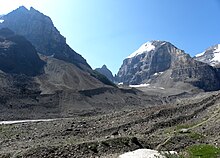
Morena is a genetic type of glacial deposits created directly by the glacier . It is a heterogeneous mixture of clastic material - from giant boulders having up to several hundred meters across to clay material formed as a result of grinding fragments during glacier movement.
Most researchers call moraine both glacial sediments that are currently being transported by the glacier, and already precipitated sediments [1] [2] . Therefore, when classifying moraines, moving and deferred are distinguished. The last row of researchers is called till [3] . By the method of forming moraines are divided into:
- The main (bottom) moraines are fragments of rocks carried inside the ice sheet and at its base. After melting and releasing from under the ice, bottom moraines form an extensive and fairly even layer of moraine accumulations.
- Side moraines .
- Central moraines - formed as a result of the confluence of glaciers.
- Final moraines - the formation of a transverse mound of debris in the area of maximum glacier distribution. Often are a natural cause of the formation of ponds of glacial origin.
Some moraines move near the surface of the ice. These include lateral moraines that form along the edges of the glacier, and median moraines that form when the two lateral ones merge. Other moraines are carried at the base of the ice sheet. When the ice moves, they break, rub against the bed and grind. Hard rocks, such as granite , are immersed in sand, while soft ones (for example, shale) are ground into thin clay. Boulder clay is often deposited on horizontal covers.
Large boulders can be carried by the glacier for many kilometers, while remaining intact. In their new place they look like foreign bodies, often resting on other rocks, and therefore are called erratic (literally, unstable).
Oblong clay hills are called Drumlins . They are composed of masses of boulder clay, which gives shape and smooths the ice passing over them. The Drumlins of Northern Ireland are among the largest in the world: some of them are more than 1.5 km long at a height of 60 m.
The word " moraine " was first used to refer to ridges and hills, composed of boulders and fine earth and found at the ends of glaciers in the French Alps . The composition of the main moraines is dominated by the material of deposited moraines, and their surface is a rugged plain with small hills and ridges of various shapes and sizes and with numerous small hollows filled with lakes and swamps. The power of the main moraines varies widely depending on the volume of material brought by the ice.
The main moraines occupy vast areas of former glaciation: in the USA , Canada , the British Isles , Poland , Finland , northern Germany and Russia . The environs of Pontiac (pc. Michigan) and Waterloo (pc. Wisconsin) are characterized by landscapes of the main moraine. Thousands of small lakes dot the surface of the main moraines in Manitoba and Ontario ( Canada ), Minnesota ( USA ), Finland and Poland .

At the front (tongue) of the glacier, deposits often accumulate and form ridge, or terminal, moraines. They occur in ablation zones - areas where the edge of the glacier melts over time. Thus, terminal moraines mark the boundaries of the last, or farthest, ice advance. The terminal moraines form powerful wide belts along the edge of the integumentary glacier. They are represented by ridges or more or less isolated hills up to several tens of meters thick, several kilometers wide and, in most cases, many kilometers long. Often the edge of the integumentary glacier was not even, but was divided into fairly distinctly separated blades. The position of the edge of the glacier is reconstructed by terminal moraines. Many researchers believe that during the deposition of these moraines the edge of the glacier for a long time was in a weakly mobile (stationary) state. At the same time, not one ridge was formed, but a whole complex of ridges, hills and hollows, which rises markedly above the surface of adjacent main moraines. In most cases, the terminal moraines that make up the complex indicate repeated small movements of the edge of the glacier [4] .
Ancient moraines form mixtite horizons characteristic of platform covers and are called tillites .
See also
- Drumlins
- Oz
- Glacial lake
Notes
- ↑ Schukin, I. S. Four-Encyclopedic Dictionary of Physical Geography. - Moscow, 1980.
- ↑ Levers G.I. General geomorphology. - M .: Publishing House of Moscow State University, 2006.
- ↑ O. V. Petrov (editor-in-chief). GEOLOGICAL DICTIONARY // third, revised and supplemented. - 2010.
- ↑ Schukin I.S. General geomorphology. - M .: Publishing house Mosk. University, 1960.
Links
- Moraine lakes in Karelia (inaccessible link)