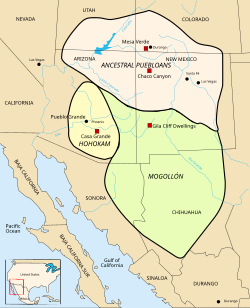

Hohokam , eng. Hohokam is a large pre-Columbian archaeological culture that existed in the southwestern United States ( Sonora Desert), partially affecting the territory of modern Mexico. It existed from the 1st to the 15th centuries. n er The culture was identified in the 1930s. as distinct from the neighboring archaeologist Harold Gladwin , who used the name from the Oodham Indians to refer to the archaeological site that he was digging in the Lower Gila Valley.
According to local traditions, the Hohokam culture could be the ancestor of the Akimel-Oodham (Pima) and Tohono-Oodham (Papago) peoples in Southern Arizona . Recent studies of the monuments of the Sobaipuri people, the ancestors of the modern Piman peoples of the Uto-Aztec family , show that the ancestors of the Pima have been present in this region since at least the last years of the Hohokam culture.
Content
Agriculture
The Hohokam culture used a number of primitive canals and dams for its agricultural purposes. In the period from 7 to 14 centuries. they also built and maintained large irrigation networks near the lower Salt River and in the middle of the Hila River (a tributary of the Colorado River ), no less complex than similar structures in the ancient Near East, Egypt or China. These canals were built using primitive digging means, without the use of complex engineering technologies. Archaeological research over the past 70 years has revealed that Hohokam residents cultivated crops such as cotton , tobacco , corn , beans and pumpkin , as well as a number of wild plants. At a late stage of development, the Khokhokamites also used methods of irrigation-free (dry) farming, mainly for growing agave . Agriculture was based on irrigation in the form of canals, which was important in the desert conditions and in the dry climate in which this culture existed, as a result of which agricultural settlements turned into large proto-urban settlements over time.
Settlements
In general, Hohokam villages resembled later ranches ; they usually arose near water and land suitable for plowing, consisted of separate groups of residential buildings, separated by outbuildings and non-residential areas. The earliest residential buildings of the Hohokam culture, such as large square or rectangular houses, look unchanged from ancient times. However, by the 7th century AD er the original architecture of the Hohokam culture appears in a fully formed form, however, preserving many of the distinctive features of archaic buildings. Archaic features in architecture do not disappear further throughout the history of Hohokam culture. A residential building was usually a building in the form of a rectangular or square house buried about 40 cm deep into the ground with a clay or trampled earthen floor, and a cup-shaped clay hearth located near the entrance.
Burials
The practice of burial has changed over time. Initially, the main method was buried in a crouched position, which was reminiscent of the tradition of the neighboring Mogollon culture east of Hohokam. At the late stage of the formation period and in the preclassical period, the Hohokamites cremated the dead, which resembled the traditions of the Patayan culture, located to the west along the lower Colorado River. Although the details of funerary practices sometimes changed, in general, the cremation tradition remained dominant for the Hohokam culture until about 1300 AD. e., when, under the influence of the neighboring culture of Salado in the north and northeast, the tradition of burial in the land quickly spread. It is also interesting to note that the features of the late burials of the Hohokam culture in many ways resembled the burials of the Tohono and Oodham Indian tribes .
See also
- Mogollon Culture
- Rock dwellings in the Gila Valley
Notes
Literature
- Gladwin, Harold S., 1965 Excavations at Snaketown, Material Culture .
- Haury, Emil, 1978 The Hohokam: Desert Farmers and Craftsmen .
- Chenault, Mark, Rick Ahlstrom, and Tom Motsinger, 1993 In the Shadow of South Mountain: The Pre-Classic Hohokam of La Ciudad de los Hornos , "Part I and II.
- Craig, Douglas B., 2001 The Grewe Archaeological Research Project, Volume 1: Project Background and Feature Descriptions .
- Crown, Patrica L. and Judge, James W, editors. " Chaco & Hohokam: Prehistoric Regional Systems in the American Southwest. "School of American Research Press, Sante Fe, New Mexico, 1991. ISBN 0-933452-76-4 .
- Russell, Frank, 2006 (reprint), The Pima Indi ans.
- Clemensen, A., 1992 Casa Grande Ruins National Monument, Arizona: A Centennial History of the First Prehistoric Reserve.
- Plog, Stephen. Ancient Peoples of the American Southwest . Thames and Hudson, London, England, 1997. ISBN 0-500-27939-X .
- Seymour, Deni J., 2007a A Syndetic Approach to Identification of the Historic Mission Site of San Cayetano Del Tumacácori. International Journal of Historical Archeology, Vol. 11 (3): 269-296. http://www.springerlink.com.ezproxy2.library.arizona.edu/content/w43p168015123202/fulltext.html
- Seymour, Deni J., 2007b Delicate Diplomacy on a Restless Frontier: Seventeenth-Century Sobaipuri Social And Economic Relations in Northwestern New Spain, Part I. New Mexico Historical Review, Volume 82, No. four.
- Seymour, Deni J., 2008a Delicate Diplomacy on a Restless Frontier: Seventeenth-Century Sobaipuri Social And Economic Relations in Northwestern New Spain, Part II. New Mexico Historical Review, Volume 83, No. 2
- Wilcox, David R., C. Sternberg, and TR McGuire. Snaketown Revisited. Arizona State Museum Archaeological Series 155, 1981, University of Arizona.
- Wilcox, David R., and C. Sternberg. Hohokam Ballcourts and Their Interpretation. Arizona State Museum Archaeological Series 160, 1983, University of Arizona.
- Wood, J. Scott 1987 Checklist of Pottery Types for the Tonto National Forest. The Arizona Archaeologist 21, Arizona Archaeological Society.
Links
- National Park Service, Casa Grande Ruins
- A student project with information on the Hohokam
- Hohokam Indians of the Tucson Basin , an online book from the University of Arizona
- Encyclopaedia Britannica, Hohokam Culture - full article
- Hohokam stargazer may have recorded 1006 supernova
- Experts question Hohokam "supernova" interpretation