The Bethe – Bloch formula is a formula for the specific ionization energy loss during the passage of charged particles through matter. Received by Felix Bloch and Hans Bethe . The formula is written in the GHS system.
For a heavy charged particle, this formula has the form:
- ,
![{\ displaystyle - \ left ({\ frac {dT} {dx}} \ right) = {\ frac {4 \ pi n_ {e} z ^ {2} e ^ {4}} {m_ {e} v ^ {2}}} \ left [\ ln {\ frac {2m_ {e} v ^ {2}} {I}} - \ ln (1- \ beta ^ {2}) - \ beta ^ {2} - \ delta -U \ right]}](https://wikimedia.org/api/rest_v1/media/math/render/svg/3dcd997e3923dc7a843366f8b0a70df0f54fe824)
Where - kinetic energy of a particle; - particle velocity; - the path traveled by a charged particle in a substance; Is the mass of the electron; - the average ionization potential of the atoms of the absorbing substance (erg); - electron density in the medium; - electron charge; - particle charge; ; , Are terms that take into account the density effect and the coupling of K and L electrons. The main result that follows from this formula is that the specific energy loss of a charged particle by ionization is proportional to the square of the particle’s charge, electron concentration in the medium, and a certain function of velocity and does not depend on the particle mass :





 :
:- .
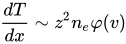
The formula for calculating the ionization loss of electrons looks somewhat different:
- ,
![{\ displaystyle - \ left ({\ frac {dT} {dx}} \ right) ^ {(e)} = {\ frac {2 \ pi e ^ {4} n_ {e}} {m_ {e} v ^ {2}}} \ left [\ ln {\ frac {m_ {e} v ^ {2} T_ {e}} {2I ^ {2} {(1- \ beta ^ {2})}}} - \ ln 2 ({2 {\ sqrt {1- \ beta ^ {2}}}} - 1+ \ beta ^ {2}) + 1- \ beta ^ {2} + {\ frac {1} {8} } (1 - {\ sqrt {1- \ beta ^ {2}}} ~) ^ {2} - \ delta \ right]}](https://wikimedia.org/api/rest_v1/media/math/render/svg/e014f93a155f27977459f91bd46fcf8e3f25992d)
Where - relativistic kinetic energy of an electron; - electron density in the medium; - correction for the density effect. The difference is explained by the fact that when considering the elementary process of interaction of two electrons, one must take into account the deflection of both particles, as well as the quantum-mechanical effect of the exchange due to their identity. For high-energy electrons, as well as for heavy charged particles, it is necessary to take into account the density effect, which leads to a decrease in ionization losses. However, at very high energies, electrons begin to effectively lose energy due to the increasing and increasing role of radiation drag. When the electron energy exceeds the critical one, these losses prevail over the ionization ones.
