Solikamsk is a city in the Perm Territory of Russia , the administrative center of the Solikamsk region (which is not included), the third largest city in the region , has the status of a city of regional significance , the center of the city district .
| City | |||||
| Solikamsk | |||||
|---|---|---|---|---|---|
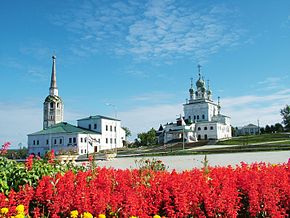 | |||||
| A country |  Russia Russia | ||||
| Subject of the federation | Perm region | ||||
| City district | Solikamsky | ||||
| Chapter | Fedotov Alexey Nikolaevich | ||||
| History and Geography | |||||
| Founded | in 1430 | ||||
| Former names | Salt Kamskaya; Usolye Kamskoe | ||||
| City with | 1573 years | ||||
| Area | 166.55 [1] km² | ||||
| Center height | 150 m | ||||
| Timezone | UTC + 5 | ||||
| Population | |||||
| Population | ↘ 93 118 [2] people ( 2019 ) | ||||
| Density | 559.1 people / km² | ||||
| Katoykonim | Solikamets, Solikamka, Solikamians | ||||
| Digital identifiers | |||||
| Telephone code | +7 34253 | ||||
| Postal codes | 618540-618556 | ||||
| OKATO Code | 57430 | ||||
| OKTMO Code | |||||
| Other | |||||
| Tagline | The salt capital of Russia | ||||
| adm.solkam.ru | |||||


Content
- 1 Geography
- 2 History
- 3 population
- 4 Local dialects
- 5 Local government
- 6 Natural resources
- 7 Economics
- 7.1 Financial infrastructure
- 7.2 Energy infrastructure
- 7.3 Labor market conditions
- 7.4 Investment attractiveness
- 8 Ecology
- 9 Administrative divisions
- 10 Transport
- 11 Telecommunications
- 12 Social infrastructure
- 12.1 Education
- 12.2 Health
- 12.3 Tourism
- 13 Media
- 13.1 Newspapers
- 13.2 FM broadcasting
- 13.3 Television
- 14 galleries
- 14.1 Gallery. Modern views
- 14.2 Gallery 2003
- 15 Russian Orthodox Church
- 16 Architecture and Attractions
- 16.1 Ludmila salt well
- 16.2 Temples of Solikamsk
- 16.2.1 Holy Trinity Cathedral (summer)
- 16.2.2 Church of St. John the Baptist
- 16.2.3 Cathedral bell tower
- 16.2.4 Epiphany Church
- 16.2.5 Holy Cross Cathedral (winter)
- 16.2.6 Church of the Savior
- 16.2.7 Archangel Church
- 16.2.8 Transfiguration Church
- 16.2.9 Vvedensky church
- 16.2.10 Resurrection Church
- 16.2.11 Ascension Church (Holy Trinity Church of the Monastery)
- 16.2.12 Church of Michael Malein (Ascension Church of the Monastery)
- 16.2.13 Church of the Holy Wives of the Myrrh Bearing
- 16.3 Museum of the History of Salt (former Ust-Borovsky Salt Plant)
- 16.4 Green line of Solikamsk
- 17 Famous people associated with Solikamsk
- 18 Interesting Facts
- 19 Notes
- 20 Literature
- 21 Links
Geography
The city is located in the marginal zone of the East European Plain on the territory of the Pre-Ural marginal trough at the left tributaries of the Kama - the Usolka and Borovaya rivers. The final railway station is Solikamsk along the line Chusovaya - Solikamsk. The distance to the regional center is 202 km (by road), 368 km (by rail, via Chusovskaya station). The port of the Kama reservoir.
It covers an area of 165.5 km².
History
Life and name gave Solikamsk salt . The city arose during the salt mines organized by the Vologda merchants Kalinikovs. There are indications that around 1430 they arranged pick-up pipes and winders on the bank of Usolka [3] . Initially, the city was called in the annals of 1506 Usolye on Kamsky , later Usolye Kamsky , and from the 17th century - Sol Kamsky .
The craft facilities — pipes, towers above them, chests for storing brine, varnitsa, barns — were the first buildings of the new settlement. In the years 1451-1505, the Great Perm Principality located in the headwaters of Kama was annexed to the Grand Principality of Moscow . The favorable geographical position and rich reserves of salt springs attracted merchants to Solikamsk, and in 1579, according to the first census of Perm the Great, Ivan Yakhontov, Solikamsk was considered a fortified city with a settlement. It had 190 yards, 16 saltworks, 26 shops, several churches [4] . The city has repeatedly suffered from raids by nomadic tribes and fires (for example, in 1581 it was burned during the raid by the Mansi prince Kikhek [5] ), but it was always restored.
In 1613, governors began to be appointed in Solikamsk. According to scribe books, in 1623 in Solikamsk there were already 357 yards, 67 shops, 37 warehouses and 16 forges. In the 17th century, Solikamsk, which was a major transit and transshipment point on the way to Siberia, became an important economic and administrative center. A major role in this was played by the discovery by Artemy Babinov of the direct road to the upper reaches of the Tura River and the founding of the city of Verkhoturye (1597) there.
By the end of the XVII - the beginning of the XVIII century, Solikamsk was the largest "salt factory" of Russia. Salt Kamskaya gave at that time more than half of all salt sold in the country. In the city and in Solikamsk Uyezd in the 17th century, salt industrialists from Moscow (G. L. Nikitnikov) and from Balakhna (Sokolovs) acted [6] .
Towards the end of the 17th century, with the establishment of trade relations with China , Solikamsk became a transit and trading center between Moscow and Beiping ( Beijing ); a large stone construction unfolded. During this period, Solikamsk was the most significant commercial and industrial city of Prikamye, its economic importance went far beyond the Urals. In the 1630s, copper deposits were discovered near the city, near the village of Grigorovo, and in 1635 the first copper smelter Pyskorsky appeared in Russia. In 1731, 2 km from Solikamsk, the Turchaninov built a second smelter, and near it, in 1742, a copper cookware factory (services were made for the imperial family and samovars).
In connection with the growth of open-cast salt production in the Volga region and the emergence of a new Siberian route by the end of the 17th century. the city began to lose its importance as a shopping center and the main center of Russian salt production and turned into a county town.
In 1711, 97 Swedes captured in the Northern War arrived in Sol Kama, including 93 officers and 4 doctors. There were also Swedes in the city who could not continue their journey to Siberia due to illness and when the Senate issued a decree on the return of prisoners to their homeland in 1721, 186 Swedes were in Solikamsk, some of whom converted to Orthodoxy and started families. The most famous Swedish prisoner who visited Solikamsk was the captain of the Swedish army I. von Stralenberg , the author of the concept of the origin of the toponym Perm from the Scandinavian Biarmia , who was the first to study the ancient monuments of the Urals [7] .
In the 1730s, Grigory Demidov , one of the first private botanical gardens in Russia, was created in the village of Krasnoye near Solikamsk. The number of taxa in the garden exceeded 500 items. In 1746, a collection of 80 Siberian plants by G. Steller was preserved in the garden and transferred to the Academy of Sciences. A fragmentary description of the garden and greenhouses is found in the books of I. Gmelin, J. C. d. Otrosh. In the late 60s. XVIII century A.F. Turchaninov also set up a botanical garden in his estate. Both were of great scientific, practical and educational interest.
By the beginning of the XIX century. In the city there were soap, glass and 7 tanneries, a makeshift bell factory. By the middle of the XIX century. trade is quiet. However, from the second half of the 19th century, a new economic expansion of Solikamsk began, old ones were improved and new salt plants were built (in 1860 164.4 thousand pounds of salt were boiled, in 1900 - 3.4 million pounds). By the end of the 19th and beginning of the 20th centuries, there were 2 tanneries in the city, 5 tannery establishments, carpentry and iconostasis enterprises, 2 brick and wine factories, over 20 forges, 24 trading establishments and a bank were opened; barges were built. At the beginning of the XX century. in Solikamsk there were male and female gymnasiums, 4 schools, a forest school, 3 public libraries, and cinema [8] .
On January 31 ( February 13 ), 1918 , Soviet power was proclaimed in Solikamsk, and the Zemstvo and city government were abolished.
February 25, 1918 the county center from the city of Solikamsk was moved to the village of New Usolye .
In November 1923, Solikamsk became the district center of the Upper Kama District and at the same time lost the status of a city, becoming a village.
By a decree of the All-Russian Central Executive Committee on April 5, 1926, the status of a city was returned to Solikamsk.
In September 1928, the administrative center of the Upper Kama District was transferred from the city of Usolye to Solikamsk.
In the 1920s, Solikamsk was one of the centers of industrial development of all-Union significance. The only deposit of potassium and magnesium salts in the USSR is becoming the center of development of the industry. In the 1920s, tens of thousands of political prisoners, special settlers, and exiled people were forcibly brought to Solikamsk with a population of 5,000 people .
During the years of industrialization, money from the Solikamsk Carnallite Plant , which became a bonistic rarity, was circulated in the city.
In 1941, 800 repressed Latvians from occupied Latvia were brought to Solikamsk, most of them died here. For modern Latvia, Solikamsk remains in memory as a place associated with the tragic pages of history.
In August 1941, the Solikamsk aerosled school was formed in Solikamsk, and from May 1943 - the Solikamsk tank school , which was relocated to the city of Kamyshin in 1944.
During the Great Patriotic War in Solikamsk were the relics of St. Sergius of Radonezh , taken out together with museum funds before the threat of fascist occupation [9] .
Over time, the borders of Solikamsk expanded significantly, in 1959 the city of Borovsk was included in its structure, located in the north near the Borovaya River, 6 km from the center. With the development of the potash industry in the city, in the Klestovka river valley, the modern Klestovka microdistrict has grown.
Population
| Population size | ||||||||||
|---|---|---|---|---|---|---|---|---|---|---|
| 1600 | 1609 | 1651 | 1671 | 1703 | 1740 | 1757 | 1771 | 1791 | 1801 | 1830 |
| 250 | ↗ 351 | ↗ 989 | ↗ 1000 | ↗ 2567 | ↗ 5100 | ↗ 10 179 | ↘ 8579 | ↗ 9661 | ↗ 14 141 | ↗ 21 612 |
| 1847 | 1856 [10] | 1859 | 1891 | 1896 [10] | 1897 [10] | 1926 [10] | 1929 | 1931 [10] | 1939 [10] | 1945 |
| ↗ 23 567 | ↘ 2800 | ↗ 25 090 | ↗ 40 912 | ↘ 4000 | ↗ 4100 | ↘ 3700 | ↗ 41 333 | ↘ 12,700 | ↗ 38,000 | ↗ 59 252 |
| 1959 [11] | 1967 [10] | 1970 [12] | 1973 [10] | 1975 [13] | 1976 [14] | 1979 [15] | 1982 [16] | 1985 [17] | 1986 [14] | 1987 [18] |
| ↗ 82 874 | ↗ 88,000 | ↗ 88 595 | ↗ 91,000 | ↗ 97,000 | → 97 000 | ↗ 101 158 | ↗ 103,000 | ↗ 106,000 | ↗ 107,000 | ↗ 108,000 |
| 1989 [19] | 1990 [20] | 1991 [17] | 1992 [17] | 1993 [14] | 1994 [14] | 1995 [17] | 1996 [17] | 1997 [21] | 1998 [17] | 1999 [22] |
| ↗ 110 098 | ↘ 110,000 | → 110 000 | → 110 000 | ↘ 109,000 | → 109 000 | ↘ 108,000 | ↘ 107,000 | → 107 000 | → 107 000 | ↘ 106,400 |
| 2000 [23] | 2001 [17] | 2002 [24] | 2003 [10] | 2004 [25] | 2005 [26] | 2006 [27] | 2007 [27] | 2008 [28] | 2009 [29] | 2010 [30] |
| ↘ 106,000 | ↘ 105,400 | ↘ 102 531 | ↘ 102 500 | ↘ 101,400 | ↘ 100 400 | ↘ 99,400 | ↘ 98,200 | ↘ 97 300 | ↘ 96 222 | ↗ 97 384 |
| 2011 [31] | 2012 [31] | 2013 [32] | 2014 [33] | 2015 [34] | 2016 [35] | 2017 [36] | 2018 [37] | 2019 [2] | ||
| ↘ 97 063 | ↘ 96 759 | ↘ 96 306 | ↘ 95 828 | ↘ 95 514 | ↘ 95 191 | ↘ 94 628 | ↘ 93 868 | ↘ 93 118 | ||
As of January 1, 2019 in terms of population, the city was in 185th place out of 1,115 [38] cities of the Russian Federation [39] .
In 1579 in Solikamsk it was: “190 yards, the people in them are 201 tax-paying men. floor, 26 shops and 16 varnits ” [40] .
In Soviet times, the population of the city exceeded 100,000, which was recorded in the 1989 All-Union Census. Then began a decline in the population. Sexually, the proportion of men is 46%, the proportion of women is 54%. According to the age structure, 17% are pensioners, 20% are children under 18 years old and 63% are the working-age population.
Local dialects
The dialects of the Solikamsk region were well studied in the Soviet period. In 1973, the "Dictionary of dialects of the Solikamsk district of the Perm region" was published, which included 6420 entries [41] .
Local government
The structure of local government of the Solikamsk city district is:
- Solikamsk City Duma;
- Head of the city of Solikamsk;
- Administration of the city of Solikamsk.
The head of the city is Alexei Nikolayevich Fedotov (since 2016)
Natural resources
The city is located within the unique Verkhnekamsk deposit of potash and potassium-magnesium salts . In the bowels there are large reserves of sodium chloride.
The raw materials of the deposit are complex, the ore contains rare and dispersed elements: bromine, rubidium, cesium, magnesium, and others. Near the Solikamsk railway station there is a deposit of building sands and sand and gravel. The natural resources of Solikamsk are rich in a diverse complex of mineral waters of industrial and medicinal value. (also see Preobrazhensky, Pavel Ivanovich ).
Economics
Solikamsk is one of the two economic centers of the Bereznikovsk-Solikamsk industrial region, the territory of which is economically a single whole, which contributes to the development of close industrial and technical ties between the enterprises of Bereznikov and Solikamsk.
The economic profile of the city determines:
- mining industry (extraction of potash salts and production of mineral fertilizers) - Silvinit OJSC
- since 2011 - PJSC Uralkali,
- Timber industry enterprises:
- OJSC “Solikamskbumprom” ,
- logging plant,
- as well as the metallurgical industry:
- OJSC Solikamsk Magnesium Plant (magnesium production based on the processing of potassium and magnesium salts).
- The city has engineering enterprises:
- mechanical repair plant,
- construction organizations
- food industry enterprises
- OJSC “Solikamsk Plant Ural” [42] is the largest military-industrial plant in Eastern Europe.
The basis of the city’s economic life is the potash industry. The design capacity of the 3 potash ore divisions that are part of OJSC Uralkali is 3203.2 thousand tons of potash fertilizers per year.
Currently, the city has great export potential due to the high level of development of basic chemistry, metallurgy (production of magnesium and rare-earth elements). Today, the products of Solikamsk enterprises are supplied to more than 60 countries. Solikamsk has tourist and recreational opportunities.
Financial Infrastructure
There are 9 banks in Solikamsk:
- West Ural Bank of Sberbank of Russia
- Post Bank
- Bank Ural Financial House
- additional office "VTB. Bank of Moscow [43] "
- additional office of Perm branch of Transcapitalbank
- Sovcombank
- UniCredit Bank
- additional office of the Perm branch "VTB-24"
- operational office of the Volga branch of PJSC "Vostochny Express Bank"
and 8 insurance companies
- OJSC " Military Insurance Company "
- Rosgosstrakh , insurance department in the city of Solikamsk
- Uralsib Insurance Group
- Insurance Group Spassky Gates CJSC
- SOGAZ OJSC
- Medical Insurance Company Medprana-Lux LLC
- Ingosstrakh Insurance Company, an additional office in Solikamsk
and 1 microfinance organization:
- LLC Financial Assistance
Energy Infrastructure
Gas supply to enterprises and the population of the Solikamsk city district is carried out through a gas pipeline - the Chusovoy-Berezniki-Solikamsk branch in one line with an annual gas supply of about 711 million m³. Electric networks of the Solikamsk urban district include 650 km of cable and overhead lines, 168 transformer and distribution substations. Electricity is supplied to consumers in the city of Solikamsk from the Perm Energy System and Solikamsk TPPs (STETs-12 and STETs-11) through substations. Heat generation is provided by the industrial boiler houses of Silvinit OJSC (3 sources), Solikamsk Magnesium Plant OJSC, Solikamskaya TPP LLC and the boiler house MUP Teploenergo.
Labor Market Status
The average monthly salary in the territory of the city district at the end of 2010 amounted to 18020.2 rubles with an average subsistence level in the Perm Territory for 2010 of 5535 rubles. Its value varies greatly depending on the industry: from 8806 rubles in agriculture to 27953 in financial activities. The value of the average wage in the urban district exceeds the average wage in most of the municipalities of the Perm Territory. In general, in the Perm Territory, the average monthly accrued wages for October 2010 amounted to 17056.5 rubles.
The number of economically active population as of January 1, 2010 amounted to 51988 people, or 54.6% of the total number.
The registered unemployment rate in 2010 in the urban district amounted to 1.8% of the economically active population, which is slightly lower than the average in the Perm Region at 2.1% at the end of 2010.
An important characteristic of the Solikamsk labor market is that it was possible to maintain a qualified personnel potential, primarily in the field of metallurgy and electric power industry.
Investment Attractiveness
The key factors of the investment attractiveness of the Solikamsk urban district and its main competitive advantages are:
- stable high rates of economic development, its multidirectionality;
- increased demand for mineral fertilizers and their prices positively affect the development of the main producer of the city - Uralkali;
- high level of industrial development and improvement of external market conditions;
- well-developed transport infrastructure allows you to reach the strategically important cities of Russia and abroad with the lowest costs;
- the strategic central position of Solikamsk on Belkomur , which provides favorable conditions for investing in a transport cluster;
- high level of professional education and the availability of skilled labor;
- low level of political risk;
- high purchasing power of city residents;
- high tourist potential and poor development of competing cities in the north of the Perm Territory.
Ecology
The environmental situation in the city is unfavorable. Especially unsatisfactory situation with the treatment of industrial wastewater, characterized by high toxicity. Of the 11 treatment facilities, only 5 provide normal treatment. High pollution is characterized by the state of the atmosphere. The main difficulty in developing the potash deposit is waste disposal (potash salt). There are several pollution factors in the city.
Administrative Division
In terms of spatial planning, the city is divided into the following parts:
- The southern part (the center located mainly along the Usolka River, with a significant number of administrative buildings, architectural and historical monuments (churches, buildings of the 19th and early 20th centuries); microdistricts - Upper and Lower Bolnichny, Krasnoe, 3rd microdistrict of potash workers, Klestovka; as well as a number of large villages (Kaliyets, Shakhtyorskiy, Rubtsovo), which are adjacent to the divisions of OJSC Uralkali, a magnesium plant and others.)
- The northern part is the Borovsk microdistrict (in 1949-1959, the city gravitating towards the Solikamsk PPM and the Kama River )
Between the southern and northern parts of the city is approximately 6 km. Between them are industrial zones, warehouses, bases, gas stations, as well as garden plots.
Transport
Solikamsk is a major transport hub. The city has a Solikamsk railway station in the Perm branch of the Sverdlovsk railway . From Solikamsk by train, you can get to Yekaterinburg (Solikamsk-Yekaterinburg train). The city has a bus station that serves both suburban and intercity routes. By bus from Solikamsk you can get to Perm , Yekaterinburg, Bereznikov , Cherdyn , Krasnovishersk , Nyrob , Kizel , Lysva , Aleksandrovsk , Nytva . City transport is represented by 22 bus routes. The minibus in the city did not take root. The main carrier company is City Express. Most routes were laid from the southern part of the city to the North.
Municipal property has 326.6 km of roads, the length of paved roads is 261.5 km. Solikamsk is the largest of the road junctions in the north of the region. The Solikamsk urban district is connected by roads of territorial significance with the cities of Krasnovishersk and Cherdyn in a northerly direction, Berezniki, Aleksandrovsk, Kizel, Perm in a southerly direction.
Closed airport is located 12 km from the city. Back in 2004, it was possible to fly from Solikamsk to Moscow, and in the summer there were flights to Anapa and Sochi .
The city has access to the Unified Deepwater System of the European part of Russia along the Kama River.
After soil subsidence as a result of a man-made disaster , passenger traffic along the Yaiva - Berezniki railway line was suspended. The management of Russian Railways has decided to build a new bypass branch of the railway. Construction was completed in 2009, and in the spring of 2010 traffic was opened bypassing the hazardous area.
Telecommunications
Telephone landline
The provision of population with apartment phones increased rapidly every year until 2002, then the growth rate began to decline, and the number of phones stabilized. In 2008, this indicator amounted to 226 phones per 1000 people, which significantly exceeds the regional average, lagging only from the regional center and Bereznikov. On the telephone networks of the city, 101 payphones for city telephone communications are in operation, of which 76 are universal long-distance ones. The only telephony service provider in the city is Rostelecom. Wired broadcasting in the city ceased in 2010.
mobile connection
Wireless radio communications (cellular services) are developing rapidly. The number of GSM subscribers in the city by 2010 reached 200 thousand people (2 times the population of the city). Four cellular operators are represented in Solikamsk - Tele 2, MTS , MegaFon and Beeline . All of them provide stable reception of a cellular network signal within the city. MTS, Megafon and Beeline operators offer their subscribers mobile services and broadband data services in the modern 3G standard, along with the GSM standard. The most developed mobile communication centers are Euroset and Svyaznoy.
Internet access
In Solikamsk, Internet access services are provided by the following providers: MegaFon OJSC, Rostelecom OJSC, MTS OJSC under the MTS brand. Since 2011, Internet access services for corporate clients, and since 2012, for individuals, have been provided by Ural-TransTeleCom CJSC. Access to the Internet is carried out using dial-up ( Dial-UP , ADSL ) and dedicated connections. The number of broadband subscribers is more than 30 thousand. The Big Three operators (Beeline, MTS and Megafon) also provide 3rd generation mobile services (3G), which has significantly increased the penetration of broadband Internet access in recent years.
Social Infrastructure
Education
The total number of state and municipal daytime and general education institutions is 20.
The city’s education network covers all levels: from pre-school education to higher education. The Solikamsk State Pedagogical Institute exists in the status of a branch of the Perm State National Research University ( Perm State Scientific Research University ), there are 6 specialized secondary educational institutions, the oldest of which are the Pedagogical College (formerly Solikamsk Gymnasium ) and a branch of the Berezniki Medical School. There are two gymnasiums. Much attention is paid to preschool education. The number of places in preschool educational institutions is growing every year, and by 2009 it has reached 5336.
Health
Medical services are provided to the city’s population by treatment and prophylactic institutions, whose capacity is 1.4 thousand hospital beds and 2.2 thousand visits per shift in outpatient-type institutions. In total, 342 doctors of all specialties work in these institutions. In total, 2585 people work in the healthcare and social services industry. During the year, the municipal programs “Reproductive Health of the Population of the City of Solikamsk for 2008–2011” and “Development of the Service of Anesthesiology and Resuscitation of the City of Solikamsk for 2007–2009” were implemented. In addition, the national project "Health" raised funds in the amount of 56.8 million rubles. (in 2008 - 63.9 million rubles).
Tourism
In 1970, the city was included in the list of historical cities, in which there are 67 cultural monuments, 26 architectural monuments (23 of them are of federal significance), among which the leading place is occupied by the Trinity Cathedral. In the city: a city museum of local lore with rich collections of coins, icons and other exhibits, departmental museums of OJSC Uralkali, OJSC Solikamskbumprom, OJSC SMZ. Since 2005, the Museum of the History of Salt "hosts the festival of blacksmithing" Lights of Hephaestus ". Since 2010, the city has positioned itself as "Solikamsk - the salt capital of Russia." In 1994, the Memorial Botanical Garden of Grigory Demidov was founded in Solikamsk. Up to 8 thousand guests visit the garden annually. In 2008, according to official figures, more than 10 thousand people visited the city of Solikamsk.
In 2011, the Green Line excursion route appeared in Solikamsk.
Media
Cable TV
- Solikamsk TV - in the structure of the Solikamsk-MEDIA holding. solnews.ru
- "Salt TV".
Newspapers
- Solikamsk Worker is a political newspaper in the structure of the Solikamsk-MEDIA holding.
- Our Solikamsk is a private weekly newspaper.
- GorodOK on Kama is a private weekly newspaper.
- Wallet is a corporate newspaper of Solikamskbumprom OJSC.
- Magnievik is a corporate newspaper of OJSC Solikamsk Magnesium Plant.
FM Broadcasting
- 93.1 MHz - DFM
- 94.3 MHz - Comedy Radio
- 95.1 MHz - Radio 7 on seven hills
- 95.9 MHz - Retro FM
- 96.3 MHz - Pioneer FM
- 97.0 MHz - Love Radio
- 97.4 MHz - Autoradio Plan
- 97.8 MHz - Radio Dacha
- 98.3 MHz - Radio Record
- 99.1 MHz - Radio Sol FM
- 99.5 MHz - Traffic Radio
- 100.5 MHz - Solikamsk FM
- 106.0 MHz - Kama wave
Television
- First channel
- Russia 1 / GTRK Perm
- REN TV
- NTV
- Channel Five / Ural-Inform TV
- TNT
- STS
- Star
- STS Love
- YU
- Disney
- Russia To
- The first multiplex RTRS-1
- The second multiplex RTRS-2
- Carousel
Galleries
Gallery. Modern Views
The historic center of Solikamsk
View from the northern hill to the city of Solikamsk.
House of the Governor in Solikamsk.
House of the Governor.
Chapel of the Apostles Peter and Paul.
Holy Cross Cathedral (1698-1702) with a new superstructure
Church of the Myrrh Bearing Women.
The restored Church of Mikhail Malein (Ascension) ( 1734 ). City of Solikamsk.
from. The hillfort. Znamenskaya church ( 1750 - 1780 ). Solikamsk district.
from. The hillfort. The multi-tier bell tower of the Sign Church (1750-1780).
from. The hillfort. Фрагмент деревянного иконостаса Знаменской церкви
Галерея 2003 года
Дом Воеводы.
Общий вид Троицкого собора ( 1685 — 1697 ).
Фасад Троицкого собора ( 1685 — 1697 ).
Церковь-корабль Иоанна Предтечи ( 1721 ).
Крестовоздвиженский Собор ( 1698 — 1702 ) до реконструкции.
Спасская церковь ( 1689 ) до реставрации, 2003 год.
Архангельская церковь ( 1725 ), 2003 год.
Преображенская церковь ( 1683 — 1690 ).
Глава Введенской церкви ( 1687 — 1695 ).
Воскресенско-Рождественская церковь ( 1714 — 1752 ). Общий вид. На заднем фоне – Соборная колокольня.
Вознесенская (Свято-Троицкая) церковь ( 1704 ).
Фасад Вознесенской (Свято-Троицкой) церкви ( 1704 ).
Церковь Михаила Малеина ( 1734 ).
Соликамский традиционный дом.
Russian Orthodox Church
- Богоявленская церковь [45]
- Церковь во имя Введения во храм Пресвятой Богородицы [46]
- Церковь святых Жён-Мироносиц [47]
- Церковь во имя Нерукотворного Образа Спасителя. Построена в 1689—1691 гг. [48]
- Церковь во имя Преображения Господня (Спасо-Преображенская) [49]
- Кладбищенская церковь во имя святого праведного Симеона Верхотурского [50]
- Свято-Троицкий мужской монастырь [51]
- Женский Иоанно-Предтеченский (Красносельский) монастырь [52]
Архитектура и достопримечательности
Город насыщен памятниками истории и архитектуры, располагая уникальным ансамблем церквей XVII - XVIII веков . Среди памятников гражданской архитектуры: воеводский дом (1688, с килевидными многоступенчатыми кокошниками в наличниках); двухэтажный деревянный жилой дом (начало XVIII в.) вблизи кремлёвского холма, на набережной; бывшая усадьба Турчанинова (1760-80-е гг.) с 3 уцелевшими домами. В заречной части Соликамска сохранился бывший дом купца И. С. Лапина (конец XVIII в.). В 1920-30-х гг. город расширился в связи с интенсивным промышленным и гражданским строительством. На центральной улице расположены 2 здания в стиле конструктивизма: кинотеатр и Госбанк (оба — начало 1930-х гг.). По р. Боровой — район, примыкающий на западе к целлюлозно-бумажному комбинату, с невысокой застройкой 1950-х гг. С композиционной живописностью решены кварталы на склоне р. Усолка восточной части центрального района Соликамска и на правобережье. Среди мемориальных памятников Соликамска — комплекс, посвящённый воинам Великой Отечественной войны 1941-45, умершим в госпиталях города, и юбилейный мемориал (1985), посвящённый танковым училищам города.
В 20 км к северу от Соликамска, в селе Верх-Боровая, — древнейшая на Урале кирпичная Крестовоздвиженская церковь (1678, южный придел — 1683-91) с восьмигранной колокольней и деревянной папертью (XIX в.), с порталом, наличниками и храмовой надписью, выполненной из наборного лекального кирпича , а также традиционные для северного Прикамья жилые усадьбы с расписными домами и остатки солеварного промысла (конец XIV в.). В 5 км к северо-востоку от Соликамска, в селе Городище, — каменная Знаменская церковь (1750-80), построенная на месте 2 деревянных храмов, с многоярусной колокольней и деревянной скульптурой иконостаса в интерьере. В 15 км от Соликамска, за р. Кама, в селе Касиб, на возвышенном месте, — монументальная церковь Богородицы (1885) с 4-гранной колокольней; сохранилась жилая застройка с многообразными приёмами в декоре крылец. Между Касибом и Соликамском, в селе Пегушино, — 5-пролётный деревянный мост через р. Лысьва с высоко поднятыми конструкциями. К северу от Касиба, в селе Вильва, на горе, — динамичная по композиции Богоявленская церковь (1779) с высокой колокольней, крыльцом и лопатками на фасадах; в жилой архитектуре села — влияние городецкой резьбы (дом Засухиной). [8]
Людмилинская соляная скважина
Недалеко от центра города на берегу Усолки находится Людмилинская соляная скважина , которой более ста лет. Ранее на этом месте находился Троицкий солеваренный завод, принадлежащий купцам Рязанцевым. Людмилинская скважина была пробурена в 1906—1907 годах в геологоразведочных целях и имела глубину около 100 метров. Добытая оттуда соль содержала большое количество калия и была непригодна для употребления в пищу [53] . Однако теперь эта скважина является местной достопримечательностью.
Храмы Соликамска
Свято-Троицкий собор (летний)
Построен в 1684—1697 гг. на средства жителей города и государево жалованье, в память о котором на южной стене храма был помещён изразец с двуглавым орлом, а на западной стене выложена кирпичная императорская корона. Престолы собора были освящены в честь Святой Троицы, Предтечи и Крестителя Господня Иоанна и святителя Николая. Храм не отапливался, и службы в нём велись только в летнее время. В 1916 году стал центральным храмом новоучреждённого Соликамского викариатства Пермской епархии. Здесь находился до революции знаменитый складень с образом святителя Николая. В 1929 г. собор был закрыт и передан музею. Во время Великой Отечественной войны в храме хранились фонды эвакуированных в Соликамск музеев центра страны. В настоящее время здесь размещаются экспозиции Соликамского краеведческого музея. Прекрасный пятиглавый храм московской архитектурной школы. Из трёх крылец до нашего времени сохранились только два. Декор, характерный для деревянных построек, выполнен в камне. Памятник истории и архитектуры федерального значения.
Церковь Иоанна Предтечи
Церковь пригородного села Красного (ныне входящего в состав города) строилась с 1715 по 1772 г. Первоначально на средства купцов Суровцевых в 1715—1728 гг. возведён был нижний храм во имя св. мученика Иоанна Воина. Летний верхний храм во имя рождества Предтечи и Крестителя Господня Иоанна достроен на средства А. Ф. Турчанинова и освящён в 1772 г. Престолы храма освящены во имя Предтечи и Крестителя Господня Иоанна и во имя св. мученика Иоанна Воина. В 1891 г. при церкви при поддержке Рязанцевых была учреждена женская община, позднее получившая статус монастыря. В числе насельниц его была будущая игумения Чердынского Иоанно-Богословского женского монастыря Руфина. После закрытия обители в начале 1920-х годов храм стал приходским. Закрыт он был в 1930-х годах. В 1989 г. храм был передан верующим, и в нём возобновились богослужения. Одноглавый храм с высокой столповой колокольней имеет уникальное соотношение ширины и высоты, не имеет аналогов на территории епархии. Внешний вид церкви напоминает корабль. Сохранилась внешняя отделка храма, лепные украшения нижнего придела утрачены полностью, верхнего — повреждены и нуждаются в реставрации. Частично сохранились росписи, украшавшие верхний двусветный храм. Особенно славится церковь св. Иоанна Предтечи гармоничным колокольным звоном. Памятник истории и архитектуры федерального значения.
Соборная колокольня
Строительство соборной колокольни было начато в 1713 году. Высота её от основания до креста 62 метра. Колокольный звон вёлся в 12 колоколов весом от 355 пудов до 20 фунтов. Колокольня имеет небольшой наклон. Построена звонница на двухэтажном каменном здании — «на палатах» — в котором в разное время размещались духовные и гражданские учреждения. Подклет здания, состоявший из 8 палаток, использовался первоначально для хранения купеческих товаров. В конце 1930 годов здание соборной колокольни передано в ведение НКВД, позднее — другим учреждениям. В настоящее время здесь размещается отдел природы Соликамского краеведческого музея. Памятник истории и архитектуры федерального значения. Соборная колокольня Соликамска — один из символов города.
Богоявленская церковь
The temple was built in 1688-1695. at the expense of parishioners. His thrones were consecrated in memory of the Epiphany of the Lord, in honor of the Vladimir Icon of the Mother of God and in the name of the wonderworkers of the Caves Anthony and Theodosius. The parish was liquidated in 1934, the church building was transferred to the museum. In 1943-1962 Divine services were held in the temple, then it was again closed. Since 1989, the exposition of the Department of Old Russian Art of the Solikamsk Museum of Local Lore has been housed here. Currently, the exposition of this department in the Epiphany Church contains the icon of St. Nicholas, according to legend, sent by Tsar Ivan the Terrible to the inhabitants of Solikamsk in response to their request for help against raids by non-tribes. The iconostasis has been restored in the temple, the interior decoration has survived. The five-domed main church with the Vladimir side chapel, also having a cupola. The bell tower, located above the porch, in the XVIII century was built on three tiers, but the foundation could not withstand such a load. Currently, the bell tower has returned to its original form. The temple has rich stone décor and tiled decoration. After the restoration work carried out in 2005, the Epiphany Church is a wonderful decoration of Solikamsk. A monument of history and architecture of federal significance.
Holy Cross Exaltation Cathedral (winter)
Built in 1698-1709. at the expense of city residents. The thrones of the temple were consecrated in the name of the Exaltation of the Holy Cross, St. Stephen, Bishop of Great Perm, and the Icon of the Mother of God “The Sign”. Side chapels were arranged in the corners of the refectory of the church: on the north side - Stefanovsky, on the south - Znamensky. In this warm temple, cathedral services were held in winter. In 1929, the cathedral was closed and transferred to the food factory. For a long time it housed a brewery. In 2005, work began on the restoration of the temple. One-story two-pillar temple on the basement, with one glaucus. Some details of the external decor of the temple are unique and have no analogues in medieval Russian architecture. A monument of history and architecture of federal significance.
Church of the Savior
The summer church in the name of the Not Made Image of the Savior was built in 1689-1691. at the expense of parishioners on the site of a wooden church burned down in a fire in 1672. Initially, it had two chapels, the thrones of which were consecrated in honor of St. Apostle and Evangelist John the Theologian and St. Simeon the Pillar. The temple was not heated, services in it were conducted only in the summer. In the early 1930s, the church was closed. At present, the Spassky Church is a parish church; divine services are resumed there. The five-domed one-story two-light temple has a rare layout - "the altar in the altar." Until 1850, the temple's head was covered with a wooden ploughshare, later replaced with gilded iron. The church had not only internal, but also external paintings, partially preserved to our time. A monument of history and architecture of federal significance.
Archangel Church
Winter church of the parish of the Savior Church, built in 1712-1725. at the expense of parishioners. His throne was consecrated in the name of Archangel Michael and the heavenly forces of the ethereal. Divine services in this warm temple were performed in the winter. In the 1930s, the church was closed. Currently, the city archive is located here. A one-domed church with a refectory has almost no external decorative details. The interior decoration is completely lost. Monument of architecture of federal significance. The architectural ensemble of churches of the Spassky Parish also included a stand-alone pillar bell tower, which has not been preserved to this day.
Transfiguration Church
The Summer Transfiguration Church was built in 1683–1692 at the expense of the Moscow merchant widow Evdokia Shchepotkina for the Transfiguration Monastery for women. It was built by Login Korsakov “with comrades”. The only throne of the temple was consecrated in honor of the Transfiguration of the Lord. After the monastery was transferred to Ufa in 1765, the temple became a parish. In 1929 the parish was liquidated. Divine services in the Transfiguration Church resumed in 1991. The five-domed temple with a tented bell tower located above the porch. A monument of history and architecture of federal significance.
Vvedensky Church
The winter temple was built in 1683-1713 for the Preobrazhensky convent. His throne was consecrated in memory of the Entry into the church of the Most Holy Theotokos. In this church, before the monastery was transferred to Ufa, services were held in winter. After 1765 the temple became a parish. From 1933 to 1991 the temple was closed. Currently, it is the ascribed church of the Transfiguration Parish. The one-domed church has preserved a wooden head covered with a ploughshare. A monument of history and architecture of federal significance.
Resurrection Church
It began with the construction of the funds of parishioners in 1714. The Winter Christmas chapel was consecrated in 1721, the summer Resurrection Church was erected in 1752. There are two thrones: in the summer temple - in honor of the Resurrection of Christ, in the winter - in honor of the Nativity of Christ. The temple was closed in 1929, the domes, the bell tower and the altar part were dismantled. Currently, the church building houses an exhibition hall and one of the departments of the Solikamsk Museum of Local Lore. Before the revolution, it was one of the most beautiful temples of the city, five-domed, with a head over the chapel and the pillar bell tower. A monument of history and architecture of local importance.
Ascension Church (Holy Trinity Church of the Monastery)
Built in 1698-1704. at the expense of salt producers of the Surovtsevs as a summer church of a man’s monastery. Has a winter chapel. The throne of the summer temple was originally consecrated in honor of the Ascension of the Lord, the detached - in honor of the Annunciation of the Blessed Virgin Mary. After the Istobensky Holy Trinity Monastery was transferred to Solikamsk, the throne of the main monastery church was consecrated in honor of the Holy Trinity. After the monastery was closed, the temple became a parish, closed in 1926. Since 1999, the revival of the monastery began, in the church services are performed. This is a one-domed two-light church with a decor typical of Solikamsk churches similar in architecture. A monument of history and architecture of federal significance.
Church of Michael Malein (Ascension Church of the Monastery)
Built at the expense of salt industrialist Mikhail Turchaninov in 1731-1734. It has two aisles: the lower one is warm, winter. The temple was consecrated in the name of Rev. Michael Malein. After the Istobensky Holy Trinity Monastery was transferred to Solikamsk, the repaired church of Mikhail Malein was re-consecrated in memory of the former name of the monastery Voznesensky, and the altars of the chapels - in honor of the icon of the Mother of God "All Who Sorrow of Joy", the upper - in honor of the Ascension of the Lord. In the Soviet period, the temple was closed. Divine services in it in the winter chapel resumed in 2005. At present, with the blessing of the Bishop of Perm and Solikamsk, Irinarch, the lower chapel of the church is consecrated in honor of the holy martyr Theophanes, Bishop of Solikamsk. A feature of the church is the installation of a bell tower over the main temple. The upper tiers of the bell tower were dismantled in Soviet times. A monument of history and architecture of federal significance.
Church of the Holy Wives of Myrrh Bearers
The cemetery single-throne church, consecrated in the name of the holy Wives of the Myrrh Bearing, was built in 1776-1780. at the expense of the salt industrialist M. G. Surovtsev. It was built by the tradesman Ivan Gorbovsky. In 1911, the church received parish status. In 1929 the parish was liquidated, the church was closed. In 2000, work began to restore it, the service resumed. The one-domed church originally had a three-tier bell tower, lost in Soviet times. Partially preserved to this day, the internal paintings of the temple. In the church, her clerk M.G.Surovtsev and members of his family were buried. A monument of history and architecture of local importance. [54] .
Museum of the History of Salt (formerly Ust-Borovsk Salt Plant)
Museum of the History of Salt - a branch of the Solikamsk Museum of Local Lore has the status of a museum of industrial architecture of the 19th century of federal significance, which includes 17 objects. It was opened in October 1986, when a scientific-practical conference “Salt and land development” was held here in the building of the former baking plant office.
The museum was created on the basis of the salt factory located in the modern Solikamsk Ust-Borovsky salt factory, built in 1878-1882. at the expense of the Solikamsk merchant of the 1st guild Alexander Vasilievich Ryazantsev. The brine here was mined from wells above which stood tall log cabins brine-lifting towers. In total, 14 wells were drilled at the plant to a depth of 170 to 215 meters, then the brine was accumulated in wooden chests , and from there it was delivered to the winders . Before shipment to the consumer, the salt was stored in large wooden barns . All production buildings are built in the old traditions and are unique examples of industrial wooden architecture.
The Salt Museum is a unique architectural complex, the exposition of which recreates the salt production process chain that has existed since the 15th century.
Salt production was the basis of the existence of Solikamsk, from the moment of its birth in the 15th century to 1972. At the end of the 17th century, Solikamsk was the center of Russian salt production: the annual production in the city and county at 231 baskets was 7 million pounds of salt, which accounted for 70% of the total Russian production. Currently, salt cooking in the city is stopped. The last salt factory of the Ust-Borovsk plant closed production in 1972. Now it is a unique, the only open-air salt factory in Russia, which is the only monument of industrial wooden architecture in the country.
Industrial wooden constructions of the plant by their architectural merits belong to the unique monuments of Russian wooden architecture. These are brine-raising towers, salt chests, salt containers and barns.
The complex of structures of the Ust-Borovsky Salt Plant also includes the house of salt industrialist A.V. Ryazantsev. He served as a country cottage and at the same time as a barn factory office. The lower stone floor was office, the wooden upper and the mezzanine were residential [55] .
Green Line Solikamsk
In Solikamsk in 2011, the Green Line pedestrian route appeared, by analogy with the Perm Green Line . The walking route includes the main attractions of the city (18 items) [56] . Unlike Perm, where the route is laid on the pavement and equipped with information pedestals, in Solikamsk the Green line is mostly virtual - the marking was preserved only at the beginning of the route, and there are no information pedestals.
Famous people associated with Solikamsk
- Bankovsky, Lev Vladimirovich (1938-2011) - Russian scientist ( Institute of Economics, Ural Branch of the Russian Academy of Sciences ), from 2000 until the end of his life - he worked at the Solikamsk State Pedagogical Institute , co-initiator of the creation of the children's educational center "ROST ".
- Davydychev, Lev Ivanovich - Russian children's writer, born in Solikamsk.
- Demidov, Grigory Akinfievich (1715-1761) - a nobleman, salt industrialist and metallurgist, botanist, founder of the first private botanical garden in Russia. Correspondent Karl Linnaeus, noted in the second edition of the "Species plantarum" in 1762. After the fire, Kuntskamera in St. Petersburg on December 6, 1747 - provided a three-story house for free for a collection and a library until 1766. Savior of the collection of 80 plants by George Steller, transferred on March 11, 1748 to the Academy of Sciences.
- Dmitriev Oleg Alekseevich - Soviet / Russian artist, honorary citizen of the city of Solikamsk, took an active part in the foundation of the Solikamsk Museum of Local Lore, donated more than 300 of his paintings to the museum.
- Ermolova Irina Vladimirovna (1969) - Honored Artist of the Russian Federation, actress of the Sverdlovsk State Academic Drama Theater , starred in Andrei Konchalovsky ’s film “White Nights of Postman Alexei Tryapitsin” . Born in Solikamsk and studied in high school 4, in 1985-86. studied at the People's Theater at the Pulp and Paper Mill, under the direction of E.G. Pylskaya.
- The city of Solikamsk is the birthplace of Fyodor Zubov , an icon painter, the “royal isograph”. He signs his work, calling himself "usoltsy" [57] .
- 12 Heroes of the Soviet Union gave Solikamsk to the fronts of the Great Patriotic War. Here are their names: Nikolai Latkin , Pyotr Kondratenko, Nikolai Antonov, Vasily Kuznetsov, Pyotr Lavrov, Konstantin Rodenko, Nikolai Sherstobitov, Konstantin Shuvalov, Vasily Suslov, Grigory Shumkov, Dmitry Chebotaryov, Valentin Yelkin. Among them, the city is more famous Nikolai Latkin .In the battles of the Great Patriotic War, he participated in July 1942. Sergeant-gunner. He fought as part of the troops of the North Caucasian, 1st Baltic Fronts. He fought at Smolensk, Yelnya, Kursk and Glukhov. Already in East Prussia on February 7, 1945, the gun crew of Nikolai Latkin held strategic heights until the approach of the Soviet troops. Sergeant Latkin remained the last Soviet soldier at this height, holding German tanks alone with gunfire. The title of Hero of the Soviet Union was awarded posthumously for this feat on June 29, 1945 [58] . His name is in the city street, square. In Borovsk, a monument was erected to him.Monument to Ladkin
- Karapetyan, Olga Vladimirovna (1958-2010) - Russian architect, chief architect (chairman of the Committee on Architecture and Urban Planning) of Solikamsk.
- Kornienko, Nina Grigoryevna (1943) - Soviet and Russian theater and film actress, Honored Artist of Russia.
- Potapov, Mikhail Mikhailovich (1904-2007) - an honorary citizen of Solikamsk, an artist.
- Shumilova, Ekaterina Evgenievna (1986) - Russian biathlete, Honored Master of Sports of Russia.
- Trusova, Irina Andreevna (1988) - Russian biathlete, master of sports of Russia [59] .
- Chetina Elizaveta Vladimirovna (1997) - Russian chess player. Candidate for the master of sports of Russia. Vice-champion of the world and Europe, bronze medalist of the Russian championship, champion of the Volga Federal District among boys and girls [60] [61] .
- Yudin, Yuri Efimovich (1937-2013) - an honorary resident of the city of Solikamsk, one of ten members of the notorious Dyatlov group , who left the group before the tragedy and survived.
- Shilova Elena (1988) - Russian theater and film actress. In school, she played in the theater studio Peremena (supervisor E.G. Pylskaya). In 2011 she graduated from VGIK (workshop of V. Fokin). Played over 24 roles. [62]
- Lumpova Nadezhda Vitalievna (1989) - Russian theater and film actress. It is brought in the memory bank "Gifted children of Russia". Until 2006, she played in the Peremena Theater Studio (Solikamsk; director - E.G. Pylskaya). In 2010 she graduated from the directing department of RATI-GITIS (the acting group of Oleg Kudryashov’s Studio). Prize for Best Actress at the X All-Russian Festival of Children's and Youth Theater Teams “Mask” -2005. Winner of the Golden Leaf 2010 Award in the nomination for Best Actress. Played over 15 roles. [63]
- Слинкин (Арбенин) Дмитрий Алексеевич (1989) - российский актёр театра и кино. В 2010 году окончил Ярославский государственный театральный институт (курс Александра Кузина). Как приглашённый артист, играет в Санкт-Петербургском ТЮЗе им. Брянцева. Награжден медалью маршала Жукова. Лауреат Международного фестиваля-конкурса "Москва - город мира" (спектакль "Дамское танго" В. Аслановой, Театр "Четвёртая стена). Сыграл более 20 ролей. [64]
- Серваль Светлана Александровна (1964) - российская актриса театра и кино. Окончила ЛГИТМиК, драматического искусства (1987 г.), педагог - Горбачев И.О. Актриса Александринского театра. [65]
- Ухов, Иван Анатольевич (1995) - российский профессиональный баскетболист, играющий на позиции атакующего защитника . Выступает за баскетбольный клуб ЦСКА и за сборную России по баскетболу .Участник Матча всех звёзд Единой лиги ВТБ 2018 . В сезоне 2016/2017 Ухов получил награду «Лучшего молодого игрока» Единой лиги ВТБ . Согласно приказу Министерства спорта РФ № 155-нг от 17 октября 2016 года, за победу в Кубке России , Ухову присвоено спортивное звание « Мастер спорта России ».
- Санников, Степан Романович (1990) - российский хоккеист , нападающий . Выступает за хоккейный клуб Локомотив . Бронзовый призёр чемпионата мира 2016 года.
Interesting Facts
- 1 марта 2011 года Банк России выпустил памятную монету «Соликамск» номиналом 10 рублей из серии «Древние города России». Сплав: латунь/мельхиор. Диаметр, 27 мм. Тираж: 5 млн шт. Чеканка: Санкт-Петербургский (СПМД). Художник: С. В. Сутягин. Скульптор: Ф. С. Андронов, А. А. Долгополова. Каталожный номер: 5514-0076 [66] .
- В честь Соликамска назван астероид Главного пояса (11542) Соликамск , который обнаружил Эрик Эльст в обсерватории Ла-Силья 22 сентября 1992 года [67] .
- В романе « Дальнейшие приключения Робинзона Крузо » — продолжении первой книги Даниэля Дефо о Робинзоне, Робинзон Крузо проехал через Соликамск, возвращаясь в Англию из Китая через Архангельск [68] [69] .
Notes
- ↑ БД ПМО Пермского края. Город Соликамск
- ↑ 1 2 Предварительная оценка численности населения ПК на 1 января 2019 года и в среднем за 2018 год . Date of treatment April 1, 2019.
- ↑ В. В. Косточкин. Чердынь. Соликамск. Усолье. — М. : Стройиздат, 1988. — ISBN 5-274-00186-6 .
- ↑ Ерофеева Т. И. Социо-культурная и лингвистическая составляющие литературной речи жителей г. Соликамска // Филологические заметки. — 2011. — Т. 2. — С. 233.
- ↑ Космовская А. А. Военные функции воевод в Пермском Прикамье в конце XVI—XVII веке // Вестник Пермского университета. — Серия: История. — 2014. — № 2 (25). - S. 8.
- ↑ Беляева В. Н. Солепромышленники Соколовы (по материалам Балахны и Соликамска XVII — начала XVIII в.) // Вестник Нижегородского университета им. N.I. Lobachevsky. — 2015. — № 5-6. — С. 19—20.
- ↑ Чагин Г. «Только б шведов не поморить…» // Родина. — 2009. — № 12. — С. 111—112.
- ↑ 1 2 Города России. Соликамск
- ↑ Иоанн (Самойлов), игумен «Земной Ангел и Небесный человек». К 700-летию преподобного Сергия Радонежского // Московские Епархиальные Ведомости. — № 9—10. - 2013.
- ↑ 1 2 3 4 5 6 7 8 9 Народная энциклопедия «Мой город». Соликамск . Date of treatment June 18, 2014. Archived June 18, 2014.
- ↑ 1959 All-Union Census. The number of urban population of the RSFSR, its territorial units, urban settlements and urban areas by gender . Demoscope Weekly. Date of treatment September 25, 2013. Archived on April 28, 2013.
- ↑ 1970 All-Union Population Census. The number of urban population of the RSFSR, its territorial units, urban settlements and urban areas by gender. . Demoscope Weekly. Date of treatment September 25, 2013. Archived on April 28, 2013.
- ↑ Российский статистический ежегодник, 1998 год
- ↑ 1 2 3 4 Российский статистический ежегодник. 1994 . Дата обращения 18 мая 2016. Архивировано 18 мая 2016 года.
- ↑ 1979 All-Union Population Census. The number of urban population of the RSFSR, its territorial units, urban settlements and urban areas by gender. . Demoscope Weekly. Date of treatment September 25, 2013. Archived on April 28, 2013.
- ↑ Народное хозяйство СССР 1922-1982 (Юбилейный статистический ежегодник)
- ↑ 1 2 3 4 5 6 7 Российский статистический ежегодник. Госкомстат, Москва, 2001 . Дата обращения 12 мая 2015. Архивировано 12 мая 2015 года.
- ↑ National Economy of the USSR for 70 years : anniversary statistical yearbook: [ arch. June 28, 2016 ] / USSR State Committee for Statistics . - Moscow: Finance and Statistics, 1987. - 766 p.
- ↑ 1989 All-Union Population Census. The urban population . Archived on August 22, 2011.
- ↑ Российский статистический ежегодник.2002 : Стат.сб. / Госкомстат России. – М. : Госкомстат России, 2002. – 690 с. – На рус. яз. – ISBN 5-89476-123-9 : 539.00.
- ↑ Российский статистический ежегодник. 1997 год . Дата обращения 22 мая 2016. Архивировано 22 мая 2016 года.
- ↑ Российский статистический ежегодник. 1999 год . Дата обращения 14 июня 2016. Архивировано 14 июня 2016 года.
- ↑ Российский статистический ежегодник. 2000 год . Дата обращения 13 июня 2016. Архивировано 13 июня 2016 года.
- ↑ 2002 All-Russian Population Census. Tom. 1, table 4. The population of Russia, federal districts, constituent entities of the Russian Federation, districts, urban settlements, rural settlements - district centers and rural settlements with a population of 3 thousand or more . Archived February 3, 2012.
- ↑ Российский статистический ежегодник. 2004 год . Дата обращения 9 июня 2016. Архивировано 9 июня 2016 года.
- ↑ Российский статистический ежегодник, 2005 год . Дата обращения 9 мая 2016. Архивировано 9 мая 2016 года.
- ↑ 1 2 Оценка численности постоянного населения Пермского края в разрезе муниципальных образований на 1 января 2006 (погрешность 150 человек) и 2007 (погрешность 50 человек) годов . Дата обращения 25 января 2015. Архивировано 25 января 2015 года.
- ↑ Административно-территориальное деление Пермского края на 1 января 2008 года . Дата обращения 18 августа 2013. Архивировано 18 августа 2013 года.
- ↑ The number of permanent population of the Russian Federation by cities, urban-type settlements and districts as of January 1, 2009 . Date of treatment January 2, 2014. Archived January 2, 2014.
- ↑ ВПН-2010. The number and distribution of the population of the Perm Territory . Date of treatment September 10, 2014. Archived on September 10, 2014.
- ↑ 1 2 Численность населения Российской Федерации по муниципальным образованиям. Table 35. Estimated resident population as of January 1, 2012 . Date of treatment May 31, 2014. Archived May 31, 2014.
- ↑ The population of the Russian Federation by municipalities as of January 1, 2013. - M.: Federal State Statistics Service of Rosstat, 2013. - 528 p. (Table 33. The population of urban districts, municipalities, urban and rural settlements, urban settlements, rural settlements) . Date of treatment November 16, 2013. Archived November 16, 2013.
- ↑ Table 33. The population of the Russian Federation by municipalities as of January 1, 2014 . Date of treatment August 2, 2014. Archived on August 2, 2014.
- ↑ The population of the Russian Federation by municipalities as of January 1, 2015 . Date of treatment August 6, 2015. Archived on August 6, 2015.
- ↑ Population of the Russian Federation by municipalities as of January 1, 2016
- ↑ The population of the Russian Federation by municipalities as of January 1, 2017 (July 31, 2017). Date of treatment July 31, 2017. Archived July 31, 2017.
- ↑ Population of the Russian Federation by municipalities as of January 1, 2018 . Date of treatment July 25, 2018. Archived July 26, 2018.
- ↑ taking into account the cities of Crimea
- ↑ The population of the Russian Federation by municipalities as of January 1, 2019. Table "21. The population of cities and towns by federal districts and constituent entities of the Russian Federation as of January 1, 2019 ” (RAR archive (1.0 Mb)). Federal State Statistics Service .
- ↑ населённые места Перми за Строгановыми
- ↑ Ерофеева Т. И. Социо-культурная и лингвистическая составляющие литературной речи жителей г. Соликамска // Филологические заметки. — 2011. — Т. 2. — С. 234
- ↑ ОАО «Соликамский завод Урал»
- ↑ Часто задаваемые вопросы :: Реорганизация :: О банке :: ВТБ Банк Москвы . www.bm.ru. Date of treatment July 14, 2017.
- ↑ Литвинов Н. Н. Бренд-стратегия территорий. Алгоритм поиска региональной идентичности (часть 2) // Бренд-менеджмент. — 2010. — № 5(54). — С. 309.
- ↑ Богоявленская церковь (недоступная ссылка) . Дата обращения 3 января 2013. Архивировано 2 января 2013 года.
- ↑ Церковь во имя Введения во храм Пресвятой Богородицы (недоступная ссылка) . Дата обращения 3 января 2013. Архивировано 2 января 2013 года.
- ↑ Церковь святых Жён-Мироносиц (недоступная ссылка) . Дата обращения 3 января 2013. Архивировано 2 января 2013 года.
- ↑ Археологический ансамбль Спасской и Архангельской церквей (недоступная ссылка) . Дата обращения 3 января 2013. Архивировано 2 января 2013 года.
- ↑ Освящение Спасо-Преображенского храма (недоступная ссылка) . Дата обращения 3 января 2013. Архивировано 2 января 2013 года.
- ↑ Кладбищенская церковь г. Соликамска во имя святого праведного Симеона Верхотурского (недоступная ссылка) . Дата обращения 3 января 2013. Архивировано 2 января 2013 года.
- ↑ Свято-Троицкий мужской монастырь (недоступная ссылка) . Дата обращения 3 января 2013. Архивировано 10 августа 2015 года.
- ↑ Женский Иоанно-Предтеченский (Красносельский) монастырь (недоступная ссылка) . Дата обращения 3 января 2013. Архивировано 2 января 2013 года.
- ↑ Людмилинская соляная скважина
- ↑ Храмы Соликамска (недоступная ссылка) . Дата обращения 21 апреля 2011. Архивировано 19 января 2012 года.
- ↑ Усть-Боровской солеваренный завод
- ↑ У «Зелёной линии» Перми появился «брат» в Соликамске (недоступная ссылка) . DayPerm.ru (19 июля 2011). Дата обращения 7 июня 2013. Архивировано 8 июня 2013 года.
- ↑ Словарь русских иконописцев
- ↑ НеСекретно | Двенадцать (Пермский обозреватель, 02.05.05) (недоступная ссылка) . Дата обращения 19 февраля 2010. Архивировано 21 января 2015 года.
- ↑ Профиль Ирины Трусовой на сайте СБР (недоступная ссылка) . Дата обращения 19 февраля 2012. Архивировано 8 апреля 2014 года.
- ↑ Профиль Е. Четиной на сайте ФИДЕ
- ↑ Личный сайт Е. Четиной (недоступная ссылка)
- ↑ Елена Шилова — биография, фильмография, фотографии актрисы . РУСКИНО - Российское кино, актёры, фильмы, сериалы, новости, статьи, рецензии, интервью, премьеры, фестивали. Дата обращения 14 января 2018.
- ↑ Надежда Лумпова — биография, фильмография, фотографии актрисы . РУСКИНО - Российское кино, актёры, фильмы, сериалы, новости, статьи, рецензии, интервью, премьеры, фестивали. Дата обращения 14 января 2018.
- ↑ Дмитрий Арбенин — биография, фильмография, фотографии актёра . РУСКИНО - Российское кино, актёры, фильмы, сериалы, новости, статьи, рецензии, интервью, премьеры, фестивали. Дата обращения 14 января 2018.
- ↑ Светлана Серваль — биография, фильмография актрисы . РУСКИНО - Российское кино, актёры, фильмы, сериалы, новости, статьи, рецензии, интервью, премьеры, фестивали. Дата обращения 14 января 2018.
- ↑ 10 рублей. Соликамск (недоступная ссылка) . Дата обращения 20 августа 2012. Архивировано 6 декабря 2011 года.
- ↑ Список астероидов (11501—11600)
- ↑ Робинзон Крузо в России . Дата обращения 7 февраля 2013. Архивировано 11 февраля 2013 года.
- ↑ Даниэль Дефо. Дальнейшие приключения Робинзона Крузо, составляющие вторую и последнюю часть его жизни, и захватывающее изложение его путешествий по трём частям света… . Дата обращения 7 февраля 2013.
Literature
- Алфёров Н.С. Зодчие старого Урала. Первая половина XIX века. Свердловск, 1960.
- Археологические открытия Урала и Поволжья. – Ижевск, 1991.
- Архитекторы и архитектурные памятники Пермского Прикамья: Крат. энцикл. словарь. – Пермь, 2003.
- Архитектурные ансамбли Соликамска. – Соликамск, 1995.
- Баньковский Л. В. Соликамск: город-кристалл: Начала соликамсковедения. - 2nd ed. — Соликамск: Изд-во СГПИ, 2006. — 306 с. — ISBN 5-89469-042-0 .
- Баньковский Л. В. Соликамск – соляная столица России. — Соликамск: СГПИ, 2010. — 148 с. — ISBN 978-5-89469-063-6 .
- Баньковский Л. В. Сад XVIII века. - 3rd ed. – Соликамск, 2010. — ISBN 978-5-89469-065-0 .
- Барадулин В.А. Народные росписи Урала и Приуралья. Крестьянский расписной дом. – Л., 1988.
- Белавин А.М., Бординских Г.А., Мельничук А.Ф. Археологические памятники Соликамского района: Каталог. – Соликамск, 1989.
- Берх В.Н. Путешествие в города Чердынь и Соликамск для изыскания древностей. – Спб., 1821.
- Бординских Г.А. Тайны истории Перми Великой. – Соликамск, 1994.
- Бординских Г.А. Церковно—историческое описание городов Чердыни и Соликамска. – Соликамск, 1996.
- Бординских Г.А., Жебелев О.В., Жебелева Н.А. и др. География города Соликамска и Соликамского района: Учебное пособие. – Соликамск, 2005.
- Бординских Г.А., Федосеев Н.Ф., Чирков Ю.С. На перекрёстках времён и дорог. Соликамский район: история и современность. – Пермь, 2004.
- Бординских Г.А., Шилов В.В. Бабиновская дорога – путь длиною в 400 лет. – Березники, 1998.
- Бубнов Е.Н. Русское деревянное зодчество Урала. - M., 1988.
- Введенский А.А. Дом Строгановых в XVI—XVIII веках. – М., 1962.
- Вестники старого ботанического сада. – Соликамск, 1999.
- Власова И.В. Русские: Заселение и хозяйственное освоение русскими Северного Приуралья (XVI—XX вв.). – М., 1991.
- Генинг В.Ф. Этническая история Западного Приуралья на рубеже нашей эры. - M., 1988.
- Горбацевич Н.П., Шатрова Н.В. Прикамье: Странички далёких и близких времён. – Пермь: Кн. мир, 2003.
- Город на память. / Баньковский Л. В. , Вагина М. Н., Красик Д. Е., Мазунина А.В. и др. — Соликамск: Типограф, 2007. — 255 с. — ISBN 978-5-91252-007-5 . (Посвящается 50-летию со дня образования Соликамского строительного треста).
- Именитые люди, бароны и графы Строгановы / Автор—составитель А.Н. Онучин. – Пермь, 1996.
- Иофа Л.Е. Города Урала. – М., 1951.
- Исторические миниатюры о Земле Пермской. – Пермь, 1998.
- Канторович Г.Д. Каменные гражданские здания Прикамья XVII—XVIII веков // Проектирование, строительство и эксплуатация зданий и сооружений. – Пермь, 1973.
- Каптиков А.Ю. Архитектура Урала (XVII— первая половина XIX в.). – Екатеринбург, 1997.
- Каталог памятников истории и культуры Пермской области: Т. 2: Памятники истории, архитектуры и искусства. – Пермь, 1993.
- Колясников В.А. Градостроительная экология Урала. – Екатеринбург, 1999.
- Косточкин В. В. Чердынь. Соликамск. Усолье. — Москва: Стройиздат, 1988 — ISBN 5-274-00186-6 .
- Кривощёкова—Гантман А.С. Географические названия Верхнего Прикамья. – Пермь, 1983.
- Лещенко В.Ю. Серебро закамское. – Пермь, 1974.
- Лингвистическое краеведение Прикамья. – Пермь, 1977.
- Логунов Е.В. и др. Усть—Боровский Солеваренный завод: Вчера, сегодня, завтра / Е.В. Логунов, Л.Б. Перминова, В.А. Шкерин. – Екатеринбург, 1995.
- Мазитов М.Ш. Отечественная история: Учебно—метод. allowance. – Соликамск: СГПИ, 2004.
- Маковецкий И.В. Памятники народного зодчества Русского Севера. – М., 1955.
- Малые города России: культура, традиции, современность. Содержание регионального компонента среднего и высшего образования. Мат—лы науч.—практ. конф. – Соликамск: СГПИ, 1999.
- Маслих С.А. Русское изразцовое искусство XV—XIX веков: Альбом. - M., 1976.
- Матвеев А.К. Географические названия Урала. – Свердловск, 1987.
- Меткое слово. Песни. Сказки: Дореволюционный фольклор Прикамья / Собр. В.Н. Серебренников. – Пермь, 1964.
- Миндовский В.Л. Озеленение северных городов. – Пермь, 1972.
- Мониторинг социально—экономического развития г. Соликамска. – Соликамск, 2000.
- На путях из земли Пермской в Сибирь: Очерки этнографии северноуральского крестьянства XVII—XX вв.– М., 1989.
- Народная роспись по дереву / Сост. V.A. Барадулин. – Пермь, 1987.
- Николаев С.Ф. Всё Верхнекамье: Справочная книга о Березниковско—Соликамском промышленном районе. – Пермь, 1978.
- Оборин В.А. Древнее искусство народов Прикамья. Пермский звериный стиль. – Пермь, 1976.
- Оборин В.А. Заселение и освоение Урала в конце XI— начале XVII в. – Иркутск, 1990.
- Оборин В., Зырянов А. Чудские древности Урала. – М., 1973.
- Оборин В.А. , Чагин Г.Н. Чудские древности Рифея: пермский звериный стиль. – Пермь, 1988.
- Обыденнов М.Ф. Древняя архитектура Урала: Учеб. пособие / ВЭГУ. – Уфа, 1995.
- Памятники архитектуры Пермской области : Комплект из десяти буклетов / Автор—составитель Г. Канторович. – Пермь, 1971.
- Памятники истории и культуры Пермской области. – Пермь, 1976.
- Пермская деревянная скульптура. – Пермь, 1985.
- Пермская область: Путеводитель. – М., 2004.
- Путешественник между веками. Михаил Михайлович Потапов: Альбом репродукций. – Екатеринбург, 1999.
- Региональные особенности градостроительства Урала: Ч. 1, 2. – Екатеринбург, 1995.
- Розен Б.Я. Пермянка. История соляного производства в Прикамье. – Пермь, 1965.
- Русские народные сказки Пермского края / Сост. А.В. Черных. – Пермь, 2004.
- Савенкова Н.М. Соликамская историческая азбука. – Соликамск, 2001.
- Серебренников Н.Н. Пермская деревянная скульптура. – Пермь, 1967.
- Смирнов Я.И. Восточное серебро. – СПб., 1909.
- Соколков А.К. Соликамск. – Пермь, 1961.
- Соликамск в печати: 1980—2000 гг.: Указатель литературы. – Соликамск, 2002.
- Соликамск. Историко—культурные памятники. – Пермь, 1980.
- Соликамск: Краткий путеводитель / Автор—составитель А.К. Соколков. – Пермь, 1969.
- Соликамск: Путеводитель. – Пермь, 1975.
- Соль и освоение края: Мат—лы науч.—практ. конф. – Соликамск,1991.
- Список археологических памятников Пермской области (К Своду памятников истории и культуры РСФСР). – Пермь, 1986.
- Старообрядческий мир Волго—Камья: Проблемы комплексного изучения: Материалы научной конференции. – Пермь, 2001.
- Строгановы и Пермский край: Материалы научной конференции 4—6 февраля 1992 г. – Пермь, 1992.
- Терёхин А.С. Архитектура Прикамья XVI—XIX вв. – Пермь, 1970.
- Терёхин А.С., Канторович Г.Д. Памятники каменной архитектуры XVII— нач. XVIII века в Соликамске // Уральский археографический ежегодник за 1970 г. – Пермь, 1971.
- Традиционная народная культура населения Урала: Мат—лы междунар. науч.—практ. конф. – Пермь, 1997.
- Туризм в Пермской области. – Пермь, 2002.
- Устюгов Н.В. Солеваренная промышленность Соли Камской в XVIII веке. К вопросу о генезисе капиталистических отношений в русской промышленности. – М., 1957.
- Халиков А.Х. Волго—Камье в начале эпохи раннего железа VIII—VI вв. до н.э. – М., 1977.
- Харитонова Е.Д. Солеваренная промышленность Прикамья в XVIII вв. – Пермь, 1971.
- Чагин Г.Н. История в памяти русских крестьян Среднего Урала в середине XIX— начале XX века. – Пермь, 1999.
- Чагин Г.Н. Культура и быт русских крестьян Среднего Урала в сер. XIX— начале XX в.: Этнические традиции материальной жизни. – Пермь, 1991.
- Чагин Г.Н. Мировоззрение и традиционная обрядность русских крестьян Среднего Урала в середине XIX— начале XX века. – Пермь, 1993.
- Чагин Г.Н. На древней Пермской земле. – М., 1988. – (Дороги к прекрасному).
- Чагин Г.Н. Окружающий мир в традиционном мировоззрении русских крестьян Среднего Урала. – Пермь, 1998.
- Чагин Г.Н. Этнокультурная история Среднего Урала в конце XVI— первой половине XIX века. – Пермь, 1995.
- Чагин Г.Н. Народы и культуры Урала в XIX—XX вв.: Историко—этнографический атлас. – Екатеринбург, 2003.
- Чагин Г.Н., Черных А.В. Народы Прикамья: Очерки этнокультурного развития в XIX—XX вв. – Пермь, 2002.
- Чирков Ю. Позвала Бабиновская дорога: Путевой очерк. – Соликамск, 1997.
- Шилов В.В. Очерки истории династии Строгановых: Кн. 2. – Березники, 1995.
- Шилов В.В. Первая столица Строгановых в Прикамье: загадки истории Орла—Городка. – Березники, 2001.
- Эйриян Т. Пермские Строгановы. Родословная роспись. – Пермь, 2002.
Links
- Соликамск — сайт администрации города
- Соликамск — соляная столица России.
- Соликамск. Портрет города.
- История Соликамска
- История герба Соликамска
- Соликамск в энциклопедии «Мой город»
- Описание города, история, фото
- « Соль через край ». Илья Изотов. « Российская газета » № 33 (4857) от 23 февраля 2009.