The great ayatollah Mohammad Kazem Shariathmadari ( azerb. محمدکاظم شریعتمداری / Məhəmməd Kazım Şəriətmədari , Persian محمدکاظم شریعتمداری ; 1905 , Tehlis , the Great and the Great - was the leading representative of the clergy in the last years of the reign of Mohammad Reza-Shah Pahlavi [1] . After the death of the great Ayatollah Borujerdi, Shariathmadari became one of the most influential margins , with a large number of followers in Iran , Pakistan , India , Lebanon , Kuwait , as well as in some countries of the Persian Gulf .
| Mohammad Kazem Shariahmadari | |
|---|---|
| azerb. محمدکاظم شریعتمداری , Persian. محمدکاظم شریعتمداری | |
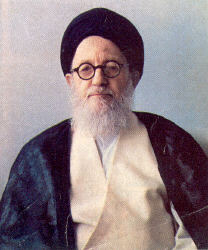 | |
| Religion | Islam , Shiite |
| Title | Great ayatollah |
| Date of Birth | 1905 |
| Place of Birth | Tabriz , East Azerbaijan |
| Date of death | April 3, 1986 |
| Place of death | Tehran |
| A country | |
| Children | |
Biography
Mohammad Kazem Shariathmadari was born in 1905 in Tabriz . Ethnicity - Azerbaijani [2] . He studied at Najaf ( Iraq ), and then at Qom (Iran) [1] . On June 4, 1963, Shariatmadari was arrested by the Shah secret police of SAVAK along with Ayatollahs Khomeini , Talegani , Zanjani and some mullahs, such as Falsafi, Mahallati and others, but later all of them, except Khomeini and Telegani, were released [3] . Khomeini himself was later expelled from the country, and Talegani was imprisoned. After the security forces raided a Shariatmadari-led religious institution in January 1978 , as a result of which two Taliban (that is, a “student”) were killed, including his personal secretary, he openly took an anti-Shah position [4] . Intending to split the opposition forces, the Shah authorities in the autumn of the same year suggested that the Shariathmadari should head a council of religious supervision of five ulama, which was provided for by the Russian constitution in 1906 but he declined this offer [5] . While Ayatollah Khomeini was in exile, Shariatmadari was considered the main religious authority in Iran and he actively contributed to the growth of Khomeini’s popularity in the country, but after the return of the last relationship between the two Ayatollahs took on a strained character [6] .
Shariatmadari said that he “is a supporter of material and scientific progress if progress contributes to the improvement of man and benefits everyone” , and he argued that Islam “does not reject the achievements of the last 14 centuries, and that there are still Muslim laws that are relevant for the present time ” [7] . He opposed the introduction of the principle of “velayat e faqih” in the Iranian constitution [6] . At the first stage of the revolution in the field of foreign policy, Shariatmadari advocated friendly relations with the Soviet Union , while Ayatollah Khomeini tried not to mention the USSR at all [7] .
As an ethnic Azerbaijani, Shariatmadari played an important role in the consolidation of Iranian Azerbaijanis in support of the 1979 Islamic Revolution . Using the ethnic factor, he opposed the Shah’s regime, which impeded the development and preservation of Azerbaijani culture in Iran, the new government, which allegedly agreed to grant autonomy to the ethnic minorities of the country. By the end of 1979 , however, it became clear that the new Khomeini regime was not going to implement this plan. In response to this, riots broke out in areas inhabited by ethnic Kurds and Balochs . In Tabriz (populated mainly by Azerbaijanis), under the tacit leadership of Shariatmadari, a rebellion of Azerbaijani members of the MPRP was organized. However, in January 1980, the ayatollah ordered the rebels to abandon their positions, although by then the Azerbaijanis had already managed to seize the local television studio, radio station, government buildings and capture several key persons. Shariahmadari believed that the uprising was doomed to failure and the rebels would not be able to cope with the large army of Khomeini supporters who declared a “holy war” to regional movements and drowned the Kurds and Balochis in the blood [8] .
In April 1982, an associate of Khomeini, former Iranian Foreign Minister Sadik Gotbzadeh , was arrested on charges of plotting a coup and killing Khomeini . He admitted that Ayatollah Shariathmadari was aware of the conspiracy and promised funding and support, if successful. Gotbzade was shot, and Shariatmadari's son-in-law, who was the link between Gotbzade and Ayatollah, was sentenced to prison. Shariahmadari, because of his status as a mujtahid , was not executed, but his party was dissolved, the Center for Islamic Studies and Publications headed by him was closed, and he himself was under house arrest until his death on April 3, 1986 [9] .
Notes
- ↑ 1 2 Mohammad Kazem Shariat-Madari (English) , Encyclopædia Britannica .
- ↑ Svante E. Cornell. Azerbaijan Since Independence . - ME Sharpe, 2010 .-- S. 319-320. - ISBN 0765630036 , 9780765630032.Original textDuring the 1978-79 revolution, the strong following of the ethnic Azerbaijani Ayatollah Mohammed Kazem Shariatmadari in Tabriz and other parts of Iranian Azerbaijan was linked to a perception among Azerbaijanis that Shariatmadari was a representative of their specific interests.
- ↑ Doroshenko E.A. Shiite clergy in modern Iran. - Science, 1985 .-- S. 123.
- ↑ Aliev S.M. History of Iran. XX century. - M .: Institute of Oriental Studies, Russian Academy of Sciences: Kraft +, 2004. - P. 459. - ISBN 5-93675-075-2 , 5-89282-184-6.
- ↑ Islam in the modern politics of the countries of the East (late 70s – early 80s of the 20th century). - M .: " Science ", 1986. - S. 150.
- ↑ 1 2 Iranian Revolution: 1978-1979: Causes and Lessons. - Science, 1989 .-- S. 206.
- ↑ 1 2 Doroshenko E.A. Shiite clergy in modern Iran. - Science, 1985 .-- S. 198.
- ↑ Joel Cretan . “Calculation and Confrontation: Explaining Ethnic Rebellions in the Islamic Republic of Iran.” Stanford Journal of International Relations vol. 9 no. 2 (Spring 2008), pp68-77.
- ↑ Negin Nabavi, Babak Rahimi . Iran: From Theocracy to the Green Movement - Palgrave Macmillan, 2012 - p. 58 - ISBN 978-0-230-11469-2