The French presidential election in 2002 (after changes to the law, the French president was now elected for a five-year term, instead of a seven-year one) received wide international resonance, as they were marked by a scandalous sensation.
← 1995  2007 → 2007 → | |||
| French presidential election | |||
|---|---|---|---|
| April 21 and May 5, 2002 | |||
| Voter turnout | 71.6% in the first round, 79.71% in the second | ||
 |  |  | |
| Candidate | Jacques Chirac | Jean-Marie Le Pen | Lionel Jospin |
| The consignment | Union in support of the republic | National front | Socialist party |
| Votes in the first round | 5 665 855 (19.88%) | 4 804 713 (16.86%) | 4 610 113 (16.18%) |
| Votes in the second round | 25 537 956 (82.21%) | 5 525 032 (17.79%) | |
| Other candidates | see below | ||
| Election result | Jacques Chirac re-elected president for 2 term | ||

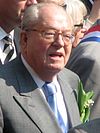
Suddenly, the main rival of the current President of the Republic, Jacques Chirac , the French Prime Minister socialist Lionel Jospin did not go into the second round, losing in the first round on April 21 less than 1% to the far-right candidate, leader of the National Front, Jean Marie Le Pen . This is the second case in the post-war history of France, when the left was defeated in the first round of the presidential election (the first time in 1969 , when the Gaullist Georges Pompidou and the centrist Alain Poer came out in the second round).
The defeat of Jospin was partly influenced by the dispersion of the left electorate (for example, three Trotskyist candidates - Olivier Bezansno , Arlette Lagieux and Daniel Gluckstein - together won 10% of the vote, that is, almost 3 million votes; at the same time, Robert Yu from the French Communist Party received a record low result for his party — less than 4%), partly unpopular antisocial reforms and a sluggish election campaign, as well as the highest level of absenteeism since 1969 . The success of Le Pen became part of the pan-European trend of strengthening nationalists. The leader of the National Front began his journey to the presidential Olympus in 1974 and since then has steadily improved his result from 0.74% to 15% in 1995 .
Le Pen gained a reputation as a racist and demagogue, although he was not the most radical (2.3% of the votes were received by the more right Bruno Megre). Le Pen spoke under the slogans of protecting against crime and strengthening France in the international arena. His program contained provisions on the expulsion of illegal immigrants, restriction of the voting rights of foreigners, the abolition of the automatic acquisition of citizenship, withdrawal from the Maastricht Treaty and Schengen agreements, as well as referenda on the introduction of the death penalty and the abolition of the euro . Le Pen showed the best results in the eastern departments of France along the border (having received a relative majority there).

The exit of the nationalist and Europhobe in the second round caused a shock, both in France itself and abroad. Thousands of anti-Lenin rallies were held in large cities of the country, including those held on May 1 (as a sign of the unity of the nation, it was not the red flags that were displayed on it, but the state ones). Leading world leaders made worried statements. Some Israeli politicians even urged Jews to urgently leave France. The world press abounded with apocalyptic commentaries and portended the threat of neo-Nazism. Allegations were voiced about the “disease of France,” defects in its electoral system and “responsibility of voters.” Other ultra-right European politicians, such as Jörg Haider in Austria and Vladimir Zhirinovsky in Russia, expressed their support to Le Pen.
In this situation, the position of Jacques Chirac was extremely facilitated; not only his moderately right opponents, but almost all the left called for either to support Chirac as a “ lesser evil ” or to mobilize against Le Pen. He easily gained an overwhelming majority of votes in the second round on May 5 . His opponent was able to improve his result only slightly (less than 1%). However, the results of the second round clearly demonstrated that the National Front has a confident electorate, ready to vote for its leader again and again. These were the only nationwide presidential elections in France, where in the second round the same candidate won in all departments.
Statistics
First Round
April 21, 2002
| Voters registered: | 41 194 689 |
| Voters Voted: | 29,495,733 |
| Of them: | |
| Invalid and blank ballots: | 997,262 3.38% |
| valid newsletters: | 28 498 471 100.00% |
| Candidate | The consignment | Number of votes | Percent |
|---|---|---|---|
| Jacques Chirac | Republic Support Association (RPR) | 5,665,855 | 19.88% |
| Jean-Marie Le Pen | National front | 4,804,713 | 16.86% |
| Lionel Jospin | French Socialist Party (PS) | 4,610,113 | 16.18% |
| Francois Bayroux | Union for French Democracy (UDF) | 1,949,170 | 6.84% |
| Arlette Lagieux | Labor struggle | 1,630,045 | 5.72% |
| Jean-Pierre Schevenman | Citizens movement | 1,518,528 | 5.33% |
| Noel Mamer | Green | 1,495,724 | 5.25% |
| Olivier Uncensored | Revolutionary communist league | 1,210,562 | 4.25% |
| Jean Saint-Joss | Hunting, fishing, nature, traditions | 1,204,689 | 4.23% |
| Alain Madeleine | Liberal Democrats | 1,113,484 | 3.91% |
| Robert U | French Communist Party (PCF) | 960,480 | 3.37% |
| Bruno Megre | National Republican Movement | 667,026 | 2.34% |
| Kristien Tobira | Left radical party | 660,447 | 2.32% |
| Corin Lepage | Participation - 21st Century | 535,837 | 1.88% |
| Christine Bhutan | Union for French Democracy | 339,112 | 1.19% |
| Daniel Gluckstein | Workers Party | 132,686 | 0.47% |
Second Round
May 5, 2002
| Voters registered: | 41 191 169 |
| Voting voters: | 32 832 295 |
| Of them: | |
| Invalid and blank ballots: | 1,769,307 5.39% |
| valid newsletters: | 31 062 988 100.00% |
| Jacques Chirac , Union for the Republic | 25,537,956 | 82.21% |
| Jean-Marie Le Pen , National Front | 5,525,032 | 17.79% |