The attack on Dutch Harbor is one of the military clashes during the Pacific campaign during World War II . It happened June 3 - 5, 1942 , near the island of Amaknak , west of Alaska .
| Assault on Dutch Harbor | |||
|---|---|---|---|
| Main Conflict: World War II , Pacific War | |||
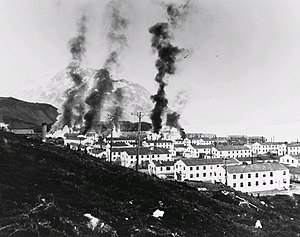 Dutch Harbor fires after Japanese attack | |||
| date | June 3 - 5, 1942 | ||
| A place | Amaknak and Unalashka islands | ||
| Total | Japan's tactical victory, strategic goal was not achieved | ||
| Opponents | |||
| |||
| Commanders | |||
| |||
| Forces of the parties | |||
| |||
| Losses | |||
| |||


Content
Background
Before the attack on Midway, the Japanese command had planned a distraction. The target was the American naval base Dutch Harbor in the Aleutian Islands , off the coast of Alaska. For this, the connection of ships under the command of Rear Admiral Kakuta in the composition of the aircraft carriers Ryujo and Junyo , two cruisers and three destroyers left the island of Honshu . Admiral Hosogaya with a support unit was near Paramushir . Compounds that were to capture the islands of Attu and Kyska also entered the sea.
Fight
On June 3, Kakuta, 180 miles southwest of Dutch Harbor, took off his air group. Due to the bad weather, which made it difficult to see, many planes, not finding the target in the fog, simply returned to the aircraft carriers. However, 12 out of 42 aircraft still reached their goal at 8:08. Several fuel tanks were set on fire, and the hospital and barracks were damaged. One bomber was shot down by anti-aircraft fire. After the raid, the Americans immediately began searching for Japanese ships, but to no avail.
On the same day, Kakuta sent planes to strike Makushin Bay, where, according to the reports of the returning pilots, there were several American destroyers. However, due to bad weather, the air group returned, not reaching the goal and having lost one plane on the way back due to the attack of fighters.
On June 5, Dutch Harbor was again hit by air strikes. This time there were more aircraft and the raid itself was better organized. The fuel depot was finally destroyed, several ships in the harbor were damaged. One fighter was shot down. At the same time, the Japanese formation of ships was discovered from the air and bombed, which, however, did not bring results.
On the same day, the operation was postponed and the compound ceased hostilities. Ships remained in Aleutian waters until June 24 , and then returned home.
Summary
Despite the significant destruction of the American military base and the ratio of losses in favor of the Japanese, they did not achieve the strategic goal of distracting the Americans from Midway . By that time, American cryptologists had revealed the Japanese military code, and the plans of the Japanese were known to the American command.
After the Japanese troops captured and occupied the islands of Attu and Kyska , it was decided to evacuate the civilian population from the islands of Amaknak and Unalashka to the mainland.
Literature
- Paul Stephen Dall. Combat Path of the Imperial Japanese Navy / Translated from English by A.G. Sick . - Yekaterinburg: Sphere ,1997 . - 384 p. - (Sea battles close-up).