The 64th Fighter Aviation Corps (64 IAC ) - a combination of the Air Force ( Air Force ) and Air Defense ( Air Defense ) of the Armed Forces of the USSR , which took part in the Korean War ( 1950 - 1953 ). The corps included all Soviet flight and anti-aircraft units involved in the Korean theater of operations .
| 64th Fighter Aviation Corps 64 jac | |
|---|---|
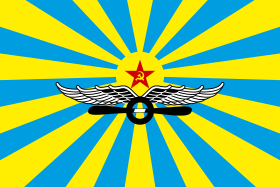 | |
| Years of existence | November 27, 1950 - 1956 |
| A country |  the USSR the USSR |
| Type of | (Aviation) Fighter |
| Number of | about 26,000 people |
| Participation in | War in korea |
| Commanders | |
| Famous Commanders | See list |
Content
Connection History
Soviet combat aviation was sent to China as early as the beginning of 1950 to protect the Shanghai area from attacks by the Kuomintang air force . With the outbreak of the Korean War, the territory of China began to periodically undergo raids by American aircraft. When China entered the war in October 1950, Soviet aviation was tasked with protecting the Chinese troops and rear communications from the operations of UN assault and bomber aircraft (mainly the US Armed Forces). Soviet pilots made their first combat flight on November 1 . By this time, three fighter aviation divisions of the USSR were concentrated in Northeast China, which were merged into the 64th Fighter Air Corps on November 27 [1] .. Initially, it was part of the Operational Group of Soviet Air Forces in China, and in November 1951 Included in the United Air Force (which also included Korean and Chinese air units).
The tasks of the air corps included providing cover for bridges and the Supkhun hydroelectric station on the Yalujiang River (the border river between Korea and China), military and economic facilities on the territory of the DPRK , as well as the rear communications of Chinese and Korean troops. In addition, pilots of the air corps participated in the training of pilots of the Chinese and North Korean air forces [2] . The main combat aircraft of the hull was the MiG-15 fighter.
At the end of hostilities, the corps relocated to Petrozavodsk and became part of the 22nd Air Army .
Corps Commanders
| Rank | Name | Period | Note |
|---|---|---|---|
| Major General Aviation | Ivan Vasilievich Belov | 11/14/1950 - 09/17/1951 | |
| Major General Aviation | George Ageevich Lobov | 09/18/1951 - 04/25/1953 | |
| Lieutenant General Aviation | Sidor Vasilyevich Slusarev | 04/25/1953 - 05/12/1955 | active hostilities continued until July 27, 1953 |
Housing basing
- The headquarters of the corps is Mukden ( PRC ) / Andun ( PRC ), since September 1953 - Petrozavodsk .
- The main airfields were in the territory of the PRC: Mukden , Anshan , Andun / Myagou
Composition
The composition of the corps was unstable. During the war, 12 fighter divisions, 2 separate night fighter regiments, 2 naval fighter regiments, 4 anti-aircraft artillery divisions and various rear units passed through it. The number of the corps in 1952 was about 26,000 people; on November 1 of the same year, there were 321 aircraft in combat units [3]
The participation of the Soviet Union in the war was secret, so the pilots were forbidden to approach the front line and fly over the sea. The aircraft carried Chinese identification marks, the pilots were issued Chinese uniform and Chinese documents. At the early stage of the corps’s actions, the pilots were also required not to speak Russian during the sorties; they had to learn the necessary Korean phrases in aerial combat, but after the first battles this requirement was removed because of its practical impracticability [4] . The very fact of the participation of Soviet pilots in the war was made public in the USSR only in the 1970-1980s. Despite all the secrecy, UN aviation pilots were well aware of who their adversary was.
Aircraft Aviation Parts
From November 27, 1950 to March 1951, the base of the 64th air corps consists of three divisions:
- 28th Fighter Division [5]
- 67th Fighter Aviation Regiment
- 139th Guards Fighter Aviation Regiment
- 50th Fighter Aviation Division
- 29th Guards Fighter Aviation Regiment
- 177th Fighter Aviation Regiment
- 7th PLA Fighter Aviation Regiment (operational submission)
- 151st Guards Fighter Division
- 28th Guards Fighter Aviation Regiment
- 72nd Guards Fighter Aviation Regiment
The formation of the 50th IAD and the transfer of the 151st Guards Fighter Aviation Division was carried out using the resources of the Moscow Air Force and the 67th Fighter Aviation Corps (Air Force FEB). Combat support in the first period was also provided by units of the 149th IAD (3rd, 18th, 582nd IAP) of the 55th Separate Air Defense Fighter Corps, Major General P.F. Batitsky (Primorsky Military District).
They were replaced by the first military spring (for the period February 1951 - February 1952)
- 303rd Smolensk Red Banner Fighter Aviation Division
- 17th Fighter Aviation Regiment
- 18th Guards Fighter Aviation Regiment
- 523rd Fighter Aviation Regiment
- 324th Svir Red Banner Fighter Division
- 176th Guards Fighter Aviation Regiment
- 196th Fighter Aviation Regiment
- The 351st Fighter Aviation Regiment from the 106th Fighter Aviation Division of the Shanghai Group of Forces took part as a separate night IAP on La-11 and (from February 1952) MiG-15 : from June 23, 1951 to February 18, 1953 of the year.
- 97th Air Defense Fighter Division
- 16th Fighter Aviation Regiment
- 148th Guards Fighter Aviation Regiment
- 190th Polotsk Red Banner Fighter Division
- 256th Fighter Aviation Regiment
- 494th Fighter Aviation Regiment
- 821st Fighter Aviation Regiment
In July 1952, new units appeared in the skies of Korea:
- 32nd Red Banner Fighter Division
- 224th Fighter Aviation Regiment
- 535th Fighter Aviation Regiment
- 913th Fighter Aviation Regiment
- 133rd Fighter Division
- 147th Guards Special Purpose Fighter Aviation Regiment
- 415th Fighter Aviation Regiment
- 726th Fighter Aviation Regiment
- 578th Fighter Aviation Regiment of the Air Force Pacific Fleet (operational submission)
- 216th Gomel Fighter Aviation Air Defense Division
- 518th Fighter Aviation Regiment
- 676th Fighter Aviation Regiment
- 878th Fighter Aviation Regiment
- 781st Fighter Aviation Regiment of the Air Force Pacific Fleet (operational subordinate)
In February 1953, night fighter aviation regiments changed: the 351st fighter aviation regiment was replaced by the 298th fighter aviation regiment (02.15.1953 - 07.27.1953)
The last to go to Korea (July 1953)
- 37th Fighter Aviation Division
- 236th Fighter Aviation Regiment (1950)
- 282nd Fighter Aviation Regiment (1950)
- 940th Fighter Aviation Regiment
- 100th Air Defense Fighter Division
- 9th Guards Fighter Aviation Regiment
- 731th Fighter Aviation Regiment
- 735th Fighter Aviation Regiment
Air defense and corps units
- The 28th Anti-Aircraft Artillery Division (Angelov Settlement; January 1953 - to the end)
- 503rd anti-aircraft artillery regiment (p / c Kletsko);
- The 505th anti-aircraft artillery regiment (n / a. N. F. Shandryuk);
- 507th anti-aircraft artillery regiment (p-to-Samoilov).
- 35th anti-aircraft artillery division (January 1953 - until the end)
- The 508th anti-aircraft artillery regiment;
- 513rd anti-aircraft artillery regiment.
- The 87th Antiaircraft Artillery Division (Settlement A.I. Varlygo; March 1951 - January 1953)
- 151st anti-aircraft artillery regiment (bst Bystrov);
- The 1777th anti-aircraft artillery regiment (n / n N. F Medyantsev).
- The 92nd Anti-Aircraft Artillery Division (March 1951 - January 1953)
- 666th Anti-Aircraft Artillery Regiment;
- 667th anti-aircraft artillery regiment.
- The 16th Aviation Technical Division (p. V. S. Zaitsev; July 1953 - December 1954)
- 180th OBATO;
- 277th OBATO;
- 838th OBATO;
- 854th OBATO;
- 859th OBATO.
- The 18th Aviation Technical Division (pp. M. P. Mironovich; June 1951 - July 1953)
- 10th separate anti-aircraft searchlight regiment (regiment E.A. Belenko; March 1951 - February 1953)
- The 20th Separate Anti-aircraft Searchlight Regiment (Agapov Settlement; January 1953 - December 1954)
- 65th ODRS-division of AIR;
- 61th anti-aircraft company.
- 1406th Hospital of Infectious Diseases (Pr. A. Gorelik)
- 8th Mobile Military Field Hospital
- 534th department of radiography;
- 70th separate disinfection platoon;
- 99th separate disinfection platoon;
- 18th plague prevention squad;
- 357th Sanitary and Epidemiological Laboratory.
- 81st Separate Communications Company (November 1950 - April 1953)
- 727th Separate Communications Battalion (April 1953 - December 1954)
- 133rd Separate Radio Engineering Battalion (April 1953 - December 1954)
- 61st Separate Radio Engineering Company (radio navigation; April 1953 - December 1954)
- 114th radio technical regiment
Anti-aircraft artillery divisions had different types of equipment. So the 87th zenad had 59 85-mm and 56 37-mm anti-aircraft guns ; 92nd zenad - 96 85-mm and 84 37-mm anti-aircraft guns. The units of the time had the following organization: 4 gun batteries and 12 gun battalions.
Each anti-aircraft regiment had on equipment 36 RAP-150 radio-projectile stations. The regiment consisted of 3 searchlight battalions (3 searchlight companies with 12 searchlight stations each). The searchlight platoon had on equipment 2 RAP-150 and 2 anti-aircraft searchlight stations 3-15-3. At the same time, a searchlight platoon allocated to ensure night-time combat operations of maneuverable MZA batteries initially included one station RAP-150 and three stations 3-15-4. The practice of combat work showed the inappropriateness of using the RAP-150 stations when firing at low flying targets, since in the conditions of mountainous terrain interference was observed over the entire range of the station. In addition, the impossibility of adjusting the radars of the RAP-150 stations according to the elevation angle with the frequent change of positions, the insufficient maneuverability of the stations and the difficulties of masking it made them refuse to use the RAP-150 in maneuver platoons.
150 cm RPM RADIOPROJECT STATION RP-150
It is intended for detecting air targets and determining the slant range to them, accurately pointing the searchlight in azimuth and test angle to the detected target, for illuminating it with a searchlight beam at night. The station is an anti-aircraft searchlight ZP-15-2 (mirror diameter 150 cm, arc lamp, radar, automatic tracking of the illuminated target. The brightness of the searchlight beam at an altitude of 5-7 km is 1200 units or 1.5 million candles (for comparison, the brightness of the Sun - 900 units)), on which a radar and a remote control system with a remote control station are mounted. The station also includes a power unit on a ZIS-151 car, which is also a tractor. The detection range of airborne targets is at least 28–30 km. Bearing range - at least 25 km. The minimum range of detection and bearing of air targets is 1 km. The mass of the radio projector (with a cart ZU-13p) is about 5070 kg.
Summary
During their participation in the war (November 1950 - July 1953), pilots of the 64th air corps made about 64,000 sorties and conducted 1,872 air battles. According to the final data of the corps (somewhat overestimated [6] ), about 1,250 enemy aircraft were shot down, including 1,100 aircraft were destroyed by group fighters and 150 by anti-aircraft artillery. Own losses amounted to 335 aircraft, killing at least 120 pilots and 68 anti-aircraft gunners [7] .
Heroes of the Soviet Union Awarded the Title for the Korean War
Main article: List of Heroes of the Soviet Union - participants in the Korean War .
- Ges Grigory Ivanovich , squadron commander of the 176th Guards Fighter Aviation Regiment of the 324th Fighter Aviation Division on October 10, 1951, by decree of the Presidium of the Supreme Soviet of the USSR, was awarded the title Hero of the Soviet Union. Gold Star No. 10871.
- Karelin Anatoly Mikhailovich , major, deputy commander for flight training - a pilot-inspector for piloting the 351th separate night fighter aviation regiment of the 64th fighter aviation corps. By the Decree of the Presidium of the USSR Supreme Council of July 14, 1953 he was awarded the title Hero of the Soviet Union. Golden Star No. 10832. It is considered the best night ace, having shot down 6 aircraft at night (5 strategic B-29 bombers and one RB-29 reconnaissance aircraft).
- Kramarenko Sergey Makarovich , deputy squadron commander of the 176th Guards Fighter Aviation Regiment of the 324th Fighter Aviation Division on October 10, 1951, by decree of the Presidium of the Supreme Soviet of the USSR, was awarded the title Hero of the Soviet Union. Gold Star number 9283.
- Mikhin Mikhail Ivanovich , Major, Deputy Squadron Commander of the 518th Fighter Aviation Regiment of the 216th Fighter Aviation Division By Decree of the Presidium of the Supreme Soviet of the USSR dated July 14, 1953, was awarded the title Hero of the Soviet Union. Gold Star number 10834.
- Pepelyaev Evgeny Georgievich , commander of the 196th Fighter Aviation Regiment of the 324th Fighter Aviation Division on April 22, 1952, by decree of the Presidium of the Supreme Soviet of the USSR, was awarded the title Hero of the Soviet Union. Gold Star No. 9290. Shot down 23 aircraft (officially credited 20).
- Grigoriy Ivanovich Pulov (1918–2005) - fighter pilot, shot down 8 aircraft. Regiment commander. ( 17th Fighter Aviation Regiment , 303rd Fighter Aviation Division ).
- Dmitry Aleksandrovich Samoilov (1922–2012) - fighter pilot, shot down 10 aircraft. ( 523rd Fighter Aviation Regiment , 303rd Fighter Aviation Division ).
- Smorchkov Alexander Pavlovich (1919—1998) - fighter pilot, shot down 13 (1 in the group) aircraft. ( 18th Guards Fighter Aviation Regiment , 303rd Fighter Aviation Division )
- Subbotin Serafim Pavlovich , pilot of the 176th Guards Fighter Aviation Regiment of the 324th Fighter Aviation Division on October 10, 1951, by decree of the Presidium of the Supreme Soviet of the USSR, was awarded the title Hero of the Soviet Union. Gold Star No. 9289.
- Sutyagin Nikolai Vasilyevich (1923—1986) - fighter pilot, shot down 22 aircraft. The best al fighter of the Korean War. Deputy squadron commander 17 IAP. ( 17th Fighter Aviation Regiment , 303rd Fighter Aviation Division ).
- Schukin, Lev Kirillovich (1923–2009) - a fighter pilot, shot down 15 aircraft. ( 18th Guards Fighter Aviation Regiment , 303rd Fighter Aviation Division )
- Bakhaev Stepan Antonovich (1922-1995) - a fighter pilot, shot down 11 aircraft. ( 523rd Fighter Aviation Regiment , 303rd Fighter Aviation Division ).
- Fighters Arkady Sergeevich (1923-2000) - fighter pilot, shot down 6 aircraft. (The 16th Fighter Aviation Regiment , 97th Fighter Aviation Division ).
- Nikolay Grigorievich Dokashenko (1921-1992) - fighter pilot, shot down 9 aircraft. ( 17th Fighter Aviation Regiment , 303rd Fighter Aviation Division ).
- Georgy Ageevich Lobov (1915–1994) - fighter pilot, shot down 4 aircraft. Commander of the 64th Jacob since October 1951. (Earlier, the commander of the 303rd Fighter Division)
- Naumenko Stepan Ivanovich (1920-2004) - fighter pilot, shot down 6 aircraft. ( 29th Guards Fighter Aviation Regiment 50th Fighter Aviation Division )
- Obraztsov Boris Alexandrovich , senior lieutenant, pilot of the 176th Guards Fighter Aviation Regiment of the 324th Fighter Aviation Division, on October 10, 1951, was awarded the title Hero of the Soviet Union by decree of the Presidium of the Supreme Soviet of the USSR. Posthumously.
- Oskin Dmitry Pavlovich (1919-2004) - fighter pilot, shot down 15 aircraft. Then commander 523 IAP. ( 523rd Fighter Aviation Regiment , 303rd Fighter Aviation Division ).
- Ogai Grigory Ulyanovich (1919-2002) - fighter pilot, shot down 11 aircraft. Deputy Commander 523 iap. ( 523rd Fighter Aviation Regiment , 303rd Fighter Aviation Division ).
- Mikhail Sergeevich Ponomarev (1920–2006) - fighter pilot, shot down 10 aircraft. ( 17th Fighter Aviation Regiment , 303rd Fighter Aviation Division ).
- Shebanov Fedor Akimovich , senior lieutenant, senior pilot of the 196th Fighter Aviation Regiment of the 324th Fighter Aviation Division, on October 10, 1951, was awarded the title Hero of the Soviet Union by decree of the Presidium of the Supreme Soviet of the USSR. Posthumously.
- Stelmach Evgeny Mikhailovich (1923-1951) - fighter pilot, shot down 2 aircraft. Hero of the Soviet Union posthumously. ( 18th Guards Fighter Aviation Regiment , 303rd Fighter Aviation Division )
See also
Notes
- Order of the Chief of the General Staff No. 5564 of November 15, 1950 “On the establishment of the operational group of the 64th Fighter Aviation Corps”.
- ↑ I. M. Popov, S. Ya. Lavrenov, V. N. Bogdanov. Korea in the fire of war. - Zhukovsky; M .: Kuchkovo Pole, 2005. - p. 263. - 544 p. - 1000 copies - ISBN 5-86090-100-3 .
- ↑ I. M. Popov, S. Ya. Lavrenov, V. N. Bogdanov. Korea in the fire of war. - Zhukovsky; M .: Kuchkovo field, 2005 .-- S. 268 - 269. - 544 p. - 1000 copies - ISBN 5-86090-100-3 .
- Красные "Red Devils" in the sky of Korea, c. 39
- ↑ Anokhin V. A., Bykov M. Yu. All Stalin's fighter regiments. The first full encyclopedia. - A popular science publication. - M .: Yauza-press, 2014 .-- S. 234.- 944 p. - 1500 copies - ISBN 978-5-9955-0707-9 .
- ↑ On the inaccuracies in the assessment of air victories, see: Tepsurkayev Yu. G., Krylov L. E. “Stalin falcons” versus “Flying Fortresses”. - M .: Yauza, Eksmo, 2008 .-- S. 11-12 and 80-83.
- ↑ I. M. Popov, S. Ya. Lavrenov, V.N. Bogdanov. Korea is on fire. - Zhukovsky; M .: Kuchkovo field, 2005 .-- S. 272-274. - 544 p. - 1000 copies - ISBN 5-86090-100-3 .
Literature
- Lobov G. A., In the sky of North Korea. - M.: “Aviation and Cosmonautics” No. 10-12 1990, No. 1-5 1991.
- I. M. Popov, S. Ya. Lavrenov, V. N. Bogdanov. Korea is on fire. - Zhukovsky; M .: Kuchkovo Pole, 2005. - 544 p. - 1000 copies - ISBN 5-86090-100-3 .
- Seydov I. "Red Devils" in the sky of Korea. - M .: Yauza; Eksmo, 2007. - 704 p.
- I. G. Drogovoz. Air Shield country tips. -Minsk: Harvest, 2002. - 544 p.
- A.Pochtarev. In the hot war with the Pentagon. // HBO, 21/07/2000
- Soviet Air Order of Battle - Korea 1950-53
- S. L. Rogoza, N. B. Achkasov. Secret wars. 1950—2000 - M .: Publishing House AST, LLC; SPb .: LLC Polygon Publishing House, 2004. - 558 p.