Staroselsky Moss is a bog in the Tver region of Russia . It is a state complex reserve of regional significance.
| Staroselsky Moss | |
|---|---|
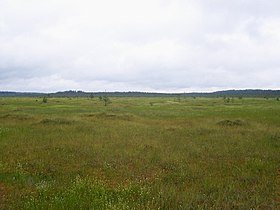 General view of the swamp | |
| Specifications | |
| Square | 6.17 km² |
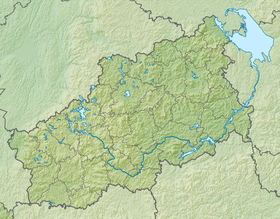
| Location | |
| A country |
|
| The subject of the Russian Federation | Tver region |


Content
General information
Swamp Staroselsky Moss occupies a series of sewer basins at the top of the watershed of the Mezha and Tudovka rivers within the buffer zone of the Central Forest Reserve . Geographic coordinates Its area is 617 hectares, the maximum depth of the deposit is 5.5 m, the average is 3.2 m. 3 streams and a system of minor depressions are the water inlets. The water level is unstable and ranges from 0 to 0.6 m.
Origin
The swamp massif began to form during the phase of the lower Holocene spruce (boreal period). In the northwestern part, peat is underlain by lake sediments. The southeastern part of the swamp is the youngest; it is underlain by loams . Apparently, different parts of the swamp have different origins. The northwestern part could be formed due to overgrowth of the postglacial lake. The southeastern part is due to dry swamping through the pine-elm-birch mesotrophic phase. Starting from the Atlantic period (6 thousand years ago), the development of the swamp occurred evenly in the oligotrophic type of swamping. Currently, the waterlogging process continues in a southerly direction. This occurs, according to researchers, due to the slow lowering of some parts of the territory relative to others.
Vegetation cover
The vegetation cover is typical for the highlands of the southern taiga zone. Outskirts on the gentle slopes are occupied by blueberry pine forests. Communities with pine stands, less often birch trees , or no trees at all, are formed on flat areas. Peat gley soils form here.
The gentle slopes of the convex part of the swamp are a ridge-urea complex . Ridges can be covered with pine woodlands or unforested. On the ridges, whitewash , cotton grass grow, in the ossicles there is an trophy , sheikhtseria . Their special types of sphagnum are confined to ridges and pits.
The northern part of the swamp has some lowering in the center. Mesotrophic communities predominate here according to the type of transitional bogs , in which horsetail , sedge , reed , as well as cheretnik and sphagnum dominate.
See also
- Swamps of the Tver region
Literature
- Minaeva T. Yu. Et al. Essay on the marshes of the Central Forest Reserve // Transactions of the Central Forest Reserve. - Tula: Grif and K, 2007. - Issue. 4 . - S. 267-296 .
- Yu. G. Puzachenko et al. Central Forest State Natural Biosphere Reserve . - M .: Business World, 2007. - 80 p.