Operation Wunderland (from German Wunderland - “Wonderland”) is the Kriegsmarine offensive operation undertaken in the Kara Sea in the second half of August 1942 to prevent the passage of Allied convoys to the Barents Sea from the east, the Northern Sea Route and the destruction of the Soviet port infrastructure.
| Operation Wunderland | |||
|---|---|---|---|
| Main Conflict: World War II | |||
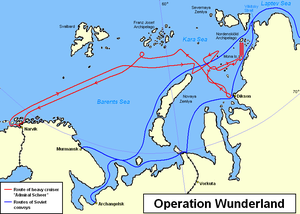 Operation chart | |||
| date | August 16 - August 30, 1942 | ||
| A place | Kara Sea | ||
| Total | Ambiguous: interpreted by both sides as their own success | ||
| Opponents | |||
| |||
| Commanders | |||
| |||


Planning
The possibility of action against Soviet shipping along the Northern Sea Route was considered by the Kriegsmarine command from the very beginning of the war with the USSR . There was even a project providing for the suppression of the Soviet fleet in the Kara Sea and further east with the aim of organizing the posting of German-Japanese convoys by the Northern Sea Route, bypassing the Allied sea blockade of Germany. When planning, we used the report of the German auxiliary cruiser “ Comet ”, which passed this way in 1940 with the assistance of the USSR for raiding in the Pacific Ocean [1] , photographic materials and other intelligence taken during the scientific expedition of the “Count Zeppelin” airship in 1931 [2] .
The command of the Nord group Kriegsmarine began direct planning in May 1942. By July 1942, an operation plan was prepared and approved by the Kriegsmarine High Command [3] .
The plan for the operation, scheduled for mid-August, set the main task to interrupt Soviet shipping in the Kara Sea. Preference should be given to the destruction of convoys coming from the east. The secondary objective was to attack the port of Amderm , which the Germans considered an important point of unloading of the Allied Arctic convoys . Initially, it was planned to use the heavy cruisers Admiral Scheer and Lutzov in the operation, but the latter, during Operation Horse Riding ( German Rösselsprung ), jumped onto an underwater rock and needed to be repaired. Operational intelligence was assigned to submarines [4] .
Due to insufficient intelligence (which the Norwegian Admiral pointed out during planning [Comm. 1] Hubert Schmundt [1] ), the operation plan contained several erroneous assumptions. The main one was the assumption that the route of Soviet convoys runs from the Barents Sea to the Vilkitsky Strait by the shortest route: along the western and northern coasts of Novaya Zemlya and then straight across the Kara Sea [7] [8] . The Germans' opinion on the significance of the port of Amderm was also erroneous, since the allied convoys were unloaded only in Murmansk and Arkhangelsk [9] [10] .
In early August, the Germans received from their allied Japan a message about a Soviet convoy consisting of 4 icebreakers and 19 cargo ships that passed the Bering Strait on August 1 northward. His arrival in the Kara Sea was expected by the Germans around August 22 [11] , which again was a mistake related to underestimating the difficulty of sailing along the Northern Sea Route: in fact, this convoy passed the Vilkitsky Strait a month later [12] .
During the preparation of the operation, aerial reconnaissance was carried out with five long-range seaplanes Blohm & Voss BV.138С-1 , two of them were lost due to accidents [7] .
On August 15, Luftwaffe aerial reconnaissance discovered a large convoy, proceeding east from Arkhangelsk , presumably to the Wilkitsky Strait , which he was supposed to reach also around August 22. Thus, an opportunity was created for the capture of two convoys at once in the narrow strait, where they would become easy prey for a heavy cruiser .
Start of operation
On the evening of August 16, "Admiral Scheer", under the command of Captain First Rank Wilhelm Meendsen-Bolken, left the Skomm Fjord in the Narvik area, accompanied by 4 destroyers . On August 17, the guards destroyers turned back, and the cruiser continued on its way north. On August 18, a lone merchant ship was spotted from the Sheer [11] . It was the Soviet ship "Frederick Engels", flying from New York via Iceland to Dickson [13] . Admiral Scheer did not attack, so as not to detect his presence prematurely. On the night of August 19, “Admiral Scheer” north of Novaya Zemlya met with a U-601 submarine, which was engaged in reconnaissance of the ice situation and Soviet navigation in the area [11] .
From U-601, the Sheer commander received information about the difficult ice situation and the lack of Soviet shipping in the area of her patrol. On August 19, the cruiser tried to go from Cape Zhelaniya in the direction of Solitude Island , planning to move further east to the Vilkitsky Strait, but met impenetrable ice and was forced to turn back, and then moved south. On the morning of August 20, a rendezvous with U-251 took place, which also did not report anything interesting [11] .
Submarine Actions
Five submarines were deployed to support Operation Wunderland. Three of them were intended for exploration north and east of Cape Desire [14] :
- U-601 (captain-lieutenant Peter-Ottmar Grau) had previously been in the area of Novaya Zemlya. On the night of July 27, she fired at the Malye Karmakuly polar station, destroying two Katalina seaplane anchored [15] , on August 1, U-601 sank the Soviet merchant ship “ Peasant ” ( 2513 GRT ), loaded with coal, which went to Belushya Guba unaccompanied [16] , and on August 3 returned to Kirkenes [15] . On August 9, U-601 again went on patrol with the task of collecting information about Soviet convoys, ice and weather conditions at the northern tip of Novaya Zemlya and east of it [17] . On August 24, northwest of Dixon, she sank the unmanned Kuibyshev steamer ( 2332 brt ) and the tug port Medvezhonok towed by him [18] .
- U-251 (Lieutenant Captain Heinrich Timm ) left Narvik on August 14 and patrolled north and then east of Novaya Zemlya [19] .
- U-255 (Lieutenant Commander Reinhard Rehe ) has been on patrol since August 4. Since August 11, it has supported one of the reconnaissance seaplanes BV.138C-1 in the Spitsbergen area. On August 14, the plane crashed, and on August 17 it sank during towing. After that, the submarine was sent to patrol the Kara Sea [20] . On the morning of August 25, on its own initiative, fired at a Soviet weather station on Cape Zhelaniya. This action provoked the disapproval of the German command, but was a distraction [21] , since the Soviet side attributed the shelling to an enemy surface ship [22] .
Two more submarines covered the area of operations from the west, patrolling the Kara Gates and Matochkin Shar straits:
- U-456 (captain-lieutenant Max-Martin Tichert ) left Neidenfjord on August 15 and patrolled off the west coast of Novaya Zemlya [23] .
- U-209 (Lieutenant Commander Heinrich Brodda) left for Kirkenes on August 5 to patrol the Barents Sea [24] . On August 17, near Matveyev Island, she attacked with an artillery fire and torpedoes an unarmed caravan of five NKVD vessels, which included a barge transporting prisoners. The barge, the coal lighter and the faulty Komiles towing steamer were sunk, the Komsomolets tugboat caught fire and landed ashore. Of the 328 people, only 23 escaped from these vessels. The tug “Nord” managed to escape and call for help [25] [26] . Claims from the NKVD prompted the command of the Northern Fleet of the USSR to begin the transfer of artillery from Dikson Island to the coast of Belushya Bay for the defense of the latter, which played a negative role in the subsequent defense of Dikson .
Convoy Hunt
"Admiral Scheer" continued to move across the Kara Sea to the south, eventually reaching clear water, then turning back towards Vilkitsky Strait. On the afternoon of August 21, the Arado Ar 196 seaplane launched from a cruiser announced the discovery of a convoy north-east of the island of Kravkova [Comm. 2] , about 60 miles from the cruiser. According to the pilots, the convoy was heading southwest, that is, directly towards the Sheer [28] .
In fact, it was the “3rd Arctic convoy”, following from west to east [Comm. 3] . He did not have guarding by warships, so the cruiser could count on an easy victory. However, the favorable moment for the attack was missed, as the German pilots made a mistake in determining the course of the convoy. It was not possible to continue observing him from the air, because the next time the plane took off, there was thick fog [30] .
Meendsen-Bolken decided to expect a convoy approach from Ermak's bank [Comm. 4] using a radar to detect it. But a long wait did not bring results. The radio interception service recorded negotiations in the north-east direction, so the results of air reconnaissance were questioned and the cruiser slowly (due to poor visibility and ice) moved to the Nordenskjöld archipelago . The aircraft was unable to re-find the convoy, but information obtained by radio interception and direction finding indicated that it was heading northeast at a speed of five knots and was heading for the Wilkitsky Strait [33] .
On the morning of August 22, the aircraft conducted reconnaissance of the ice situation, which showed that passage from the Nordenskjöld archipelago to the Wilkitsky Strait is possible. Near the southern Firnlea Islands , a small single vessel was seen (the hydrographic vessel Yakutia [27] ), but the pursued convoy was again found from the air only on August 23 after noon at the anchorage in the southern part of the Vilkitsky Strait south-west of Gelland Island Hansen [Comm. 5] [35] [36] . A seaplane flight was seen from Yakutia and from the polar station on the islands of Geberg , but it was not recognized as an enemy [37] .
Despite the low speed of the convoy, the task of intercepting and destroying it was not easy due to the difficult ice situation and navigation difficulties. Between August 23 and 24, Admiral Scheer advanced east to Russky Island and tried to get around it from the north, where he fell into a dangerous position for some time due to a change in wind that caused ice to move [38] .
On August 25, it was planned to enter the Vilkitsky Strait to attack the convoy, but during the next departure, the seaplane crashed during landing and was flooded. Having lost the main means of intelligence, Meendsen-Bolken lost hope of finding a convoy and turned southwest [39] .
The “3rd Arctic convoy” avoided the danger of destruction, but could not overcome the ice in the Laptev Sea and pass east along the Northern Sea Route. He later returned to the Kara Sea and was disbanded [40] .
Sinking of the icebreaker Alexander Sibiryakov
P.P. Pavlinov , 1945.
Going west for Admiral Scheer was easier as ice conditions improved. Around noon on August 25, 10-15 miles from Belukha Island [Comm. 6] a Soviet icebreaker was spotted. It was “ Alexander Sibiryakov ”, flying from Dikson to Severnaya Zemlya with a cargo of fuel, supplies and materials to support the polar stations. On board were a civilian and military crew, as well as passengers — builders and personnel of the polar stations, totaling about 100 people [Comm. 7] [44] [45] .
According to some sources, on August 24 the Main Directorate of the Northern Sea Route already had information about the possibility of the presence of an enemy surface ship in the Kara Sea [46] [47] , however, “ Alexander Sibiryakov ” did not receive any warning, and the meeting with the warship was unexpected for him [ 48] [22] .
In order to mislead the enemy and obtain intelligence, Admiral Scheer raised the American flag and headed straight for the icebreaker, thus hiding its silhouette. A signal spotlight transmitted a message in Russian: “Who are you, where are you going, come closer” [44] .
Swiss historian Jürg Meister writes that after this, a clear-text radiogram was transmitted from the board of Alexander Sibiryakov, which on Sheer was accepted as “I see an unfamiliar auxiliary cruiser, please watch us” [Comm. 8] , and the cruiser began to jam the wave on which the Sibiryakova transmitter was operating, and opened fire [44] .
Soviet sources, however, report a longer exchange of signals during which Admiral Scheer tried to introduce himself as the Tuskaluza American cruiser, but because of an error in transmitting or receiving a signal on Sibiryakova, they read the name as Japanese Sisiyama. A few more radiograms are also described, allegedly transmitted and received by the radio operator "Alexandra Sibiryakova" in spite of the production of radio interference. The Russian historian Miroslav Morozov considers the possibility of such a radio exchange dubious [50] .
“Alexander Sibiryakov” was assigned to the White Sea naval flotilla and had armament: two [Comm. 9] 76 mm and two 45 mm guns and machine guns [52] . Despite the obvious superiority of the enemy, the captain of Sibiryakova Anatoly Alekseevich Kacharava (military rank: Lieutenant of the USSR Navy [53] ) returned fire and tried to withdraw his ship towards Belukha Island under cover of a smoke screen [44] .
"Admiral Scheer" made six volleys of main-caliber guns, three of them only with a bow turret (a total of 27 shells were fired) [54] . “Alexander Sibiryakov” received at least four hits and lost speed; the fuel transported in barrels on the deck ignited. He did not lower the flag and fired at the enemy to the last opportunity, but did not achieve hits [44] [55] . In view of a hopeless situation, an order for flooding was executed, the survivors began to leave the ship [56] .
A boat was launched from Admiral Sheer, which picked up about 20 [Comm. 10] people, including the seriously wounded captain Kacharava. Some survivors refused to be saved by the Germans. Some showed resistance, the fireman Nikolay Matveyev was shot dead [59] [60] . About an hour after the start of the battle, “Alexander Sibiryakov” sank [44] [61] . When the Germans left, the fireman Pavel Vavilov , who was one of the last to leave the ship, managed to get to the abandoned boat and reach the island of Belukha. He spent more than a month there before being seen from the Sacco steamboat. September 29 Vavilov was rescued by the seaplane of Ivan Cherevichny . The remaining crew members and passengers died [62] [60] .
Dixon Bombing
The vigilance of “Alexander Sibiryakov” led to the fact that the presence of a German surface ship in the Kara Sea became known to the Soviet side, although the “Admiral Scheer” was obviously not identified: in the intercepted communications it was a “auxiliary cruiser” [44] . The patrolling of the area between Cape Desire and Dixon Island , undertaken by Sheer on August 25-26, yielded no results. Again, impenetrable ice was encountered [63] .
Meendsen-Bolken decided to proceed to the backup task - to attack one of the Soviet ports. As such, the port of Dixon was chosen, and not Amderm, since the data of radio interception indicated that it was in Dixon that the command center was located where it was possible to capture valuable information [35] [64] . For this purpose, a surprise attack was planned with a landing of up to 180 people. It was estimated that the Dixon garrison was about 60 people [63] .
The reaction of the Soviet command to the message "Alexander Sibiryakova" was delayed and inconsistent. Confusion was reinforced by reports of the appearance of enemy surface ships on the same day on August 25 in three different places: near the island of Belukha, where the Sibiryakov died; at Cape Desire, where the weather station was shelled; and at Cape Chelyuskin , not far east of which at that time was the "3rd Arctic convoy." The last two messages were erroneous (the U-255 submarine actually fired at the weather station). As a result, active preparations for repelling a possible enemy attack on Dixon did not begin until the evening of August 26 [65] .
In mid-August [66] the command of the White Sea Naval Flotilla ordered the transfer of artillery batteries from Dixon to Belushu Bay on Novaya Zemlya in connection with the activity of submarines and enemy aircraft in the area [46] . The batteries were already dismantled and partially loaded onto the barge, therefore the order for their restoration given by Admiral G. A. Stepanov on August 26 could not be quickly executed [66] . The two 152 mm guns that made up the No. 569 battery were not yet loaded. Thanks to the initiative of the battery commander, Lieutenant Nikolai Mikhailovich Kornyakov, they were installed at the pier and equipped with ammunition. The personnel of the battery was understaffed by volunteers [67] [68] .
During the day of August 26, the Dezhnev icebreaker arrived at the port of Dikson (assigned to the Northern Fleet as SKR -19, had four 76-mm and four 45-mm guns and machine guns) and the armed merchant ship “Revolutionary” (one each mm and 45 mm guns, four 20 mm “ Erlikon ”) [66] . Also, the port was an unarmed ship "Kara" with a load of explosives, creating additional danger in the event of shelling [69] .
"Admiral Scheer" approached Dixon Island at night from August 26 to 27 (was seen by the defenders at 01:05) [Comm. 11] and headed to the south entrance to the harbor, Vega Strait. Dixon radio station in plain text broadcast a message about the appearance of an enemy cruiser. Since the commander of SKR-19, senior lieutenant Alexander Semenovich Gidulyanov, was away (he was involved in organizing the defense of the port), the command of the ship was taken by senior assistant, senior lieutenant Sergey Alexandrovich Krotov [67] .
SKR-19 went on rapprochement with the enemy [70] [Comm. 12] . "Admiral Scheer" opened fire at 01:37, artillerymen SKR-19 immediately answered him. At the same time, SKR-19 placed a smoke screen [71] [63] . The “Revolutionary” also opened fire, which the Germans described as “accurate and fast.” Soon opened fire and battery number 659 [72] [63] . On the Soviet side, there were reports of several hits in the enemy and the fire caused by them on board the cruiser, but German sources do not confirm this [73] [74] .
SKR-19 quickly received several hits, at least four of them with large-caliber shells that caused significant damage. At 01:46, he left the battlefield and, covering himself with a smokescreen, retreated to the shallow water in Plane Bay, where he stood on the ground [71] . The crew of the ship lost 7 people killed and died from wounds, at least 20 people were injured [71] [75] . The “Revolutionary” anchored received three hits, causing a fire and damage to the windlass of the windlass, which temporarily deprived the ship of the ability to maneuver [71] .
The poor visibility and close explosions of the large-caliber shells of the coastal battery forced Meendsen-Bolken to abandon the landing. Instead, Admiral Scheer went around Dixon Island clockwise, firing at various objects on the shore. A total of 77 280 mm, 153 150 mm and 226 105 mm shells were fired [76] . The fog station on Bear Island, the New Dixon power station and radio center, residential buildings and other buildings were damaged. A new shelling of the port from the north side caused a fire at the fuel terminals on Cone Island. The “revolutionary” and “Kara” left the port through the Vega Strait when the “Admiral Scheer” departed from it. SKR-19 and battery No. 659 periodically renewed return fire [77] [78] . The Germans did not succeed in pinpointing the location of the coastal battery and suppressing it, so at 02:57 the cruiser stopped firing and moved towards Franz Josef Land [76] .
Completion of the operation
The results of the attack on Dixon showed the weakness of Soviet defense in the Kara Sea. However, to effectively continue the fighting, an air reconnaissance was necessary. Meendsen-Bolken hoped to have at his disposal a new ship seaplane Ar 196 or a “flying boat” BV-138 . "Admiral Scheer" was supposed to observe radio silence in order to avoid direction finding by his adversary. Therefore, the cruiser tried to meet with the U-255 submarine, which was supposed to patrol north of Novaya Zemlya and could freely use radio communications to transmit a message to the command through it. But to discover the submarine failed. In turn, with the U-255, the cruiser was seen at a great distance, but was mistaken for an enemy warship [79] .
Not finding U-255, Admiral Scheer made the transition to a more remote area, southwest of Franz Josef Land, from where he himself could safely contact the headquarters of the Norwegian Admiral Hubert Schmundt. An exchange of several radio messages followed, while the headquarters received orders based on a misconception about the course of the operation, and the message “Admiral Sheer” that an aircraft with fuel was needed to continue operations in the Kara Sea was misunderstood. In the end, Schmundt received an unequivocal order to stop the operation and return to Narvik, which was fulfilled. On August 29, “Admiral Scheer” met with an escort of three destroyers, and in the evening of August 30 came to Narvik [80] .
Summary and Grades
The German side initially estimated the results of the operation very optimistic. High efficiency of the actions of “Admiral Scheer” and collection of useful information by him for carrying out the following similar operations was noted [81] . In fact, the main task of the operation was not completed: “Admiral Scheer” failed to defeat a single Soviet convoy. For the entire trip, the cruiser sank only one ship - the icebreaker Alexander Sibiryakov [82] , although Meendsen-Bolken believed that during the shelling of Dixon he managed to destroy the tanker Valerian Kuybyshev . This error is explained by the interception of the Soviet message, which mentioned the missing ship “Kuibyshev” (in fact, it was sunk by the U-601 submarine on August 24) [74] .
The damage to Port Dickson has also been greatly overestimated. The fires were quickly put out, the work of the radio station and the command center was restored by September 1. Damaged SKR-19 and Revolutionary were repaired within a few days. As a result, Operation Wunderland did not have a significant effect on Soviet shipping along the Northern Sea Route [83] [84] .
The complexity of the actions in the Arctic ice zone discovered during Operation Wunderland was one of the reasons for the cancellation of Operation Double Blow ( German Doppelschlag ), planned for September 1942, with the participation of Admiral Scheer and Admiral Hipper [85] [ 81] [Comm. 13] .
The Russian historian Konstantin Ivanovich Zubkov draws attention to the significant difference in the estimates of the effectiveness of the actions of the parties during the operation “Wunderland” in Soviet and Western historiography [87] .
Soviet historian Mikhail Ivanovich Belov and Russian historian Miroslav Eduardovich Morozov consider Operation Wunderland a failure [88] [80] , and the Swiss historian Jürg Meister is successful for the Germans [89] . Belov and Morozov call the main reason for the victory over the superior opponent the heroism of the Soviet people, such as the icebreaker team “Alexander Sibiryakov” and the defenders of Dixon [88] , but Morozov emphasizes the inefficiency of Soviet intelligence and command [80] and this is close to the assessment of Meister, who also draws attention to the fact that the Soviet command was unable to organize an effective counteraction to the Sheer, nor to intercept it with the help of the Allied forces upon returning to the base. According to Meister, only the Germans' loss of a reconnaissance aircraft saved the “3rd Arctic convoy” from heavy losses [90] .
According to Zubkov, Operation Wunderland was not of the nature of a risky tactical raid on Soviet shipping and ports, but was part of a long-term strategic plan. However, this idea itself was based on the Germans misconception about the critical importance of the Northern Sea Route and external supplies as a whole for the military potential of the USSR [91] . At the same time, the Soviet leadership also made a strategic mistake, believing that the unique experience of Soviet sailors in overcoming the difficult natural conditions of the Arctic was enough to ensure the safety of navigation. As a result, the presence of even the only enemy cruiser on the Northern Sea Route proved to be a serious problem [92] .
Further Actions Kriegsmarine in the Kara Sea
The operations of the German cruisers, scheduled for September 1942 and 1943 did not take place. Further struggle with Soviet shipping along the Northern Sea Route was entrusted to submarines, which until 1944 carried out mines, attacks on Soviet ships and coastal facilities in the Kara Sea [93] [94] .
Operation Wunderland in Fiction
Events related to the operation constitute the documentary basis of the story by E. L. Barenboim , Operation Wunderland.
Comments
- ↑ Translation from him. Admiral Nordmeer . Sometimes the position is referred to as “Admiral of the Arctic” [5] or “Commander-in-Chief Admiral in the Northern Waters” [6] .
- ↑ Kravkova island coordinates: It is the northernmost of the Mona Islands . In the translation of the book, Meister was mistakenly [27] named the island of Kiakov.
- ↑ According to Belov, the convoy consisted of the Krasin icebreaker and eight vessels: the Mossovet, Yelna-2, Chernyshevsky, the Komsomolets of the Arctic, Dvina, Shchors, Azerbadzhan and Donbass [ 29] . Morozov writes about eight dry cargo ships and two tankers [7] . On August 22 [29] they were joined by the British tanker Hopmound, accompanied by the icebreaker Lenin [7] .
- ↑ Ermak Bank - shallow water north of the Mona Islands . First discovered by the expeditionary ship "St. John's Wort" in 1929 [31] . Named after the icebreaker " Ermak ", which examined it in 1934 [32] .
- ↑ Gelland-Hansen Island coordinates [34] :
- ↑ Coordinates of Belukha Island [41] :
- ↑ Most sources are indicated by 104 people, but N. A. Elagin cites the results of studies of retired lieutenant colonel S. V. Bykov , according to which there were 99 people on board [42] [43] .
- ↑ Soviet sources cite the following text: "I see an unknown auxiliary cruiser who requests the situation." The discrepancy may be due to the staging of radio interference from the Sheer [49] .
- ↑ In some sources, four [51] .
- ↑ The number of prisoners in the sources varies from 18 to 28. According to M.E. Morozov , 22 people were captured, 13 of them returned after the war [57] . According to S. V. Bykov and N. A. Elagin , the number of 18 prisoners is correct, three of them died in captivity, there is no information about the post-war fate of two people [58] .
- ↑ Hereinafter , Moscow time . It differs from the Berlin time used in German sources by +1 hour.
- ↑ So in most sources, but Miroslav Morozov believes that SKR-19 immediately moved across the Vega Strait with the aim of taking refuge in Airplane Bay [71] .
- ↑ Other reasons were the need to repair the Admiral Scheer, whose speed decreased due to engine malfunctions [85] , and Hitler’s reluctance to distract large ships from the protection of Norway [86] .
Notes
- ↑ 1 2 Meister, 2005 , p. 199.
- ↑ Belov, 1962 , p. eight.
- ↑ Meister, 2005 , p. 199-200.
- ↑ Meister, 2005 , p. 200-201.
- ↑ Patyanin S.V. , Morozov M.E. , Nagirnyak V.A. Kriegsmarine. Navy of the Third Reich. - M .: Collection; Yauza; Eksmo, 2009 .-- S. 24, 361. - 432 p. - (Naval Encyclopedia). - ISBN 978-5-699-29857-0 .
- ↑ Zalessky K.A. Commander Admiral in the Northern Waters // Kriegsmarine. Navy of the Third Reich: Encyclopedia. - M .: Yauza, Eksmo, 2005 .-- S. 176 . - ISBN 5-699-10354-6 .
- ↑ 1 2 3 4 Morozov, 2002 , p. 25.
- ↑ Zubkov, 2016 , p. 76.
- ↑ Meister, 2005 , note 27, p. 256.
- ↑ Zubkov, 2016 , p. 78.
- ↑ 1 2 3 4 Meister, 2005 , p. 201.
- ↑ Morozov, 2002 , p. 24.
- ↑ Belov, 1962 , p. ten.
- ↑ Belov, 1962 , p. 9.
- ↑ 1 2 Patrol of German U-boat U-601 from 14 Jul 1942 to 3 Aug 1942 . uboat.net . Date of treatment December 12, 2016.
- ↑ Krest'janin (Soviet Steam merchant) . uboat.net . Date of treatment March 27, 2019.
- ↑ Patrol of German U-boat U-601 from 9 Aug 1942 to 20 Sep 1942 . uboat.net . Date of treatment December 12, 2016.
- ↑ Kujbyshev (Soviet Steam merchant) . uboat.net . Date of treatment December 14, 2016.
- ↑ Patrol of German U-boat U-251 from 14 Aug 1942 to 13 Sep 1942 . uboat.net . Date of treatment December 12, 2016.
- ↑ Patrol of German U-boat U-255 from 4 Aug 1942 to 9 Sep 1942 . uboat.net . Date of treatment December 12, 2016.
- ↑ Meister, 2005 , p. 209.
- ↑ 1 2 Morozov, 2002 , p. 27.
- ↑ Patrol of German U-boat U-456 from 15 Aug 1942 to 19 Sep 1942 . uboat.net . Date of treatment December 12, 2016.
- ↑ Patrol of German U-boat U-209 from 5 Aug 1942 to 1 Sep 1942 . uboat.net . Date of treatment December 12, 2016.
- ↑ Komsomolets (Soviet Steam tug) . uboat.net . Date of treatment March 27, 2019.
- ↑ Mikhail Spirikhin. The tragedy in the Barents Sea: full version // Nyaryana vyder (Red Tundra): newspaper. - Naryan-Mar, 2005. - February 14 ( No. 20 (18566) ).
- ↑ 1 2 Belov, 1962 , p. 12.
- ↑ Meister, 2005 , p. 201-202.
- ↑ 1 2 Belov, 1962 , p. four.
- ↑ Morozov, 2002 , p. 25-26.
- ↑ Shar-Baronov Leon Konstantinovich. The sailing of the expeditionary ship St. John's Wort in the Kara Sea in 1929 // Chronicle of the North: Collection. - M .: Thought, 1975 .-- T. VII . - S. 50-59 .
- ↑ Makarov Stepan Osipovich , Kuznetsov Nikita Anatolyevich, Dolgova Svetlana Vyacheslavovna. Appendix 3. Icebreaker "Ermak" on the geographical map of the world // Icebreaker "Ermak". - M .: Paulsen, 2010 .-- 633 p. - ISBN 978-5-98797-045-4 .
- ↑ Meister, 2005 , p. 202-203.
- ↑ Map sheet T-48-XIX, XX, XXI polar Art. Chelyuskin . Scale: 1: 200 000. Status of the area for 1959-1975. 1988 edition
- ↑ 1 2 Meister, 2005 , p. 203.
- ↑ Morozov, 2002 , p. 26.
- ↑ Belov, 1962 , p. 12-13.
- ↑ Meister, 2005 , p. 203-204.
- ↑ Meister, 2005 , p. 204-205.
- ↑ Morozov, 2002 , note 4, p. 35.
- ↑ Map sheet T-46-XXXI, XXXII, XXXIII about. Oblong . Scale: 1: 200 000. Status of the area for 1957.
- ↑ Elagin, 2008 , p. 98-106, 116.
- ↑ Bykov Sergey Vasilievich. The ship's role of the Red Banner icebreaker "A. Sibiryakov" on August 24, 1942 . Forum "Polar Post" (May 10, 1987). Date of treatment December 13, 2016.
- ↑ 1 2 3 4 5 6 7 Meister, 2005 , p. 205.
- ↑ Belov, 1962 , p. 15.
- ↑ 1 2 Belov, 1962 , p. 28.
- ↑ Morozov, 2002 , p. 26-27.
- ↑ Belov, 1962 , p. 15-16.
- ↑ Meister, 2005 , note 31, p. 257.
- ↑ Morozov, 2002 , p. 28.
- ↑ Belov, 1962 , p. 7.
- ↑ "Sibiryakov" // Radio control - Tachanka / [under the general. ed. N.V. Ogarkova ]. - M .: Military Publishing House of the Ministry of Defense of the USSR , 1980. - S. 339. - ( Soviet Military Encyclopedia : [in 8 vols.]; 1976-1980, vol. 7).
- ↑ Kacharava Anatoly Alekseevich . HBS "Memorial" . Ministry of Defense of the Russian Federation. Date of treatment December 13, 2016.
- ↑ Morozov, 2002 , p. 29.
- ↑ Belov, 1962 , p. 19-20.
- ↑ Belov, 1962 , p. 21-22.
- ↑ Morozov, 2002 , note 13, p. 35.
- ↑ Elagin, 2008 , p. 116-117.
- ↑ Belov, 1962 , p. 22.
- ↑ 1 2 Meister, 2005 , note 32, p. 257.
- ↑ Morozov, 2002 , p. 28-29.
- ↑ Belov, 1962 , p. 24-26.
- ↑ 1 2 3 4 Meister, 2005 , p. 206.
- ↑ Morozov, 2002 , p. thirty.
- ↑ Morozov, 2002 , p. 30-31.
- ↑ 1 2 3 Morozov, 2002 , p. 31.
- ↑ 1 2 Morozov, 2002 , p. 31–32.
- ↑ Elagin, 2008 , memoirs of N. M. Kornyakova, p. 92.
- ↑ Belov, 1962 , p. 38.
- ↑ Belov, 1962 , p. 32.
- ↑ 1 2 3 4 5 Morozov, 2002 , p. 32.
- ↑ Belov, 1962 , p. 36-37.
- ↑ Belov, 1962 , p. 33, 37-38.
- ↑ 1 2 Morozov, 2002 , p. 33.
- ↑ Belov, 1962 , p. 36.
- ↑ 1 2 Meister, 2005 , p. 206-207.
- ↑ Belov, 1962 , p. 39-41.
- ↑ Morozov, 2002 , p. 32-33.
- ↑ Meister, 2005 , p. 207-208.
- ↑ 1 2 3 Morozov, 2002 , p. 34.
- ↑ 1 2 Zubkov, 2016 , p. 77.
- ↑ Belov, 1962 , p. 42.
- ↑ Belov, 1962 , p. 42-43.
- ↑ Morozov, 2002 , p. 33-34.
- ↑ 1 2 Meister, 2005 , p. 210.
- ↑ Morozov, 2002 , p. 35.
- ↑ Zubkov, 2016 , p. 75.
- ↑ 1 2 Belov, 1962 , p. 44.
- ↑ Meister, 2005 , p. 211.
- ↑ Meister, 2005 , p. 211-212.
- ↑ Zubkov, 2016 , p. 75-76.
- ↑ Zubkov, 2016 , p. 78-79.
- ↑ Belov, 1962 , p. 43.
- ↑ Meister, 2005 , p. 210, 218-220.
Literature
- Belov M.I. The failure of Operation Wunderland. - M .: Sea transport, 1962. - 48 p.
- Elagin Nikander Anatolyevich. Twin cities of the Arctic. Documentary-journalistic, epistolary-bibliographic, search narrative or Composition on a given topic. - Bender, 2008 .-- 536 p.
- Zubkov Konstantin Ivanovich. Military operations in the Kara Sea in August 1942: lessons from Operation Wunderland // Victory Marshal in Russian Military History: a collection of scientific articles / chapters. ed. A.V. Speransky . - Yekaterinburg: Bank of Cultural Information, 2016. - S. 74-79 . - ISBN 978-5-9907691-1-3 .
- Meister Jurg. Eastern Front - war at sea 1941-1945 / per. with him. S. A. Lipatov , scientific ed. M. E. Morozov . - M .: Eksmo, 2005 .-- 480 p.
- Miroslav Morozov . Operation “Wunderland” // FlotoMaster: supplement to the magazine “Technique - Youth”. - 2002. - No. 1 . - S. 24-35 .