e is the base of the natural logarithm , a mathematical constant , an irrational and transcendental number. Approximately equal to 2.71828. Sometimes a number called the Euler number or the Napier number . It is indicated by a lowercase Latin letter " e ".

| Irrational numbers ζ (3) - ρ - √ 2 - √ 3 - √ 5 - ln 2 - φ, Φ - ψ - α, δ - e - and π | |
| Number system | Estimated number |
| Binary | 10,101101111110000101010001011001 ... |
| Decimal | 2.7182818284590452353602874713527 ... |
| Hexadecimal | 2, B7E151628AED2A6A ... |
| Sixty | 2; 43 05 48 52 29 48 35 ... |
| Rational approximations | 8/3 ; 11/4 ; 19/7 ; 87/32 ; 106/39 ; 193/71 ; 1264/465 ; 2721/1001 ; 23225/8544 (listed in order of increasing accuracy) |
| Continued fraction | [2; 1, 2, 1, 1, 4, 1, 1, 6, 1, 1, 8, 1, 1, 10, 1, ...] (This continued fraction is not periodic . Recorded in linear notation.) |

2.7182818284 5904523536 0287471352 6624977572 4709369995 9574966967 6277240766 3035354759 4571382178 5251664274 2746639193 2003059921 8174135966 2904357290 0334295260 5956307381 3232862794 3490763233 8298807531 9525101901 1573834187 9307021540 8914993488 4167509244 7614606680 8226480016 8477411853 7423454424 3710753907 7744992069 5517027618 3860626133 1384583000 7520449338 2656029760 6737113200 7093287091 2744374704 7230696977 2093101416 9283681902 5515108657 4637721112 5238978442 5056953696 7707854499 6996794686 4454905987 9316368892 3009879312 7736178215 4249992295 7635148220 8269895193 6680331825 2886939849 6465105820 9392398294 8879332036 2509443117 3012381970 6841614039 7019837679 3206832823 7646480429 5311802328 7825098194 5581530175 6717361332 0698112509 9618188159 3041690351 5988885193 4580727386 6738589422 8792284998 9208680582 5749279610 4841984443 6346324496 8487560233 6248270419 7862320900 2160990235 3043699418 4914631409 3431738143 6405462531 5209618369 0888707016 76839642 437814059271 4563549061 3031072085 1038375051 0115747704 1718986106 8739696552 1267154688 9570350354
First 1000 decimal places of e [1]
(sequence A001113 in OEIS )



![{\ sqrt [{x}] {x}}](https://wikimedia.org/api/rest_v1/media/math/render/svg/61b4a0a76158849854a302fc639dfc882ec16008)

The number e plays an important role in differential and integral calculus , as well as in many other branches of mathematics .
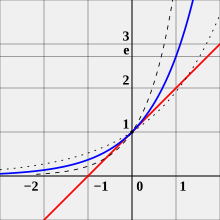
Since the exponent function integrates and differentiates "into itself", the logarithms are precisely on the basis accepted as natural .

Definition Methods
The number e can be determined in several ways.
- Over the limit:
- (second wonderful limit ).
- (this follows from the formula of Moiavre - Stirling ).
- (second wonderful limit ).
- As the sum of the series :
- or .
- As a singular for which is executed
- As the only positive number for which it is true
Properties
- The derivative of the exponent is equal to the exponent itself:
This property plays an important role in solving differential equations. So, for example, by a general solution of a differential equation are the functions where Is an arbitrary constant. - Number irrational . The proof of irrationality is elementary.
| Proof of irrationality |
|---|
| Let's pretend that rationally. Then where - the whole, and - natural. Consequently Multiplying both sides of the equation by we get We carry to the left side: All the terms on the right side are integer, therefore, the sum on the left side is integer. But this amount is positive, which means it is not less than 1. On the other hand, Summing up the geometric progression on the right side, we get: Insofar as , We get a contradiction. |
- Number transcendentally . This was first proved in 1873 by Charles Hermitage . [2] Transcendence of number follows from Lindeman's theorem .
- It is assumed that - a normal number , that is, the frequency of occurrence of different numbers in his record is the same. Currently (2017), this hypothesis has not been proved.
- The number e is a computable (and hence arithmetic ) number.
- see Euler's formula , in particular
- Number Binding Formula and , so-called Poisson integral or Gauss integral
- For any complex number z , the following equalities hold:
- The number e decomposes into an infinite continued fraction as follows (a simple proof of this decomposition related to Padé approximants is given in [3] ):
- , i.e
- {\ displaystyle e = 2 + {\ cfrac {1} {1 + {\ cfrac {1} {2 + {\ cfrac {1} {1 + {\ cfrac {1} {1 + {\ cfrac {1} { 4 + {\ cfrac {1} {1 + {\ cfrac {1} {1 + {\ cfrac {1} {6 + {\ cfrac {1} {1 + {\ cfrac {1} {1 + {\ cfrac {1} {8 + {\ cfrac {1} {1 + {\ cfrac {1} {1 + {\ cfrac {1} {10 + {\ cfrac {1} {1+ \ ldots}}}}}} }}}}}}}}}}}}}}}}}}}}}}}}}}}
- , i.e
- Or equivalent to it:
- To quickly calculate a large number of characters, it is more convenient to use another expansion:
- Catalan performance:
- Presentation through the work :
- Through bell numbers
- A measure of the irrationality of a number is equal to (which is the smallest possible value for irrational numbers). [four]
History
This number is sometimes called neperov in honor of the Scottish scientist Neper , the author of the work "Description of the amazing table of logarithms" ( 1614 ). However, this name is not entirely correct, since it has the logarithm of a number was equal .
For the first time, the constant is tacitly present in the appendix to the English translation of the aforementioned work of Napier, published in 1618 . Behind the scenes, because it contains only a table of natural logarithms determined from kinematic considerations, the constant itself is not present.
It is assumed that the author of the table was the English mathematician Otred .
The very same constant was first calculated by the Swiss mathematician Jacob Bernoulli in the course of solving the problem of the marginal value of interest income . He found that if the original amount and charged per annum once at the end of the year, the total amount will be . But if the same interest accrue twice a year, then multiplied by twice getting . Accrual of interest once a quarter leads to , and so on. Bernoulli showed that if the frequency of interest calculation is infinitely increased, then interest income in the case of compound interest has a limit : and this limit is equal to the number .
So the constant means the highest possible annual profit when per annum and the maximum frequency of interest capitalization [5] .
The first known use of this constant, where it was denoted by the letter , found in letters to Leibniz to Huygens , 1690 - 1691 .
The letter Euler began to use it in 1727 , for the first time it was found in Euler's letter to the German mathematician Goldbach dated November 25, 1731 [6] [7] , and the first publication with this letter was his work “Mechanics, or the Science of Motion, presented analytically”, 1736 year . Respectively, usually called the Euler number . Although subsequently, some scientists used the letter letter It was used more often and today is a standard designation.
In programming languages, the symbol in the exponential notation of numbers corresponds to the number 10, and not the Euler number. This is due to the history of the creation and use of the FORTRAN language for mathematical calculations [8] .
Zoom
- The number can be remembered as 2, 7 and repeating 18, 28, 18, 28. The mnemonic rule: two and seven, then two times the year of birth of Leo Tolstoy (1828), then the corners of an isosceles right triangle (45, 90 and 45 degrees). A poetic mnemophrase illustrating part of this rule: “There is a simple way for an exhibitor to remember: two and seven tenths, twice Leo Tolstoy”
- A mnemonic poem that allows you to remember the first 12 decimal places (word lengths are encoded by the digits of the number e): We fluttered and shone, / But stuck in the pass: / Our steals were not recognized / Auto rally . [ significance of fact? ]
- , with an accuracy of 0.000001;
In accordance with the theory of continued fractions, the best rational approximations of the number there will be suitable fractions of the expansion of the number into a continuous fraction.
- The number 19/7 exceeds the number e by less than 0.004;
- 87/32 exceeds e by less than 0,0005;
- The number 193/71 exceeds the number e by less than 0.00003;
- The number 1264/465 exceeds the number e by less than 0.000003;
- The number 2721/1001 exceeds the number e by less than 0.0000002;
- 87/32 exceeds e by less than 0,0005;
- The surface area of the square pyramid , in which the side faces are regular triangles with an edge length of 1 (accuracy 0.014). [ significance of fact? ]
Open Issues
- It is not known whether the number is element of the ring of periods .
- Unknown measure of irrationality for any of the following numbers: It is not even known to any of them whether it is a rational number, an algebraic irrational, or a transcendental number. Therefore, it is not known whether the numbers and algebraically independent . [9] [10] [11] [12] [13] [14] .
- It is not known whether the first number is Squuse integer.
See also
- List of objects named after Leonhard Euler
Notes
- ↑ 2 million decimal places
- ↑ Mathematical Encyclopedia. - Moscow: Soviet Encyclopedia, 1985. - V. 5. - S. 426.
- ↑ William Adkins. A Short Proof of the Simple Continued Fraction Expansion of e . arXiv . arXiv (Feb 25, 2006).
- ↑ Weisstein, Eric W. A measure of irrationality on the Wolfram MathWorld website.
- ↑ The number e . MacTutor History of Mathematics.
- ↑ Lettre XV. Euler à Goldbach, dated November 25, 1731 in: PH Fuss, ed., Correspondance Mathématique et Physique de Quelques Célèbres Géomètres du XVIII eme Siècle , vol. 1, (St. Petersburg, Russia: 1843), pp. 56-60; see page 58.
- ↑ Remmert, Reinhold. Theory of Complex Functions. - Springer-Verlag , 1991 .-- P. 136. - ISBN 0-387-97195-5 .
- ↑ Eckel B. The Philosophy of Java = Thinking in Java. - 4th ed. - SPb. : Peter, 2009. - P. 84. - (Programmer's Library). - ISBN 978-5-388-00003-3 .
- ↑ Weisstein, Eric W. The irrational number on the Wolfram MathWorld website.
- ↑ Weisstein, Eric W. Pi on the Wolfram MathWorld website.
- ↑ Sondow, Jonathan and Weisstein, Eric W. e on the Wolfram MathWorld website.
- ↑ Some unsolved problems in number theory
- ↑ Weisstein, Eric W. Transcendental number on the Wolfram MathWorld website.
- ↑ An introduction to irrationality and transcendence methods
Links
- Number e - an article from the encyclopedia "Around the World"
- Gorobets B.S. World constants in the basic laws of physics and physiology // Science and Life . - 2004. - No. 2 . (article with examples of the physical meaning of constants and )
- JJ O'Connor, EF Robertson. The history of the number e . MacTutor History of Mathematics archive . School of Mathematics and Statistics, University of St Andrews, Scotland (September 2001). (eng.)
- e for 2.71828 ... (English) (Jackson's story and rule)
- “ Exhibitor and e: Simple and Clear ” - translation of An Intuitive Guide To Exponential Functions & Number e | BetterExplained