Electrostatic potential is a scalar energy characteristic of an electrostatic field , characterizing the potential energy that a single positive test charge has placed at a given field point. The unit of measurement of potential in the International System of Units (SI) is the volt (Russian designation: V; international: V), 1 V = 1 J / C (for details on the units, see below ).
Electrostatic potential is a special term for the possible replacement of the general term of electrodynamics with scalar potential in the particular case of electrostatics (historically, the electrostatic potential appeared first, and the scalar potential of electrodynamics is its generalization). The use of the term electrostatic potential determines the presence of an electrostatic context. If such a context is already obvious, it is often said simply about potential without specifying adjectives.
The electrostatic potential is equal to the ratio of the potential energy of the interaction of the charge with the field to the magnitude of this charge:

Electrostatic field strength and potential related by [1]


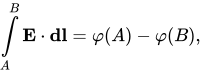
or back [2] :

Here - the operator is nabla , that is, on the right side of the equation there is a minus potential gradient - a vector with components equal to the partial derivatives of the potential with respect to the corresponding (rectangular) Cartesian coordinates, taken with the opposite sign.
 - the
- the Using this relation and the Gauss theorem for field strength It is easy to see that the electrostatic potential satisfies the Poisson equation in a vacuum. In SI units :

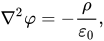
Where - electrostatic potential (in volts ), - volume charge density (in pendants per cubic meter), and - electric constant (in farad per meter).


Content
Ambiguity of potential determination
Since the potential (as well as potential energy) can be determined up to an arbitrary constant (and all the quantities that can be measured, namely the field strength, strength, work, will not change if we choose this constant one way or the other), the direct the physical meaning (at least, until we are not talking about quantum effects) has not the potential itself, but the potential difference, which is defined as:
Where:
- - potential at point 1,
- - potential at point 2,
- - work done by the field during the transfer of trial charge from point 1 to point 2.
- - potential at point 2,
In this case, it is considered that all other charges in such an operation are “frozen” —that is, stationary during this movement (I mean generally speaking an imaginary rather than a real movement, although if the other charges are really fixed — or the test charge disappears small in size — in order not to introduce noticeable perturbations into the positions of others — and is transferred quickly enough so that the remaining charges did not have time to noticeably move during this time, the formula turns out to be true for quite real work as well m moving).
However, sometimes for the removal of ambiguity they use some kind of "natural" conditions. For example, the potential is often determined so that it is zero at infinity for any point charge - and then for any finite charge system the same condition is fulfilled at infinity, and you can not think about the arbitrariness of choosing a constant (of course, you could choose instead zero is any other number, but zero is “simpler”).
Units of measure
In SI for a unit of potential difference take volt (V).
The potential difference between two points of the field is equal to one volt , if to move between them the charge in one pendant you need to do work in one joule : 1 V = 1 J / C ( L ² M T −3 I −1 ).
In the GHS, the unit of measurement of potential has not received a special name. The potential difference between two points is equal to one unit of CGSE potential, if to move between them a charge of one unit of CGS charge, it is necessary to do work in one erg .
Approximate correspondence between the quantities: 1 V = 1/300 units. CGSE potential.
Use of the term
The commonly used terms voltage and electric potential have a slightly different meaning, although they are often used incorrectly as synonymous with electrostatic potential. In the absence of varying magnetic fields, the voltage is equal to the potential difference .
Coulomb potential
Sometimes the term Coulomb potential is used simply to designate electrostatic potential as a complete synonym. However, it can be said that in general these terms differ somewhat in hue and predominant scope.
Also under the Coulomb can understand the potential of any nature (that is, not necessarily electric), which with a point or spherically symmetric source has a dependence on the distance (for example, the gravitational potential in the theory of Newton, although the latter is often referred to as Newtonian, as it was studied as a whole earlier), especially if you need to somehow identify this whole class of potentials as opposed to potentials with other dependencies on distance.
The formula of the electrostatic potential (Coulomb potential) of a point charge in vacuum:
Where marked by a coefficient depending on the system of units of measurement - for example, in SI :
- = 9 · 10 9 V · m / Kl,
- the amount of charge - distance from the source charge to the point for which the potential is calculated.
- It can be shown that this formula is valid not only for point charges, but also for any spherically symmetric charge of finite size, for example, a uniformly charged ball, but only in free space - that is, for example, above the surface of the ball, and not inside him.
- Coulomb potential in the above form is used in the formula of the Coulomb potential energy (potential energy of interaction of a system of electrostatically interacting charges):
See also
- Galvanizing potential
- Volta potential
- Vector potential of the electromagnetic field
- 4-potential
- Standard electrode potential
- Oxidation state
- Gravitational potential
- Nuclear potential
Notes
- ↑ This relation is obviously obtained from the expression for the work. where - force acting on charge from the electric field of tension . This expression for the work, in essence, is the physical meaning of the formula in the main text.
- ↑ In components (in rectangular Cartesian coordinates) this equality is painted as
-