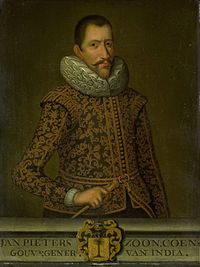
Jan Pieterszoon Coen [1] ( Jan Pieterszoon Coen ; January 8, 1587 , Horn - September 21, 1629 , Batavia ) - 4th and 6th governor of the Dutch East Indies , who managed to significantly expand the Dutch colonial possessions in the Indonesian archipelago , taking advantage of the weakening of the Portuguese Empire after the unification of the Portuguese crown with the Spanish in 1580.
| Ian Peterszone Koon | |||||||
|---|---|---|---|---|---|---|---|
| niderl. Jan Pieterszoon Coen | |||||||
 | |||||||
| Predecessor | Laurence Real | ||||||
| Successor | Peter de Carpenter | ||||||
| |||||||
| Predecessor | Peter de Carpenter | ||||||
| Successor | Jacques Specks | ||||||
| Birth | January 8, 1587 Horn ( Republic of the United Provinces ) | ||||||
| Death | September 21, 1629 (42 years old) Batavia ( Dutch East Indies ) | ||||||
| Spouse | |||||||
| Religion | Protestantism , Calvinist | ||||||
| Rank | |||||||

Biography
Kun came from a family with extremely strict Calvinist views. He studied merchantry at the Roman branch of one of the Flemish trading companies. In 1607, Kuhn accompanied Peter Verhoeff as a sales representative on his voyage to the shores of Indonesia. The expedition to the Banda Islands ended tragically for traders: Verkhuff himself and fifty of his companions died in a clash with the natives.
Upon his return to Holland, Kuhn prepared a detailed report on the state of merchant shipping in the eastern seas for the leadership of the East India Company . In 1612, he was commissioned to inspect the Spice Islands for possible rejection by the Portuguese. In 1613, he was appointed head of a trading post in Bantam in Java , and in November 1614, he was appointed director of an Asian trade company.
Thanks to Kun's energetic activities, the Dutch managed to control the spice trade in the Indonesian archipelago. For 4 years he managed to get the local rulers to provide a monopoly on the export of cloves from the Moluccas and Muscat from the Banda Islands. The Bantam Sultan tried to sell pepper bypassing the Dutch, but Kun put an end to this by moving his headquarters directly to the center of his rebellious vassal's estates - to the settlement of Jayakarta . In October 1617, Kuhn was appointed Governor General of the Dutch East Indies.
Kuhn continued to push local princes against each other, offering military and financial assistance in their conquest and defensive activities, when a new force intervened in the colonization of the East Indies - England . In 1618, English ships under the command of Thomas Dale approached Jayakarta in order to lay a British fortress there. Kun defiantly defended, realizing the lack of people and tools, as well as the danger of sinking ships with a precious load of spices.
When Kun returned to Jayakarta with reinforcements from the island of Ambon , he discovered a Dutch fort besieged by the Bantam Sultan , who in his absence ousted the British from the island. On May 30, Kun defeated the troops of the Sultan, burned Jayakarta and sent his ships in pursuit of the British. An outpost of Dutch colonialism in the East, the fortress of Batavia, was founded on the ruins of Jayakarta.
Meanwhile, in March 1620, news came to Batavia that the Dutch and British East India Companies reached an agreement on the joint development of the southern lands and the fight against enemies. Not wanting to cede the lands conquered with such labor to the British, Kuhn declared the possession of the Dutch company almost the entire territory of the island of Java. In January 1621, he landed on the Banda Islands, where, on his orders, the natives were slaughtered or enslaved. The news of Dutch atrocities on the islands reached Europe and shocked even the East India Company management.
In 1622, having established Dutch rule in Indonesia, Kun turned his eyes to the north. He intended to set up trading posts in southern China , but, convinced of the hostility and the large population there, he was satisfied with the founding of a settlement in Taiwan . For his further history, see Dutch Formosa . From here, according to Kuhn, it was possible to trade not only with China, but also with Japan (via Dejima ). Now under his control was a huge trading network, stretching from the Japanese border to Surat in western India .
In February 1623, Kun went to the Netherlands to negotiate with the company’s management regarding the future colony and to attract new settlers to Batavia. However, at the same time as Kun, the news about the Ambon massacre , organized by his subordinates on the island of Ambon, beating the rival English merchants, arrived in the metropolis. The English king blamed the death of his subjects to Kuhn himself, and in order to avoid a confrontation with his northern neighbor, he was forbidden to return to the East Indies until 1627.
Kuhn’s last trip to the East Indies is hardly a success. He arrived incognito , accompanied by his wife and several other ladies, intending to demonstrate their success to them and attract new colonists to the islands. Instead, he found himself at the center of the hostilities waged by the Sultan of Mataram against the Javanese colonists. In August 1628 and August 1629. Batavia was under siege; during the second siege, Kun died, presumably from dysentery . The Dutch maritime empire he created, however, survived it, at least in Indonesia, by nearly 350 years.
Notes
Literature
- Foskelien van Goor . Prelude to Colonialism: The Dutch in Asia . - ISBN 90-6550-806-6 .
- Oskar Hermann Khristian Spate . Monopolists and Freebooters . - ISBN 0-7099-2371-6 .
- Paul H. Kratoska . South East Asia, Colonial History . - ISBN 0-415-21540-4 .