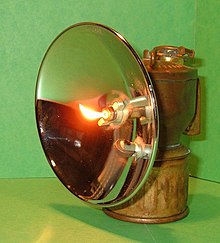
A carbide lamp is a lamp in which an acetylene flame, obtained by the chemical reaction of calcium carbide with water, serves as a light source.
This type of lamp has been widespread since the beginning of the 20th century. They were installed on carriages, cars, and even on bicycles. Nowadays, a carbide lamp is used only if you need a powerful autonomous light source, for example, speleology , on distant lighthouses, since this lighting is more advantageous than supplying a power line or an autonomous power plant. Until now, such lamps are used on ships, beacons.
Design
A carbide lamp consists of a tank (acetylene generator) and a burner. The tank is divided into two parts. In one part is carbide, in another compartment water is poured. An adjustable valve provides a metered (drip) water supply to the carbide compartment. By changing the water supply rate, the generation of acetylene and the brightness of the flashlight are regulated. The reaction proceeds according to the scheme:
The tank can be combined with a burner in a single design or connected with a flexible hose. The burner is often provided with a reflector to obtain directional light. Modern burners can be equipped with a piezoelectric element to facilitate ignition.
Carbide lamp gives a bright light of warm colors. In addition, the reaction of carbide with water is exothermic, because the tank gives a certain amount of heat suitable for heating the hands or body.
When all carbide has reacted, moist paste-like calcium hydroxide (so-called hydrated lime) remains in the tank. After cleaning the tank, it can be recharged with carbide and water.
History
In 1888 (according to other sources in 1892), Thomas Willson managed to get calcium carbide in an electric arc furnace from a mixture of calcium oxide with coke . The arc furnace provides the high temperature necessary to ensure the reaction [1] .
The process turned out to be cost-effective, and electricity available on an industrial scale made it possible to establish carbide production. Acetylene lighting began to spread since 1894. In 1895, Willson sold his Union Carbide patent [2] [3] .
Notes
- ↑ Calcium Carbide
- ↑ Morehead, JT and de Chalmot, G. The Manufacture of Calcium Carbide (Eng.) // Journal of the American Chemical Society : journal. - 1896. - Vol. 18 , no. 4 . - P. 311-331 . - DOI : 10.1021 / ja02090a001 .
- ↑ Freeman, Horace. Manufacture of Cyanamide (Neopr.) // The Chemical News and the Journal of Physical Science. - 1919 .-- T. 117 . - S. 232 .