
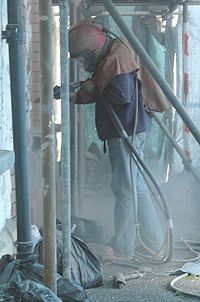
Abrasive blasting operator (sandblasting machine), a person who treats the surface with an air-abrasive jet fed through the sleeve through a nozzle under high pressure. Outwardly, the process is similar to watering a lawn or washing a car with a watering hose.
Occupation Code for OKKDTR [1]
| Code | Cc | Name of profession | Range tariff categories | Release code ETKS | Code by OKZ |
|---|---|---|---|---|---|
| 16540 | 0 | Sandblasting machine | 3-4 | 3 | 7138 |
Content
Occupational diseases
Sandblasting occupational disease is silicosis of the lungs. [2]
Personal protective equipment
The operator needs to protect the respiratory, hearing, eyes, skin. Abrasive particles accelerate to speeds of more than 650 km / h , it is necessary to provide complete operator protection. If at this speed the abrasive flow accidentally touches a person, then this can lead to serious bodily harm or even death. As personal protective equipment it is necessary to use appropriate shoes, a special sandblasting suit, leather gloves, a sandblasting helmet with a forced supply of clean air. The cost of full uniforms can be from 15,000 to 30,000 rubles, respectively, with a service life of 1 month (cheaper option) to 1 year (more expensive option). At the same time, the service life of the sandblasting mask can be extended by repair and appropriate care.
Helmet
Protecting the operator's head is a priority safety measure for blasting . When blast cleaning, operators use a helmet with forced air supply, which is made of impact-resistant plastic and rubberized outside. The air entering the helmet is cleaned of oil vapors, dust and droplets using activated carbon filters. Filter cartridges must be checked regularly and replaced as necessary. In many European countries, the use of fully head-covering helmets with air supply and positive pressure is enshrined in law. Helmets must comply with the requirements of CEN 271 Protective Respiratory Equipment [3] (1995), and must meet strict requirements to protect the eyes from abrasion, hearing from excessive noise and breathing from dust arising from blast cleaning. In Russia, most firms use a regular gas mask to save money.
To protect the organs of vision, it is important to use replaceable viewing glasses, because a rebound abrasive scratches them, which leads to poor visibility, and replacement of the glass is required.
Depending on the volume of air consumed, the material used and the place of work, the noise level can reach 110 decibels or higher. Hearing protection can be provided with ear plugs or headphones.
Costume
Protective suits or overalls, gloves and shoes are required to protect the operator from damage and must be worn even in hot or humid weather, when they can be especially uncomfortable to wear.
Abrasive Blasting Operator Technique
There are three main points to abrasive blast cleaning :
- distance to the surface;
- attack angle;
- time of processing.
Surface Distance
This is the distance from the nozzle of the abrasive blasting apparatus to the workpiece. The smaller the distance to the surface, the greater the cleaning power the system has, but the treated area will be less. Depending on the material to be removed, there is a certain correlation between cleaning power and productivity when choosing a distance to the surface. When stubborn materials such as secondary scale must be removed, the distance to the surface should be small, on the order of 30 cm. The distance to the surface can be increased to 60 cm if less coarse materials such as old paint are removed. During the initial cleaning of the surface, you must work at a distance to determine the optimal distance to achieve an effective result with the least loss of time.
Angle of attack
It is necessary to determine the optimal angle of attack - the angle of the nozzle in relation to the work surface. To remove rust, secondary scale or corrosion, the angle of attack should be 80–90 degrees, to remove old paint - 45–60 degrees, and for ordinary cleaning - 60–70 degrees. A small angle of attack avoids dust and provides better visibility. In order to better see the surface being treated in confined spaces, lighting is required. It is very important to change the direction of blasting, paying attention to the distance to the surface and the angle of inclination. When making horizontal and vertical movements, it is necessary to keep the nozzle parallel to the surface being processed, avoiding arched movements. At the same time, it is necessary to maintain an optimal angle of inclination. And finally, you should limit the distance of the nozzle in one pass on the surface to be treated during cleaning. The average distance of one passage is 75 cm. The smooth movement of the nozzle resembles the movement when working with spray guns, when there is an even surface coating.
Processing Time
Processing time is the amount of time spent cleaning a surface unit. When cleaning non-stuck, surface contaminants, the processing time of a surface unit will be minimal. When stubborn, persistent contaminants are removed, the processing time increases to several seconds. Therefore, the cleaning speed will not be the same. When cleaning uneven surfaces, it is necessary to change the distance to the surface, the angle of inclination and the processing time.
Blast cleaning is a dangerous job, which requires not only to equip and protect operators well, but also to train them well. Training in the proper use and maintenance of equipment is a key factor in the safety policy, which will prevent accidents when working with abrasive blasting machines .
See also
- Abrasive materials and abrasive treatment
- Abrasive blast nozzle
- Anticorrosion
- Blasting
- Sandblasting
- Inkjet apparatus
- Tilgman, Benjamin Chu
References to sources
- “Blasting: A Guide to High-Efficiency Abrasive Blasting” - Yekaterinburg: OOO ID Origami, 2007 - 216 pp., ISBN 978-5-9901098-1-0
- “Pocket Guide to the Anti-Corrosionist” - Yekaterinburg: OOO Origami Publishing House, 2008 - 264 pp.,
- “Guidelines for the training of inspectors on visual and measuring quality control of painting work” - Yekaterinburg: OOO Origami Publishing House, 2009—202 pp., ISBN 978-5-9901098-1-5
Notes
- ↑ ALL-RUSSIAN CLASSIFIER OF PROFESSIONS OF WORKERS, OFFICERS AND TARIFF DISCHARGES OK 016-94
- ↑ "Material quality"
- ↑ CEN / TC 271 Surface treatment equipment - Safety (link unavailable )