Black-necked Grebe [1] ( lat. Podiceps nigricollis ) is a waterfowl from the grebe family.
| Black-necked Grebe |
 |
| Scientific classification |
|---|
| No rank : | Bilateral symmetrical |
| Squad: | Grebebirds ( Podicipediformes Sharpe, 1891 ) |
|
| International scientific name |
|---|
Podiceps nigricollis
Brehm , 1831 |
| Area |
|---|

|
| Security status |
|---|
Least ConcernedIUCN 3.1 Least Concern : 22696610 |
|
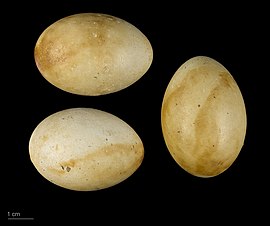
Egg
Podiceps nigricollis -
Toulouse MuseumContent
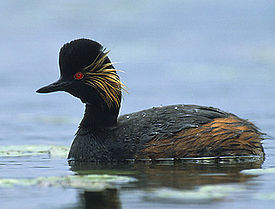
The size is slightly smaller than the red-necked grebe . The length of the body reaches 28–34 cm, weight 250–600 g. In spring and summer, the head and neck are black, behind the eyes are bundles of golden-colored feathers sticking out back and down. In winter, it features a slightly upturned dark gray beak, a gray cap that goes below eye level, and a gray neck in front. The body is black-brown above, the sides of the body are red, with dark streaks, the bottom of the body is white. In flight, the dark ends of the wings are visible.
Breeds in Europe , Central and South Asia , in most of Africa , in the south and southwest of the USA and in the north of South America . In the north of the range is a migratory bird.
Often settles with seagulls, terns and other birds. It nests in a variety of reservoirs , mainly standing, but willingly settles in river channels and backwaters. On migration occurs even on mountain rivers. At the same time, thickets of aquatic plants are mandatory in the reservoir, although this species of grebes is less attached to them than others. Does not avoid open spaces.
Spends most of the time on the water, rarely comes ashore. A swimming bird holds its neck vertically. In case of danger, she prefers to dive rather than take off, although it is much easier than other grebes to rise from the water and is able to make long flights. Of all the grebes, this species is the most public. Birds are kept in flocks during migration.
It feeds mainly on aquatic invertebrates .
Puberty occurs in the first year of life. When nesting, it usually gathers from five to six to several hundred pairs of birds in each colony, but sometimes it settles in separate pairs. It flies to central Russia in April. Both parents are involved in both nest building and egg hatching. Hatching lasts 20-22 days.
Toadstool nests are floating, occasionally located on reed flooring. They are a wet pile of dead aquatic vegetation. The shape of the nest is round or oblong. The dimensions of the nest are 16-30 cm in diameter (13-16 cm of which is the diameter of the tray), 16-45 cm in height (and only 2.5-3.5 cm are above the water, which corresponds to the depth of the tray).
The masonry consists of 3–6 whitish-greenish eggs without a pattern, measuring 39–47 by 28–32 mm. During hatching, they often turn out to be wet and dirty due to partial immersion of the nest in water. The shape of the eggs is characterized by an almost complete absence of difference between the front and rear ends.
The emerging chicks are dressed in dark fluff , with dark longitudinal stripes on their backs. After hatching, they can already swim and dive. From time to time they climb onto the mother’s back to warm themselves and relax. Parents keep with a brood in the thickets of reeds. This continues for the first eight months.
- ↑ Boehme R. L. , Flint V. E. The Bilingual Dictionary of Animal Names. Birds. Latin, Russian, English, German, French / Ed. ed. Acad. V. E. Sokolova . - M .: Rus. lang., "RUSSO", 1994. - S. 14. - 2030 copies. - ISBN 5-200-00643-0 .
- Boehme R., Dinets V., Flint V., Cherenkov A. Birds (Encyclopedia of Russian Nature). - Moscow: ABF, 1996 .-- 430 p.
- Hans-Günther Bauer, Einhard Bezzel und Wolfgang Fiedler (Hrsg): Das Kompendium der Vögel Mitteleuropas: Alles über Biologie, Gefährdung und Schutz. Band 1: Nonpasseriformes - Nichtsperlingsvögel , Aula-Verlag Wiebelsheim, Wiesbaden 2005, ISBN 3-89104-647-2
- Einhard Bezzel: Vögel. BLV Verlagsgesellschaft, München 1996, ISBN 3-405-14736-0