Siege of Sarajevo ( bosn. and Horv. Opsada Sarajeva , Serb. Opsad Sarajev ) - the siege for almost four years, the capital of Bosnia and Herzegovina, first units of the Yugoslav People's Army , and then the Army of the Republika Srpska . The siege began on April 5, 1992 and ended with the lifting of the siege on February 29, 1996, according to the Dayton Accords .
| Siege of Sarajevo | |||
|---|---|---|---|
| Main conflict: Bosnian war | |||
 Bosnian parliament after shelling | |||
| date | April 6, 1992 - February 29, 1996 | ||
| A place | Sarajevo , Bosnia and Herzegovina | ||
| Total | Dayton siege under the Dayton Accords | ||
| Opponents | |||
| |||
| Commanders | |||
| |||
| Forces of the parties | |||
| |||
| Losses | |||
| |||


Background
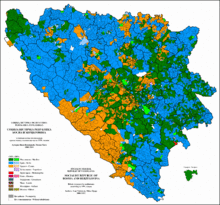
According to the last pre-war census of the population of Bosnia and Herzegovina, there were 1,905,829 Muslims (43.7%), Serbs - 1,369,258 people (31.4%), Croats - 755,892 people (17.3%). Of the 106 BiH communities, Muslims constituted the majority in 35 communities, mainly in central Bosnia, and the Serbs in 32 western and eastern communities of the republic. The Croats constituted the majority in the south of BiH and in some central communities. About 240 thousand inhabitants of BiH self-defined as “Yugoslavs”. Most of them were Serbs or children from mixed marriages. In 1991, 27% of contracted marriages were mixed. In terms of the territory occupied by the Serbs, they were ahead of other Bosnian peoples. They represented the absolute majority of the population in 53.3% of the territory of BiH [10] .
On November 18, 1990, the first multi-party elections were held in the republic. The majority of seats in the Assembly (86) were won by the Muslim Party for Democratic Action, followed by the Serb Democratic Party (72) and the local Croatian Democratic Union (44). The election results demonstrated a clear division along national lines long before the outbreak of hostilities [11] .
After the election, a coalition leadership was formed, representing all three national parties. The leader of the traffic rules Izetbegovic became chairman of the Presidium of BiH. Croatian Jure Pelivan became Prime Minister. The speaker of the Assembly became a Serb Momchilo Kraišnik. However, the cooperation of parties in the government and parliament was not achieved. Already at the first meeting of the Assembly, the deputies were divided along ethnic lines, and then the Muslim-Croat coalition began to take shape. She submitted for discussion the Declaration of Independence of the Republic, and the Serbian Democratic Party, in response, began to unite communities with the majority of the Serbian population [12] .
On October 12, the Parliament of Bosnia and Herzegovina without the knowledge of the Serbian deputies adopted the “Memorandum on the sovereignty of Bosnia and Herzegovina” by a simple majority of votes [13] [14] . Serbs and Croats in BiH were defined as national minorities [15] . This gave impetus to the autonomy of the Serbian regions. A Bosnian Serb Assembly met and a plebiscite was held, on which on November 9, 1991, the Serbs spoke in favor of unification with Serbian Krajina, Serbia and Montenegro, that is, for the creation of a renewed Yugoslav state. The leadership of Bosnia called the Serbian plebiscite illegal and insisted on an independent and unitary country. However, at the same time about creating your own state. Education - Herceg-Bosnian expressed Bosnian Croats, which deepened the process of territorial demarcation in the republic [16] .
On January 9, 1992, the Bosnian Serb Assembly proclaimed the creation of the Republika Srpska Bosnia and Herzegovina as a federal unit of the SFRY. On March 24, the Serbs formed a government, a parliament and a presidium. On March 27, the Constitution of the Republic of Srpska was adopted. At the same time they put forward a proposal to reform Bosnia and Herzegovina into a confederative republic of three equal peoples [17] .
On January 25, 1992, the BiH Assembly decided to hold a referendum on the sovereignty and independence of the republic. The Serb faction in the Assembly left the courtroom in protest. The referendum was held on March 1, 1992, 63.4% of voters (2 073 932 people) voted on it, of which 62.68% voted for independence. On the same day, sovereignty was proclaimed by the BiH authorities, a request for recognition was sent to the EU [18] .
According to the 1991 census, 527,049 people lived in Sarajevo. Of these, Bosnian Muslims accounted for 49.2%, Serbs - 29.8%, Yugoslavs - 10.7%, Croats - 6.6% [19] .
Forces and positions of the parties
Serbs
Bosnian Serb detachments were originally built on the basis of units of the Republican Territorial Defense. In the settlements, where the Serbs constituted the majority, the Serbian Democratic Party took control of THAT, creating the so-called “Crisis Headquarters” [2] . After the withdrawal of the Yugoslav People's Army from Bosnia, part of its weapons was transferred to the Republika Srpska. Those soldiers of the JNA, who were called up from Bosnia and Herzegovina and were Serbs by nationality, remained to serve in the ranks of the then-created troops of the Republika Srpska [2] [20] .
The base of the Bosnian Serb army in the Sarajevo region was the Sarajevo-Romaniy Corps [4] , which was formed on the orders of the Main Staff of the VRS on May 22, 1992 on the basis of units of the former 4th Corps of the 2nd Military Region JNA [21] . It numbered 15,000 men, up to 80 tanks, 72 artillery guns, 12 rocket launchers, several hundred mortars [2] [3] . At the beginning of the combat path, the corps was headed by Major General Tomislav Shipchich. September 10, 1992, he was replaced by Colonel Stanislav Galich, promoted to major general [3] . On August 10, the corps was headed by General Dragomir Milosevic.
Russian volunteer units fought in the Serb forces in the Sarajevo area [1] . RDO-2 fought in the spring - summer of 1993 [22] , RDO-3 - from autumn 1993 to September 1994 [22] , and then the Russians, Ukrainian and other volunteers continued to participate in hostilities as part of the shock unit of the Sarajevo-Romanian corps White Wolves ” [22] .
According to UN experts, the lack of personnel forced the Bosnian Serbs to choose tactics to weaken the city’s defense by constant shelling from the surrounding mountains and hills [23] .
In Sarajevo and its suburbs, the Serbs controlled parts of nine communities with a predominantly Serbian population — Ilidzha, Ilijash, Hadžić, Rajlovac, Vohošća, Stari Grad, Centar, Novo-Sarajevo and Trnovo. This part of the city was called “Serbian Sarajevo”, it was home to about 120,000 people [24] [25] .
Muslims and Croats
The armed forces of Muslims and Croats in Sarajevo at the beginning of the fighting were represented by units of the “Patriotic League” (10,000 people [2] ) and the formations of the Territorial Defense under their control and those forces of the republican Ministry of Internal Affairs, which consisted of Muslims and Croats. The Croats who lived in the city formed their brigade called "King Tvrtko" , which in the fall of 1993 became part of the 1st Corps of the Muslim Army [2] . At the same time, according to Western researchers, after the outbreak of the Muslim-Croat conflict in 1992, Croatian forces in the vicinity of Sarajevo collaborated with the Serbs and fought against the Muslim army [26] .
From the beginning of the fighting until August 1992, Muslim forces in the city were organized into several brigades organized according to the territorial principle [27] . In August, government-controlled forces in Sarajevo were reorganized. On the territory of the capital of the Bosnian Muslims, they were organized in the 1st Corps, which includes infantry, motorized and mountain brigades. During the existence of the corps, they were commanded by Mustafa Khayrulakhovich, Brigadier General Vahid Karavelich and Brigadier Nejad Ainajic [1] . The corps numbered from 34,500 [5] [6] to 40,500 people [5] [6] with a small amount of heavy weapons [5] .
According to Serbian data, the Muslim-Croat forces in Sarajevo were armed with 108 anti-aircraft machine guns of 12.7-mm and 14.5-mm caliber, 48 anti-aircraft guns of 20-mm caliber, 16 guns of 30-mm caliber, 14 guns of 37-mm caliber , 18 40-mm guns, 83 60-mm mortars, 51 82-mm mortars, 38 120-mm mortars, 8 122-m howitzers, 18 105-mm howitzers, 11 armored personnel carriers, 3 tanks, 14 ZIS guns, 12 mountain ones guns, 108 Stinger and Strela-2M MANPADS [28] .
Up until the fall of 1993, several paramilitary criminal groups headed by pre-war criminal leaders fought in the ranks of the Muslim army in Sarajevo. They terrorized the civilian population and participated in smuggling with the Serbian side. These groups were liquidated by the Muslim army in October 1993 [2] [23] [29] .
Chronology of the siege
1992
On March 1, 1992, on the last day of the referendum on the independence of the republic, in the center of Sarajevo, in front of the Orthodox Church, a group of armed Muslims led by criminal leader Ramiz Delalich shot a Serbian wedding , killing the father of the fiance Nikolai Gardovich and injuring priest Radenko Mikovic [2] [30] [31 ] ] . There is a version according to which the attack provoked the presence of the Serbian national flag at the wedding procession [32] . The Serbs put a number of barricades in the city, making demands to conduct an investigation and punish those responsible. They perceived this event as the beginning of anti-Serb actions [33] . Bosnian Muslims also put barricades in the city. In the shootings that occurred on both sides, four people were killed [2] . Serbian and Muslim politicians have called for a peaceful dialogue. The Republican Interior Ministry conducted an investigation that identified the perpetrator of the attack on the wedding. He was the famous Sarajevo bandit Ramiz “Chelo” Delalich, associated with the militant wing of the Muslim Party for Democratic Action Aliya Izetbegovic. However, Delalich was not brought to justice for the attack [2] . The shooting of the wedding coincided with the referendum on the independence of BiH, which was negatively perceived by the Bosnian Serbs who wanted to remain in Yugoslavia. Because of this, the Serbian barricades in Sarajevo were perceived by Muslims as a demonstration of power by the Serbs [2] .
In March, Muslims launched a sniper war against Serbs and JNA officers. On March 12, they attempted to block the headquarters of the 2nd Military Region in Bistrika, and on March 23 the first attack occurred. On April 4–5, battles were fought between the Serbs and the Muslims, employees of the republican Ministry of the Interior [34] [35] . Serb policemen attacked police stations and the Interior Ministry School. At the same time two Muslim policemen and one civilian were killed. The state of emergency was declared the next day in Bosnia and Herzegovina. [36] To separate the conflicting parties, the JNA command involved a battalion of the 49th mechanized brigade. As a result of the intervention of the army, the battle stopped, but Muslims accused the federal army of aggression [2] . On April 6, unidentified persons fired at a peaceful demonstration outside the Holiday Inn hotel, which houses the Serbian Democratic Party. Suada Dilberovich and Olga Suchic died [35] . Muslims accused Serbian snipers of shelling and broke into the hotel building, arresting six people who were considered snipers, and defeating the headquarters of the SDP in the hotel [2] . Radovan Karadzic later denied that the Serbian side was involved in the shooting and claimed that the demonstration was fired from other buildings, and not from the roof of the hotel [37] . On 11 April, the political parties of BiH, including the SDP, signed the Declaration of United Sarajevo [35] . On April 12, at the Peace Conference in Lisbon, the Serbian delegation offered Aliya Izetbegovic negotiations on a full cease-fire, especially in Sarajevo. The agreement was signed on April 13 with the participation of international mediators, but was not executed by the Muslim side [38] [39] . On April 22, Muslim artillery bombarded the Serbian suburb, Ilidzhu [40] . In response, Serbian artillery attacked Butmir, Khrasnitsa and Sokolovic-Colonies [41] . On April 30, the Yugoslav Army was proclaimed occupation [35] .
On May 2 - 3, the formation of Bosnian Muslims launched a general attack on the Yugoslav army in Sarajevo, which suffered heavy losses during the attacks. Army objects and patrols were attacked. On May 3, contrary to the agreements between the army command and the government of BiH, Muslim forces attacked a convoy in which the headquarters of the 2nd Military Region was evacuated [2] .
On May 16, members of Muslim paramilitary groups massacred Pofalichi , a suburb of Sarajevo inhabited mainly by Serbs and the former under the control of Muslim groups. Back in April, they set up checkpoints in Pofalici, which prohibited the passage of the Serbs. As a result of the attack on May 16, the number of victims amounted to 200 people [42] , 3000 Serbs fled from the Pofalic [43] . Those who did not have time to escape, fell into the camps, where they were later killed [44] . 500 Serb-owned houses were burned [45] .
On May 27, in the center of Sarajevo, an explosion occurred on Vasa Miskin Street , as a result of which, according to various sources, from 16 to 19 [35] people died, 157 were injured [46] . The organizers remained unknown, according to the Serbian side, the incident was not investigated, but the UN Security Council considered the Serbian responsible and adopted a resolution imposing sanctions against the FRY and expanding the UNPROFOR mandate to Bosnia and Herzegovina [47] .
On June 8, Muslim detachments made the first attempt to de-blockade the city. At the same time, they attacked four heights dominating the center of the city: the Moimilos Range in the south-west, the Vrače and Vidikovac hills in the southeast, and the Жuč mountain in the north-west [3] . Thanks to the surprise of the attack, they managed to capture them, but with the support of massive artillery fire, the Serbs launched a counter-offensive. As a result, only the Moimilos remained behind the Muslims, covering the south-western part of the city from sniper fire [2] [3] . On June 15, UN Secretary General Boutros Boutros-Ghali reported that Muslims use their artillery "to expand the territory they control, while Bosnian Serb forces continued to use their own artillery to bombard the city of Sarajevo." In June, the Serbs transferred the city’s airport to the control of UN peacekeepers [48] . On June 29, the UN flag was hoisted above it and the first plane landed, carrying humanitarian aid. However, due to the fighting near the airport, it was periodically closed and opened only after negotiations [49] .
August 23 as a result of a mortar attack in the city killed 22 people, about 100 were injured. On September 14, another heavy shelling occurred, about 20 people were killed and injured. During the shelling and urban battles from October 29 to October 31 , 31 people died, 118 were injured [23] .
In early December, the sides launched a series of offensives. The Serbs attacked the western suburbs of Sarajevo: Otes and Stup, who defended HVO and ARBiG. By December 6, the Serbs managed to press the Muslim-Croat units a little, but on December 7 the Muslims began the offensive. Its objectives were the heights dominating the center of the city: Zhuch hill in the north-west and part of Mount Trebevich in the south-east. Despite significant losses and the absence of artillery support, Muslims managed to occupy most of the Bug and the height of Vidikovac on Mount Trebevich. The Serbs were able to recapture Trebevich, but the ARBiH fighters entrenched themselves on Zhuche, which deprived the RS army of the opportunity to attack the northern regions of Sarajevo [2] [50] .
1993
In February — March 1993, the Serbs launched an offensive against Azichi and Stup. Azichi came under their control, but Stup remained for the Muslims [2] .
In early July, the Sarajevo-Romaniy and Herzegovina corps of the Bosnian Serb army launched a large-scale operation in the Trnov region. Its objectives were to expand the corridor linking Herzegovina with the rest of the Republika Srpska, liquidate the corridor between the Muslim enclave in Gorazd and other Muslim territories and possibly take control of Mount Igman, in which case Sarajevo would be completely surrounded. The strike force of the Serbian forces numbered up to 10,000 fighters. They were opposed by the same number of soldiers of the Muslim army. During the fierce battles, the Bosnian Serbs achieved their goals. The mountains Igman and Belashnitsa also passed under the control of the Serbian troops [51] . However, under pressure from Western diplomats threatening to be bombed by NATO, Karadzic agreed to withdraw Serb forces from these mountains and deploy UN peacekeepers there [2] [52] .
In September, the command of the ARBiG increased the pressure on the Croatian brigade "King Tvrtko" of 1,500 men under the command of Shalko Zelic. The brigade held a front two kilometers along the northern bank of the river Milakka and was part of the Croatian Defense Council. The Muslim generals demanded that the brigade surrender their weapons and join the Muslim 1st Corps. Zelich refused, the looming conflict prevented Aliya Izetbegovich's intervention.
In late October, the Muslim army conducted an operation "Trebiewicz-1", directed against the criminal field commanders "Chelo" Delalich and "Tsatso" Topalovich. For a long time, the authorities turned a blind eye to their crimes, but the new commander Rasim Delić sought to strengthen discipline, which provided for the elimination of the paramilitary gangs. The operation began on October 26, about 3,000 soldiers and policemen were involved in it [53] . Mushan Topalovich managed to capture and execute several Special Forces soldiers, but was then captured. Ramiz Delalich took 25 civilians hostage, but later released them and surrendered. In total, about 20 people died during the operation, among them 6 were civilians [2] . In parallel with the attack on the leaders of the gangs, an operation "Trebevich-2" was carried out against the brigade "King Tvrtko". Her command was arrested, and the brigade disarmed and disbanded. On November 6, the Muslim command appointed a brigade of a loyal self-commander - Nedelko Veraya, and included a brigade in the 1st Corps. Only half of the fighters remained from its initial composition [2] .
1994
On February 5, a 120-mm artillery mine exploded on the Marcal market. 68 people were killed and 144 were injured. After the tragedy, NATO presented an ultimatum to the Bosnian Serbs, stating the possibility of air strikes in the event that the Serbs did not remove their heavy weapons from the Sarajevo area. The resulting crisis eventually led to concessions to the Serbs, and the NATO military operation did not take place.
On September 18, Muslims launched an unexpected attack from the side of Grdoni on the suburb of Sedrenik to the north-east of the city. They managed to press the Serbs, but by September 20, they returned most of the lost positions [2] .
1995
On August 28, 1995, a series of explosions occurred on the Marcal market, caused by the fall of five artillery mines. 37 people were killed, 90 were injured. Again, the demand was made for the withdrawal of heavy Serb weapons from under Sarajevo; when the demand was ignored, on 30 August, the NATO bloc launched a military operation entitled “Power of Thought” , consisting of aerial bombardment and shelling of positions of the Bosnian Serb army.
Humanitarian situation in the city during the siege
During the siege, an extremely tense humanitarian situation developed in the city. On July 9, 1993, the UN Commissioner for Refugees Sadako Ogata noted that in Sarajevo more than 300,000 people were on the verge of life and death, and the threat to life was not only from the Serbian attacks, but also from hunger and disease [54] . The city took place the robbery of apartments, their unauthorized seizure. In particular, the apartment was occupied by the famous film director Emir Kusturica, who left Sarajevo [55] . The population of the city also suffered from a shortage of water and electricity, the supply of which was restored by the engineers of the communication services of the UN peacekeepers. Thousands of tons of food, medicine, clothing, fuel, and building materials were delivered to the city by peacekeepers [56] .
By order of the government, only old people and children in convoys organized by the UN could leave the city. Lists for departure were compiled by the authorities, and convoys were often postponed or did not go. The able-bodied population of the city had to perform labor service or serve in the Muslim army [57] . At the same time, Serbs and Croats were forbidden to leave the city [58] .
The city was fired daily by Serbian artillery. The shelling of Sarajevo continued from spring 1992 to February 1994 and caused great damage to the city [59] . The city produced an average of 329 shells per day, the maximum number (3,777 shells) was released on July 22, 1993. According to the estimates of the Government of Bosnia and Herzegovina, over 10,000 apartments were destroyed and over 100,000 more were damaged. Kosevo hospital, media editorial offices, public transportation facilities, parliament and government buildings, a brewery, a mill and a bakery, sports and industrial facilities, shopping centers, etc. were the most frequently shelled. [60] About 10,000 citizens died or went missing during the siege including over 1500 children. Parks and stadiums were turned into cemeteries. 56,000 citizens were injured, including nearly 15,000 children [61] .
Viktor Andreev, a delegate to the Special Representative of the UN Secretary-General in Sarajevo, recalled that the city was constantly subjected to mortar and artillery shelling, the gas supply was cut off, food disappeared from the shops. At the same time, the Bosnian leadership forbade residents to leave the city [62] .
Sarajevo Tunnel
In 1993, a tunnel ( Bosn. Tunel spasa ) with a length of 760 meters was secretly dug. The construction of the tunnel was completed on June 30 when the two tunnels met in the middle, the use of the tunnel began the next day on July 1. The tunnel was used to supply the Bosnian armed forces, including food, fuel, newspapers and weapons, up to 30 tons [63] daily. Every day, up to 4,000 Bosnian, UN soldiers (as well as civilians) could pass through the tunnel. [64] . Both entrances were guarded by Bosnian troops. Subsequently, the railways were laid and small cars with a capacity of 400 kg were used. The final tunnel had lighting, groundwater pumping, an oil pipeline and a 12 MW cable.
War victims and crimes against civilians
Losses and casualties of Bosnian Muslims and Croats
The loss of Bosnian Muslims during the siege of the city amounted to 6110 soldiers and 3389 civilians [7] [8] . Bosnian Croat losses were 67 soldiers and 682 civilians [7] [8] .
During the siege of Sarajevo, the Serbian military and paramilitary forces committed a number of crimes against the civilian population. These crimes appeared as charges at the trials of the International Tribunal for the Former Yugoslavia against the Serbian generals Stanislav Galic and Dragomir Milosevic. In addition to them, Veselin Vlahovic was convicted of Bosnian court for crimes against Muslims and Croats in Sarajevo [65] . According to Professor Smail Chekich, the Serbian genocide of the non-Serb population took place in Sarajevo [66] . The International Tribunal charged General Ratko Mladić with subordinate Serb forces occupying the highlands around the city firing on Sarajevo, including using sniper fire, purposefully killing, wounding and terrorizing the civilian population [67] .
Bosnian Serb casualties and casualties
On the Serb side, 2,229 Serbian soldiers and 1,368 civilians were killed in the battles for Sarajevo and its suburbs [7] [8] .
In the city, 10 to 15 armed groups acted against the Serbs, which, in the opinion of the Russian Yugoslav historian and Serbian senator Elena Guskova , later turned into gangs. In addition to fighting, they were engaged in robbery. Among the leaders of such units was Yusuf "Yuka" Prazin [68] , the pre-war criminal authority [69] [70] [71] [72] . Guskova claims that they themselves created from 10 to 20 private prisons [73] .
According to the independent Bosnian newspaper Dani, during the siege of the city, several hundred Serbs in the city were killed because of their ethnic origin. After the war, about 400 Serb bodies were exhumed, however, according to the Muslim side, among them were those who died of natural causes or Serb attacks [74] . Mirko Pejanovic, Chairman of the Serbian Civil Council of Bosnia and Herzegovina, noted that out of almost 12,000 victims in Sarajevo, a quarter of the victims were Serbs. According to him, the situation of the Serbs in the city improved after the regular Muslim army conducted an operation to combat criminal squads in their ranks, as a result of which the gang of Mushan Topalovic, who committed crimes against the civilian population, was destroyed [75] . According to the President of the Republic of Serbian Milorad Dodik , during the war years, 150,000 Serbs were forced to flee from Sarajevo and the surrounding area [9] .
For the execution of the Serbs, the Military Court of the District of Sarajevo in December 1994 convicted 14 people. [76]
In 1997, the independent Sarai newspaper Dani began publishing the first court records of the killings of Sarajevo Serbs during the war and the torture carried out by soldiers of the 10th Mountain Brigade under the command of Mushan "Tsatso" Topalovich [77] [78] . The bodies of the dead were found in the Kazan mine [79] .
In addition to private prisons in Sarajevo, there were government prisons and camps for Serbs. According to the Bosnian prosecutor’s office, both prisoners of war and civilians were sent to them [80] . Among them are the county prison in the converted JNA Victor Buban barracks [81] and the Silos camp . The Silo contained not only the Serbs. According to the recollections of the former prisoners of the camp from among the members of the Croatian defensive forces, they were sent to Silos for refusing to participate in the assassinations of Serbs [82] , and according to the Serbian side, the highest political leadership of the Bosnian Muslims [83] was aware of the existence of the camp.
See also
- Sarajevo roses
- Sarajevo tunnel
Notes
- ↑ 1 2 3 4 5 Dr N Thomas & K Mikulan. The Yugoslav Wars (2). Bosnia, Kosovo and Macedonia 1992-2001. - Osprey publishing. - P. 8. - ISBN 1-84176-964-9 .
- ↑ 1 2 3 4 5 6 7 8 9 10 11 12 13 14 15 16 17 18 19 20 21 22 23 Essays on the military history of the conflict in Yugoslavia (1991-1995) . ArtOfWar. The date of circulation is March 30, 2013. Archived April 5, 2013.
- ↑ 1 2 3 4 5 David C. Isby. Balkan Battlegrounds: A Military History of the Yugoslav Conflict, 1990-1995 . - Washington: Diane Publishing Company, 2003. - Vol. 1. - P. 153. - ISBN 978-0-7567-2930-1 .
- 2 1 2 3 Dr N Thomas & K Mikulan. The Yugoslav Wars (2). Bosnia, Kosovo and Macedonia 1992-2001. - Osprey publishing. - P. 14. - ISBN 1-84176-964-9 .
- ↑ 1 2 3 4 5 Prvi korpus Armije R BiH (Serb.) . The date of circulation is March 30, 2013. Archived May 11, 2013.
- ↑ 1 2 3 4 Formiran Prvi korpus Armije RBiH (Serb.) . The date of circulation is March 30, 2013. Archived May 11, 2013.
- ↑ 1 2 3 4 5 6 7 8 9 Činjenice ruše stereotipe o Srbima (Serb.) . Politics. The date of circulation is March 30, 2013. Archived May 11, 2013.
- ↑ 1 2 3 4 5 6 7 8 9 Ljudski gubici u Bosni i Hercegovini 91–95. - Sarajevo: Informaciono dokumentacioni centar. - p. 16.
- ↑ 1 2 Dodik: Fashizam oterao Srbe from Sarajev (Serb.) . The date of circulation is March 30, 2013. Archived May 11, 2013.
- ↑ Yugoslavia in the 20th century: political history essays / K. V. Nikiforov (ed.), A. I. Filimonova, A. L. Shemyakin, etc. - M .: Indrik, 2011. - P. 805. - ISBN 9785916741216 .
- ↑ Yugoslavia in the 20th Century: Essays on Political History / K. V. Nikiforov (otv. Ed.), A. I. Filimonova, A. L. Shemyakin, etc. - M .: Indrik, 2011. - P. 806. - ISBN 9785916741216 .
- ↑ Yugoslavia in the 20th Century: Essays on Political History / K. V. Nikiforov (otv. Ed.), A. I. Filimonova, A. L. Shemyakin, etc. - M .: Indrik, 2011. - P. 806. - ISBN 9785916741216 .
- ↑ Trbovich, Ana S. A Legal Geography of Yugoslavia's Disintegration . - Oxford University Press, 2008. - P. 221. - ISBN 9780195333435 .
- ↑ Cook, Bernard A. Europe Since 1945 . - Taylor and Francis, 2001. - P. 140. - ISBN 9780815340577 .
- ↑ Yugoslavia in the 20th Century: Essays on Political History / K. V. Nikiforov (otv. Ed.), A. I. Filimonova, A. L. Shemyakin, etc. - M .: Indrik, 2011. - P. 806. - ISBN 9785916741216 .
- ↑ Yugoslavia in the 20th century: political history essays / K. V. Nikiforov (ed.), A.I. Filimonova, A.L. Shemyakin, etc. - M .: Indrik, 2011. - P. 807. - ISBN 9785916741216 .
- ↑ Yugoslavia in the 20th century: political history essays / K. V. Nikiforov (ed.), A.I. Filimonova, A.L. Shemyakin, etc. - M .: Indrik, 2011. - P. 807. - ISBN 9785916741216 .
- ↑ Yugoslavia in the 20th century: political history essays / K. V. Nikiforov (ed.), A.I. Filimonova, A.L. Shemyakin, etc. - M .: Indrik, 2011. - P. 807. - ISBN 9785916741216 .
- Nic Ethnic composition of Bosnia-Herzegovina population, by municipalities, 1991. census, Zavod za statistiku Bosne i Hercegovine - Bilten no.234, Sarajevo 1991
- ↑ Dr N Thomas & K Mikulan. The Yugoslav Wars (2). Bosnia, Kosovo and Macedonia 1992-2001. - Osprey publishing. - P. 12. - ISBN 1-84176-964-9 .
- ↑ Dr N Thomas & K Mikulan. The Yugoslav Wars (2). Bosnia, Kosovo and Macedonia 1992-2001. - Osprey publishing. - P. 12. - ISBN 1-84176-964-9 .
- ↑ 1 2 3 Who are they? Volunteers . Srpska.ru. The date of circulation is September 26, 2012. Archived November 1, 2012.
- 2 1 2 3 Study of the battle and siege of Sarajevo - part 1/10 (English) (inaccessible link) . The appeal date is March 18, 2014. Archived March 2, 2014.
- ↑ Guskova E. Yu. The History of the Yugoslav Crisis (1990-2000). - M .: Russian law / Russian National Fund, 2001. - P. 269. - ISBN 5941910037 .
- ↑ Yugoslavia in the 20th century: political history essays / K. V. Nikiforov (ed.), A. I. Filimonova, A. L. Shemyakin, et al. - M .: Indrik, 2011. - P. 813. - ISBN 9785916741216 .
- ↑ Dr N Thomas & K Mikulan. The Yugoslav Wars (2). Bosnia, Kosovo and Macedonia 1992-2001. - Osprey publishing. - P. 20. - ISBN 1-84176-964-9 .
- ↑ Dr N Thomas & K Mikulan. The Yugoslav Wars (2). Bosnia, Kosovo and Macedonia 1992-2001. - Osprey publishing. - P. 7. - ISBN 1-84176-964-9 .
- ↑ Bulatovich Lilyana. Serbian General Mladic. The fate of the Defender of the Fatherland .. - Moscow: IPPK "IHTIOS", 2013. - p. 445. - ISBN 978-5-8402-0348-3 .
- ↑ Dr N Thomas & K Mikulan. The Yugoslav Wars (2). Bosnia, Kosovo and Macedonia 1992-2001. - Osprey publishing. - P. 24. - ISBN 1-84176-964-9 .
- ↑ Yugoslavia in the 20th century: political history essays / K. V. Nikiforov (ed.), A.I. Filimonova, A.L. Shemyakin, etc. - M .: Indrik, 2011. - P. 807. - ISBN 9785916741216 .
- ↑ Guskova E.Yu. History of the Yugoslav crisis (1990-2000). - M .: Russian law / Russian National Fund, 2001. - P. 233. - ISBN 5941910037 .
- ↑ Susan L. Woodward. Balkan tragedy: chaos and dissolution after the Cold War . - Washington, DC: The Brookings Institution, 1995. - p. 280. - ISBN 0-8157-9513-0 .
- ↑ Guskova E.Yu. History of the Yugoslav crisis (1990-2000). - M .: Russian law / Russian National Fund, 2001. - P. 233. - ISBN 5941910037 .
- ↑ David C. Isby. Balkan Battlegrounds: A Military History of the Yugoslav Conflict, 1990-1995 . - Washington: Diane Publishing Company, 2003. - Vol. 1. - P. 152. - ISBN 978-0-7567-2930-1 .
- ↑ 1 2 3 4 5 Hronologija opsade (Serb.) (Not available link) . The appeal date is April 30, 2013. Archived May 11, 2013.
- ↑ Nizich, Ivana. War Crimes in Bosnia-Hercegovina. - Helsinki Watch, 1992. - P. 18–20. - ISBN 1-56432-083-9 .
- ↑ Guskova E. Yu. The History of the Yugoslav Crisis (1990-2000). - M .: Russian law / Russian National Fund, 2001. - P. 244. - ISBN 5941910037 .
- ↑ Guskova E. Yu. The History of the Yugoslav Crisis (1990-2000). - M .: Russian Law / Russian National Fund, 2001. - P. 250. - ISBN 5941910037 .
- ↑ Yugoslavia in the 20th century: political history essays / K. V. Nikiforov (otv. Ed.), A. I. Filimonova, A. L. Shemyakin and others. - M .: Indrik, 2011. - p. 811. - ISBN 9785916741216 .
- ↑ Yugoslavia in the 20th century: political history essays / K. V. Nikiforov (ed.), A. I. Filimonova, A. L. Shemyakin, et al. - M .: Indrik, 2011. - P. 810. - ISBN 9785916741216 .
- ↑ Guskova E. Yu. The History of the Yugoslav Crisis (1990-2000). - M .: Russian law / Russian National Fund, 2001. - P. 249. - ISBN 5941910037 .
- ↑ Leševi sa Pofalića završili na deponiji (Serbian) . The appeal date is April 30, 2013. Archived May 11, 2013.
- ↑ Tuševljak: Zločin u Pofalićima jedno od prvih etničkih čišenja Srba (Serbian) . The appeal date is April 30, 2013. Archived May 11, 2013.
- ↑ Još se čeka optužnica za zločin nad Srbima u Pofalićima 1992 (serb.) (Not available link) . The appeal date is April 30, 2013. Archived May 11, 2013.
- ↑ Đerić: Još nema optužnica za zločine u Pofalićima (serb.) (Not available link) . The appeal date is April 30, 2013. Archived May 11, 2013.
- ↑ Vremeplov: Eksplodirale granate u Ulici Vase Miskina u Sarajevu (Serbian) . The appeal date is April 30, 2013. Archived May 11, 2013.
- ↑ Yugoslavia in the 20th century: political history essays / K. V. Nikiforov (otv. Ed.), A. I. Filimonova, A. L. Shemyakin and others. - M .: Indrik, 2011. - p. 811. - ISBN 9785916741216 .
- ↑ Dr N Thomas & K Mikulan. The Yugoslav Wars (2). Bosnia, Kosovo and Macedonia 1992-2001. - Osprey publishing. - P. 23. - ISBN 1-84176-964-9 .
- ↑ Guskova E. Yu. The History of the Yugoslav Crisis (1990-2000). - M .: Russian Law / Russian National Fund, 2001. - P. 290. - ISBN 5941910037 .
- ↑ David C. Isby. Balkan Battlegrounds: A Military History of the Yugoslav Conflict, 1990-1995 . - Washington: Diane Publishing Company, 2003. - Vol. 1. - P. 154. - ISBN 978-0-7567-2930-1 .
- ↑ Dr N Thomas & K Mikulan. The Yugoslav Wars (2). Bosnia, Kosovo and Macedonia 1992-2001. - Osprey publishing. - P. 24. - ISBN 1-84176-964-9 .
- ↑ Dr N Thomas & K Mikulan. The Yugoslav Wars (2). Bosnia, Kosovo and Macedonia 1992-2001. - Osprey publishing. - P. 24. - ISBN 1-84176-964-9 .
- ↑ Dr N Thomas & K Mikulan. The Yugoslav Wars (2). Bosnia, Kosovo and Macedonia 1992-2001. - Osprey publishing. - P. 24. - ISBN 1-84176-964-9 .
- ↑ Guskova E.Yu. History of the Yugoslav crisis (1990-2000). - M .: Russian law / Russian National Fund, 2001. - P. 255. - ISBN 5941910037 .
- ↑ Guskova E.Yu. History of the Yugoslav crisis (1990-2000). - Moscow : Russian Law / Russian National Fund, 2001. - P. 263. - ISBN 5941910037 .
- ↑ Guskova E.Yu. History of the Yugoslav crisis (1990-2000). - M .: Russian law / Russian National Fund, 2001. - P. 264. - ISBN 5941910037 .
- ↑ Guskova E.Yu. History of the Yugoslav crisis (1990-2000). - Moscow : Russian Law / Russian National Fund, 2001. - P. 263. - ISBN 5941910037 .
- ↑ Guskova E.Yu. History of the Yugoslav crisis (1990-2000). - M .: Russian law / Russian National Fund, 2001. - P. 288. - ISBN 5941910037 .
- ↑ Yugoslavia in the 20th century: political history essays / K. V. Nikiforov (otv. Ed.), A. I. Filimonova, A. L. Shemyakin, etc. - M .: Indrik, 2011. - P. 813. - ISBN 9785916741216 .
- ↑ The battle and siege of Sarajevo
- Ant Final report of the resolution 780 (1992) Annex VI - part 1 of the Sarajevo (not found (not available link) . The appeal date is November 19, 2011. Archived March 2, 2014.
- ↑ Our peacekeepers in the Balkans / Guskova, E.Yu .. - Moscow: Indrik, 2007. - P. 17. - ISBN 5-85759-397-2 .
- What to do in the Muslim East in the center of Europe: World: Travel: Lenta.ru
- ↑ The Sarajevo Tunnel
- ↑ Bosnia jails Serb Veselin Vlahovic for war crimes
- ↑ CRIME OF GENOCIDE IN SARAJEVO UNDER SIEGE
- ↑ THE PROSECUTOR OF THE TRIBUNAL AGAINST RATKO MLADIC
- ↑ Guskova E. Yu. The History of the Yugoslav Crisis (1990-2000). - M .: Russian law / Russian National Fund, 2001. - P. 259. - ISBN 5941910037 .
- ↑ Juka Prazina 1992. pucao na mitingaše (Serb.) . The appeal date is April 30, 2013. Archived May 11, 2013.
- ↑ January 10, 1994 Vreme News Digest Agency No 120 (eng.) . ArtOfWar. The date of circulation is March 30, 2013. Archived May 11, 2013.
- ↑ Juka of Sarajevo (English) . The appeal date is April 30, 2013. Archived May 11, 2013.
- ↑ Kriminalci kao ratni junaci (Serb.) The appeal date is April 30, 2013.
- ↑ Guskova E. Yu. The History of the Yugoslav Crisis (1990-2000). - M .: Russian law / Russian National Fund, 2001. - P. 259. - ISBN 5941910037 .
- ↑ Masovne grobnice u Sarajevu (Serb.) . The date of circulation is March 30, 2013. Archived May 11, 2013.
- ↑ Čemu služe izjave o poginulima (Serb.) . B92. The date of circulation is March 30, 2013. Archived May 11, 2013.
- ↑ Guskova E. Yu. The History of the Yugoslav Crisis (1990-2000). - Moscow : Russian Law / Russian National Fund, 2001. - P. 263. - ISBN 5941910037 .
- ↑ Yugoslavia in the 20th century: political history essays / K. V. Nikiforov (ed.), A. I. Filimonova, A. L. Shemyakin, et al. - M .: Indrik, 2011. - P. 813. - ISBN 9785916741216 .
- ↑ Our peacekeepers in the Balkans / Guskova, E.Yu .. - Moscow: Indrik, 2007. - P. 17. - ISBN 5-85759-397-2 .
- ↑ Guskova E. Yu. The History of the Yugoslav Crisis (1990-2000). - Moscow : Russian Law / Russian National Fund, 2001. - P. 263. - ISBN 5941910037 .
- ↑ Bosanski muslimani optuženi za ratni zločin (Serbian) . The date of circulation is March 30, 2013. Archived May 11, 2013.
- ↑ Srbe u logor dovodio ko je hteo (Serb.) . The date of circulation is March 30, 2013. Archived May 11, 2013.
- ↑ Odbio da strelja Srbe pa završio u logoru "Silos" (Serb.) The date of circulation is March 30, 2013. Archived May 11, 2013.
- ↑ I Ganić znao za logor smrti (Serb.) . The date of circulation is March 30, 2013. Archived May 11, 2013.
Literature
- in Russian
- Bulatovich Lilyana. Serbian General Mladic. The fate of the Defender of the Fatherland .. - Moscow: IPPK "IHTIOS", 2013. - 556 p. - ISBN 978-5-8402-0348-3 .
- Guskova E.Yu. History of the Yugoslav crisis (1990-2000). - M .: Russian law / Russian National Fund, 2001. - 720 p. - ISBN 5941910037 .
- MacArthur S. When they equated a feather with a bayonet. Media activities to highlight the Bosnian crisis (1992-1995). - Moscow: Institute of Slavonic Studies, Russian Academy of Sciences, 2007. - 164 p.
- Our peacekeepers in the Balkans / Guskova E.Yu. - Moscow: Indrik, 2007. - 360 p. - ISBN 5-85759-397-2 .
- Yugoslavia in the 20th century: political history essays / K. V. Nikiforov (otv. Ed.), A. I. Filimonova, A. L. Shemyakin, etc. - M .: Indrik, 2011. - 888 p. - ISBN 9785916741216 .
- in Serbo-Croatian
- Radinović R. Laži o sarajevskom ratištu. - Beograd: Svet knjige, 2004. - 261 p. - 1000 copies - ISBN 86-7396-076-2 .
- Milutinović M. Rat je poćeo rijećima. - Banja Luka: Grafid, 2010. - 495 p. - 1000 copies - ISBN 978-99955-41-15-6 .
- in English
- David C. Isby. Balkan Battlegrounds: A Military History of the Yugoslav Conflict, 1990-1995 . - Washington: Diane Publishing Company, 2003. - Vol. 1. - 501 p. - ISBN 978-0-7567-2930-1 .
- Dr N Thomas & K Mikulan. The Yugoslav Wars (2). Bosnia, Kosovo and Macedonia 1992-2001. - Osprey publishing. - ISBN 1-84176-964-9 .
- R. Craig Nation. War in the Balkans 1991-2002. - US Army War College, 2003. - 388 p. - ISBN 1-58487-134-2 .